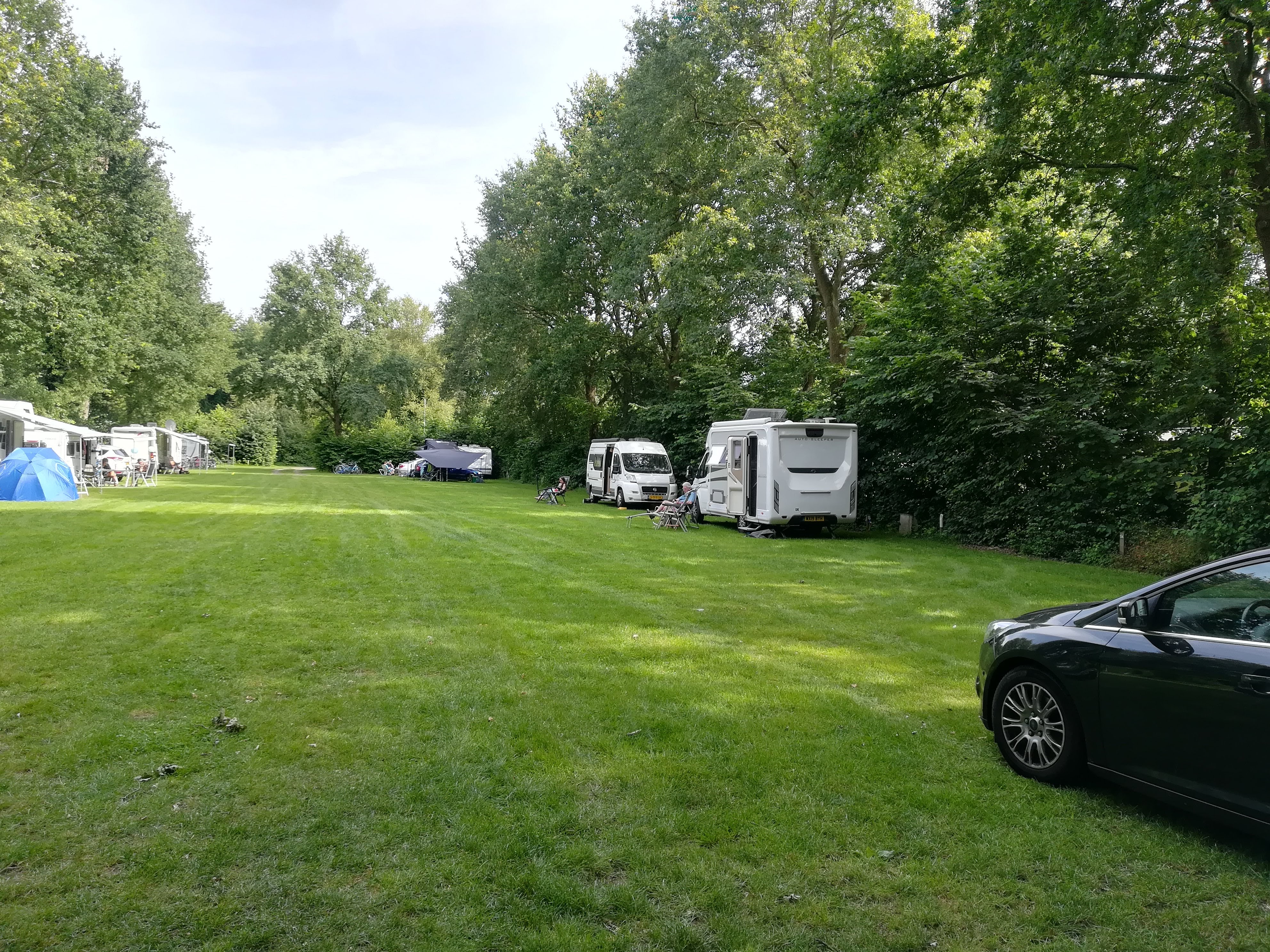
We crossed the German border into The Netherlands at Bourtange. The name should be familiar to you, as this is where we crossed on the way north. Not only was it conveniently on our route, but we wanted to return to our favourite campsite. The site at Bourtange is huge but divided into separate areas with good thick hedges. It is also delightfully quiet (families seem to be put in separate areas) and it has lots of shaded pitches. We were thrilled that the manager recognized us (well, let’s face it, we Brits stand out like a sore thumb!) and even happier to return to the self-same pitch that we’d used 2 weeks earlier. Given that it’s high season, it was busier than before, but still far more space between campers than many of the other sites we’ve stayed on.
Molly on ‘her site’!
The Hanseatic town of Deventer in the Central Netherlands was our next stop. Once again, an enormous ‘quick-stay’ campsite with far too many campers squeezed in (the motorhome next to us was about 2 ft away!), but with the convenience of being able to visit the town without driving. In fact, there was an efficient and very frequent ferry which crosses the River Ijssel for foot passengers.
Deventer from the ferry
It’s a delight to just wander the lovely narrow streets and take in the many styles of architecture. Apart from the odd blip, Deventer seems to have maintained its prosperity for centuries. The main square, known as The Brink, is full of cafes of all sorts which comes alive as the sun goes down.
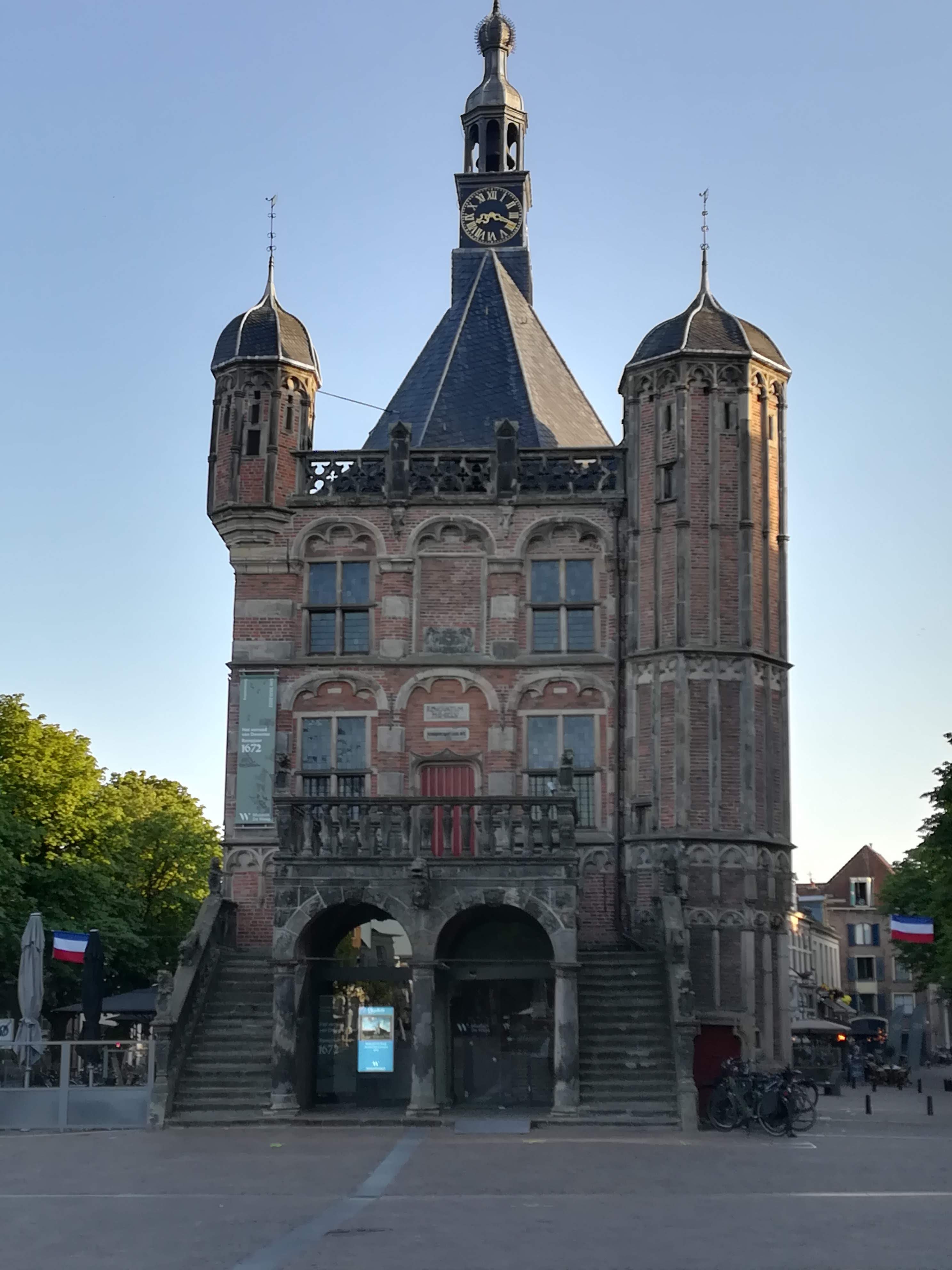
Part of the ancient fortifications in Deventer
Zwolle is another Hanseatic town (there are nine on the River Ijssel) which we visited by train (air-conditioned, Oh Bliss! We’re suffering the same heat wave as you are!) Its original fortifications were a sort of star shape, as are the canals that surround the town. Only one of the original gates is still intact – and very impressive it is too. We spent some time in the museum (again, a good way to escape the heat) and looked at an exhibition of Nature & Humanity. It was eye-opening and reminded us very much of our visit to the Floriade, way back at the beginning of this holiday.
Double decker air-c0nditioned train – bliss!Canal & One of the Original Gates in ZwolleThe Mosaic Dome on the Museum in Zwolle
We spent our final night on a small campsite, on a farm. After the very busy site at Deventer, it was bliss to sit and watch the cows coming in to be milked! Sadly our final day in The Netherlands was a wet one – only the second rainy day of the five week holiday, so we couldn’t complain. A good excuse to visit the local village of Oudewater – such a pretty little town with several canals running through it – and enjoy a long relaxed lunch.
Peaceful scene of cows coming in for milking at our last campsiteOudewater on a dull day
I’m happy to report that we had NO queues at the ferry terminal, NO problems with passport control and a thoroughly comfortable cabin for our overnight crossing of the North Sea from Hook of Holland to Harwich – we’ll definitely be using StenaLines again whenever we can!
Thanks to all of you for following our adventures – and for the many lovely comments. See you again soon. . . . . . .
We crossed the Jutland peninsula from east to west, enjoying the straight, well surfaced roads – even the back roads are well maintained in Denmark. Just a few minor points about the Danish way of living (huge generalizations I know, but it’s what we’ve noted.) 1. The majority of Danish houses are bungalows – upstairs rooms are built into the roof space rather than having a full two stories. Quite a few houses have basements. 2. The Danes being so hot on design, are also bang up-to-date with recycling – bins are provided for everything. 3. Huge anaerobic digesters are very common, and we’ve seen ‘Biogas’ lorries transporting the resulting gas. 4. Tesla cars are ’10 a penny’ here! This is not a poor nation! 5. There must be money in Christmas tree plantations – they are everywhere! 6. Danes are very patriotic. Most houses have a flag pole and flags are flown for every celebration – family occasions as well as royal birthdays and official holidays.
Flagpoles on the majority of houses – pennants or full flags if there’s a family celebration(sorry for the poor photo)
From Auning we moved south-west to a campsite near Esbjerg, on Jutland’s west coast. As part of the World Heritage UNESCO Wadden Sea National Park, we enjoyed some good walks through wetlands, woods, heathland, and sandy beaches. Annoyingly, it wasn’t warm beach weather whilst we were there!
Windswept beach on the west coast of Denmark
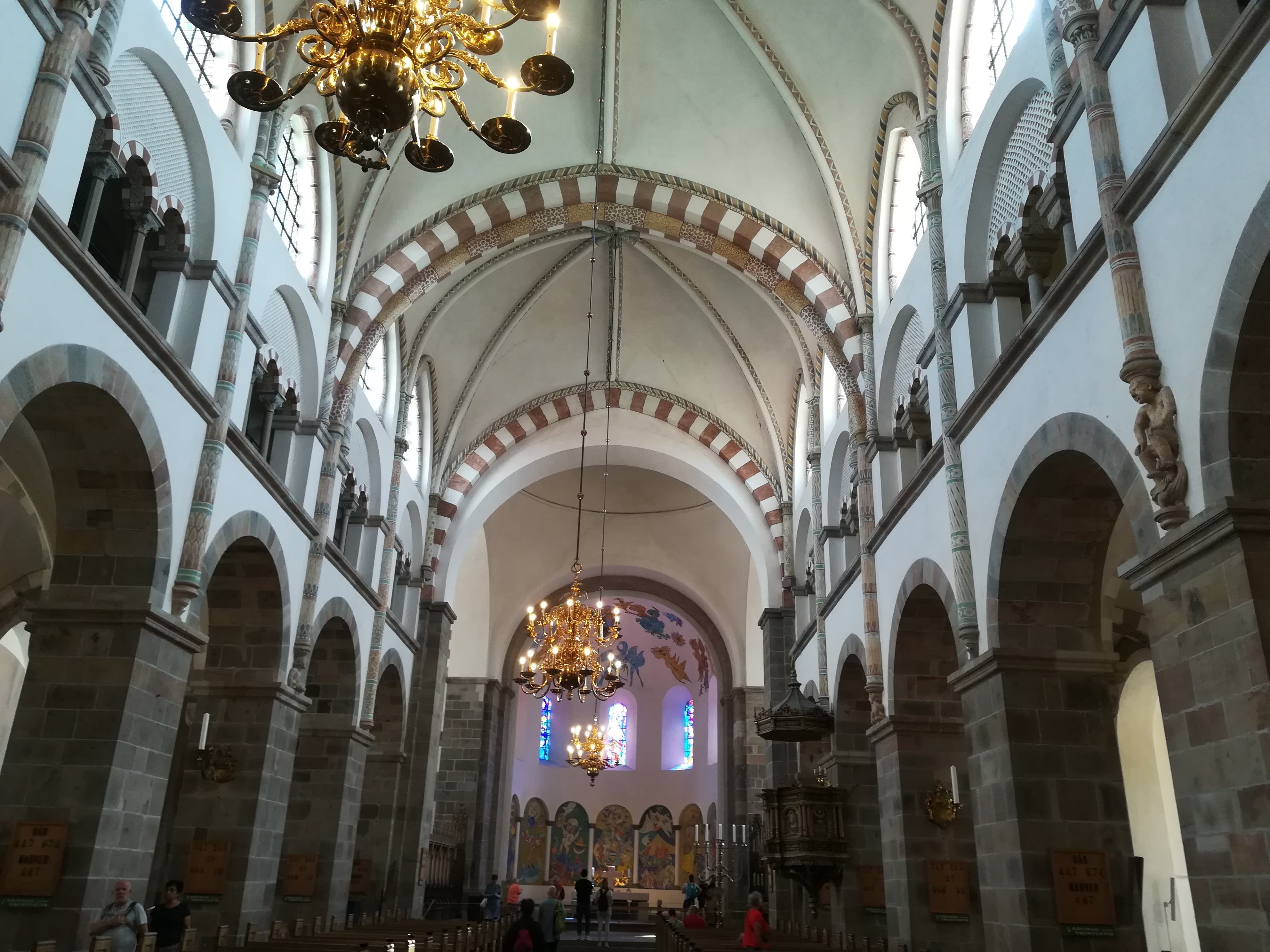
On our journey south, we stopped to see the town of Ribe – Denmark’s oldest town which dates from the 9th century. It is full of half-timbered old houses, and idyllic narrow streets. The splendid cathedral is the nation’s oldest (dates back to 948!) and sits proudly in the centre of town. Its tower serves as a look-out point for approaching floods. Ribe had a good vibe, crowded with happy tourists on a lovely summer’s day.
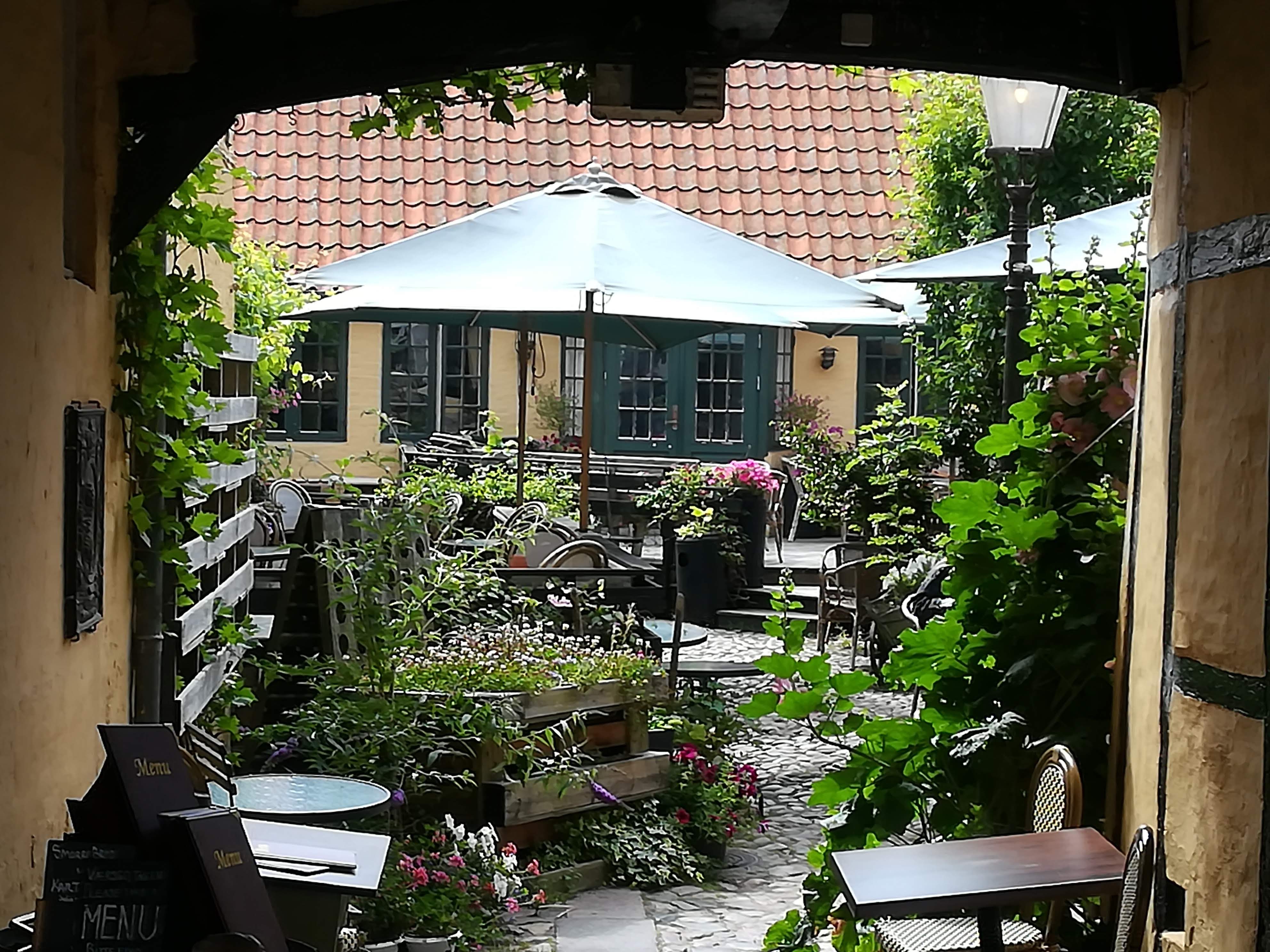
Pretty streets of RibeA pretty courtyard off the main street in Ribe, where we enjoyed a coffeeSimple but beautiful interior of the oldest cathedral in Denmark
Moving south into Northern Germany, we spent some time in the state of Schleswig-Holstein. Lots of villages, built around a farm or two, and many with some Geestharden houses – based on the original long houses, built alongside the barn, in the local red brick and with thatched roofs. Interestingly the front door is always under a gable as a safety precaution. If the thatch were to catch fire, the incumbents should be able to escape without burning thatch embers falling on their heads.
Geestharden house in Schleswig-HolsteinGeestharden house
As a complete change, we stayed on a site next to the Kiel Canal. As you’ll all know, Peter is keen on canals, so this was a ‘must visit’. We were not disappointed. This 98 km canal links the North Sea in the west with the Baltic Sea in the east. It was originally built in 1890 and has been widened since. Nowadays it has more ‘traffic’ than any other canal in the world. Upwards of 250 ships per day, use this canal! Very high railway and motorway bridges tower over the canal, small ferries take local traffic to and fro. Well maintained towpaths run along both sides. Walking along as a container ship passes, makes one realize how big these ships are, and just how small and insignificant we are. Using the canal instead of sailing all the way around the Jutland peninsula, saves the ships about 460km (250 nm) of travel.
Container ships making their way along the Kiel CanalLocal ferry in the foreground is dwarfed by the towering railway bridge across the canal
We visited the locks at the North Sea end of the canal near the mouth of the River Elbe. The locks are 45 m wide and 327 m long – a little bigger than the locks we passed through at Christmas in our narrow boat! Two or three container ships can fit in the locks at any one time.
Ship about to leave the lock on its way to sail the Kiel Canal
In order to head southwest, we had to take a ferry across the River Elbe – this huge river only has two crossings – the ferry, or a tunnel in Hamburg. Bad planning on our part meant that we joined the ferry queue on a Friday afternoon on the first day of the school holidays! Two hours later we did the 20 minute crossing. No worries, we prepared and ate our lunch as we inched forward in the queue. AND it saved more than 100 miles travel as well as facing traffic in Hamburg on a Friday afternoon.
Part of the two hour queue waiting for the Elbe ferryOne of the three ferries negotiates the sandbar, before heading to the southern shore of the River Elbe
We head further south and west tomorrow and cross back into Holland. Cannot believe where the time has gone, we only have six days of holiday left. I’ll add the final few days, and some summing up once we’re home.
We chose to enter Denmark by ferry. Scandlines run a very efficient service from Puttgarden in Northern Germany to Rodbyhavn in Denmark. We crossed an inlet of the Baltic Sea in full sunshine and with calm seas (thank goodness!)
Calm seas crossing Femern Belt
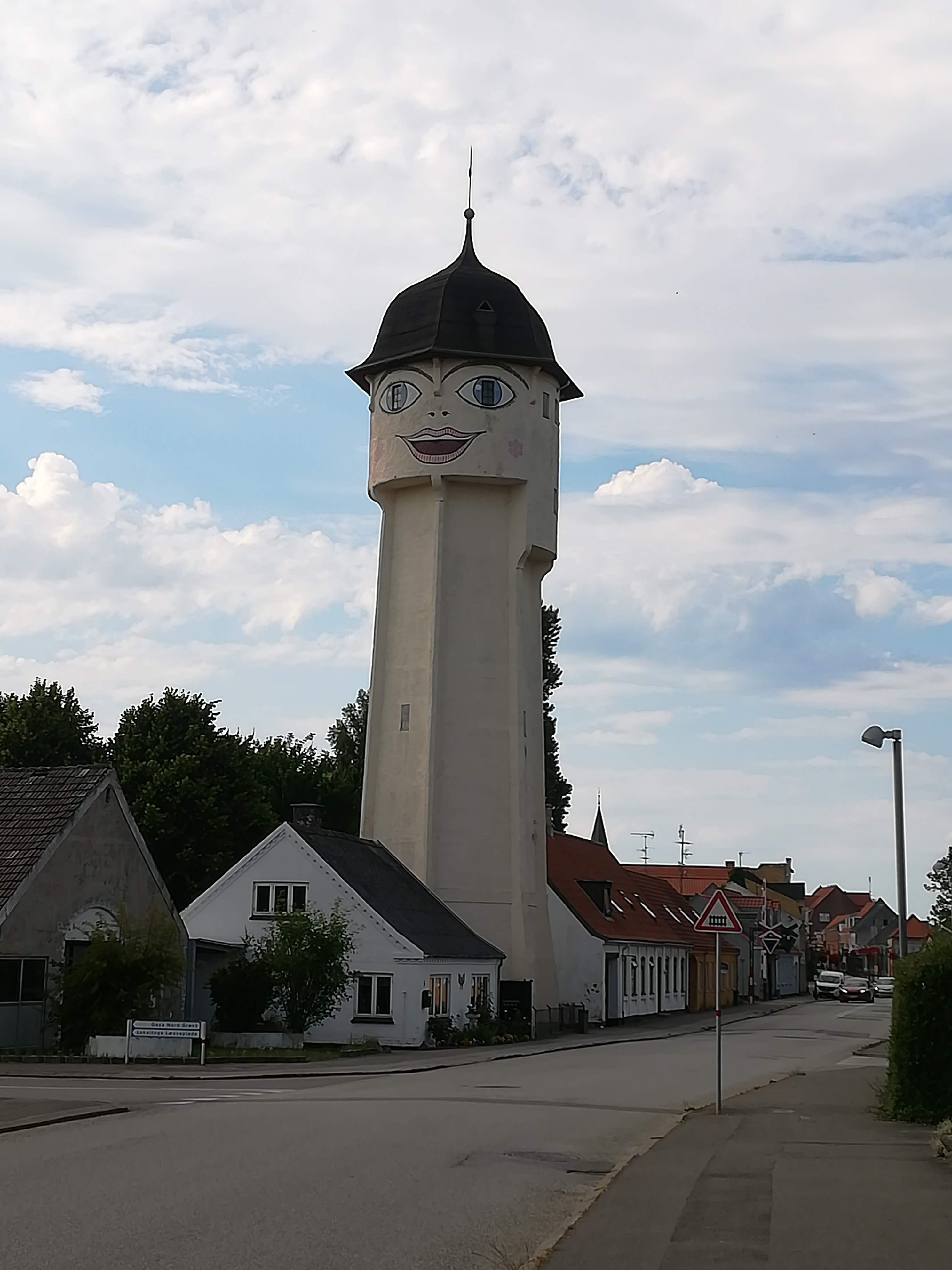
I shall profess my ignorance now – I had no idea what to expect in Denmark – I’d not had time to research it and knew nothing about it. Yet all three Scandinavian countries have always been on our bucket list! Today’s geography lesson is as follows: The peninsula of Jutland makes up Denmark, along with – wait for it. . . . . 1419 islands! Seventy-eight of those are inhabited. Zealand is the largest island and the most densely populated – and home to Copenhagen. We arrived on Lolland, and spent a couple of relaxed days in a tiny town called Sakskobing – everything was within walking distance including the rather ‘fun’ water tower.
Sakskobing water tower
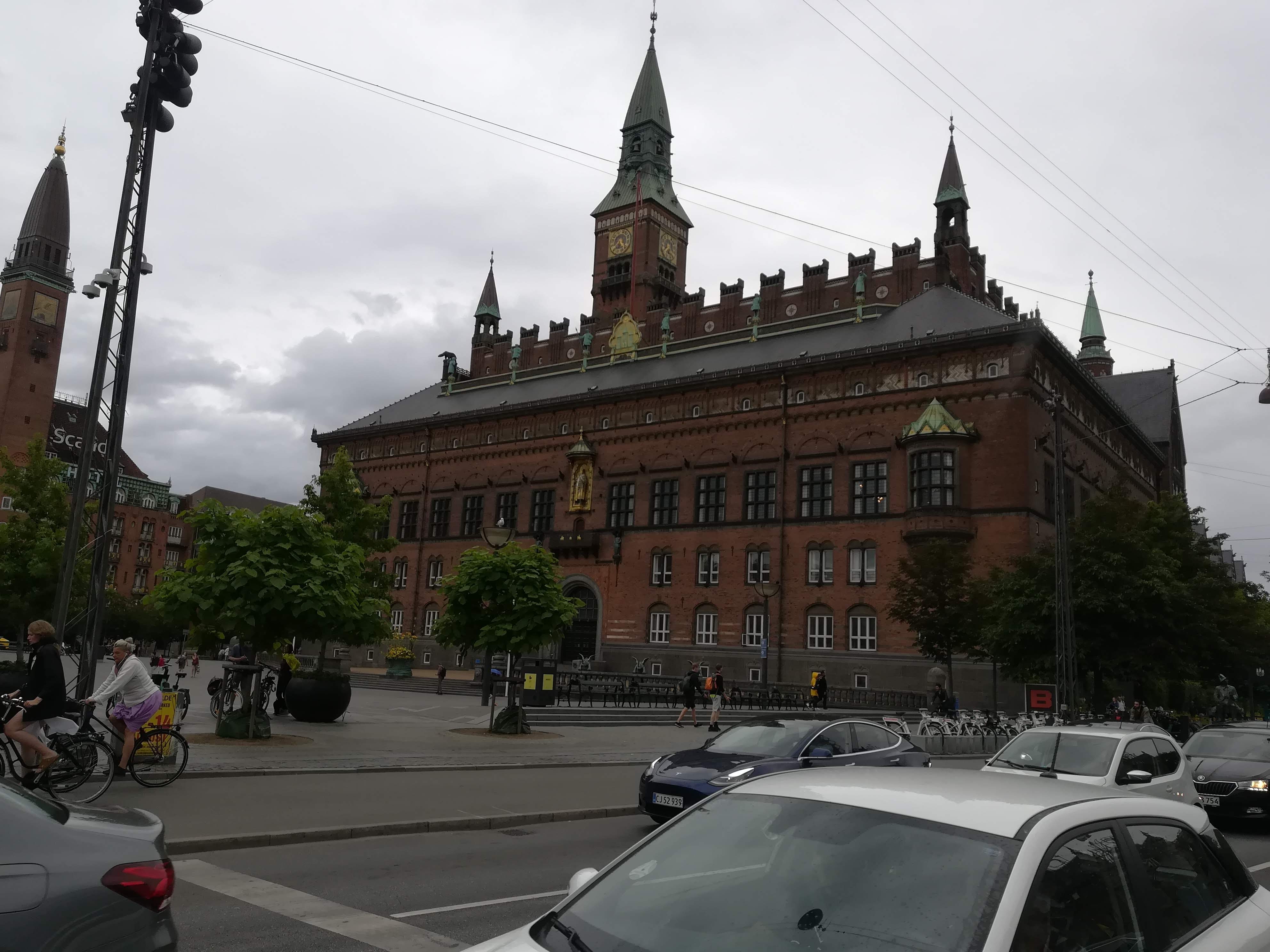
A pleasant journey on quiet roads through open countryside took us most of the way to Copenhagen. Twenty minutes of motorway-driving on the outskirts of the city led us safely to our campsite on the western edge of the city. A huge field serves as a summer-only campsite – efficiently run, with clean showers and toilets and washing facilities. A 10-minute walk to the bus stop – 10 minutes on the bus, and we were in the city centre. Again, a city pass was a good deal for two and a half days of travel in and out. (this time our passes were checked by inspectors doing spot checks!).
City Hall in Copenhagen
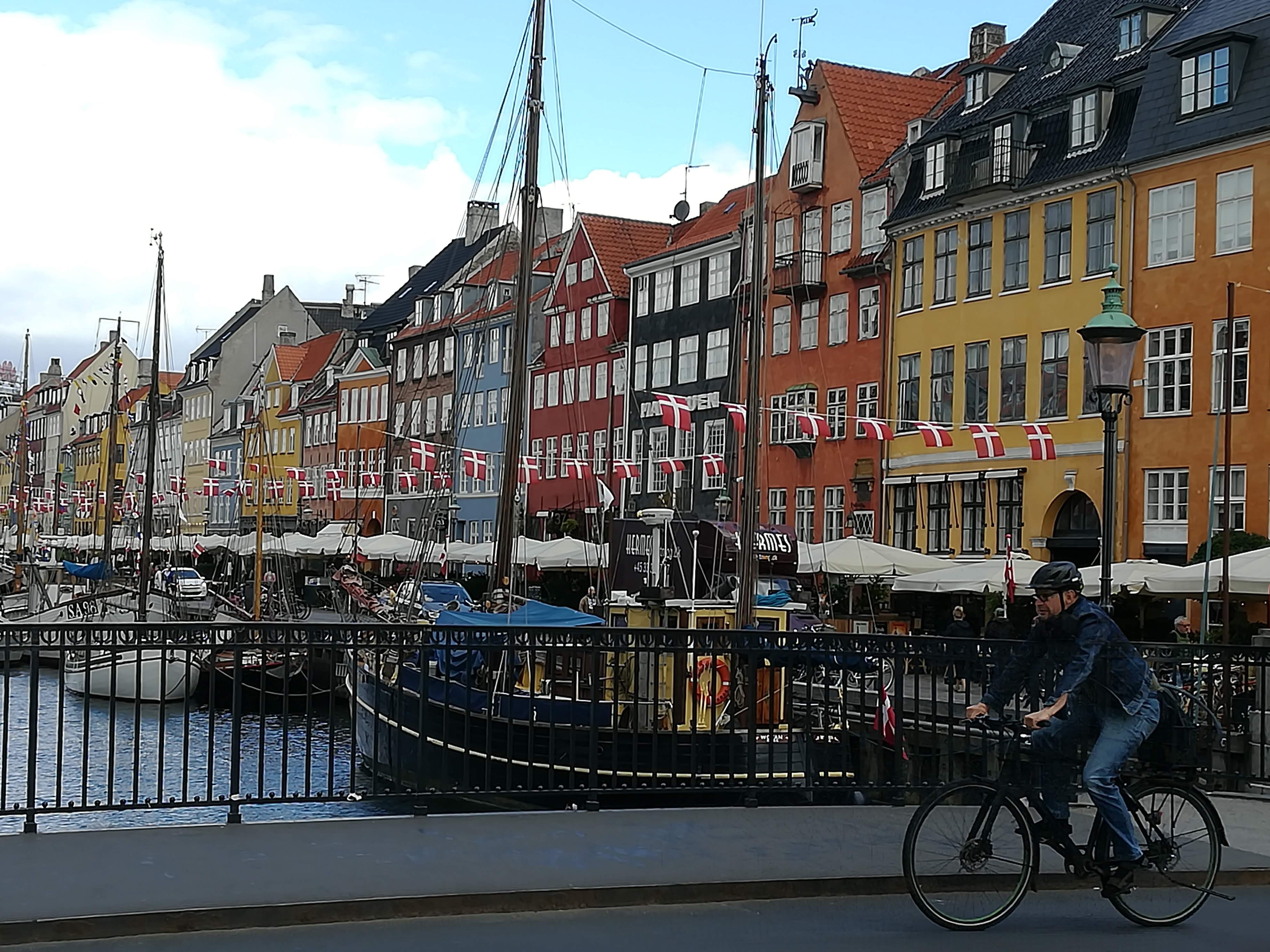
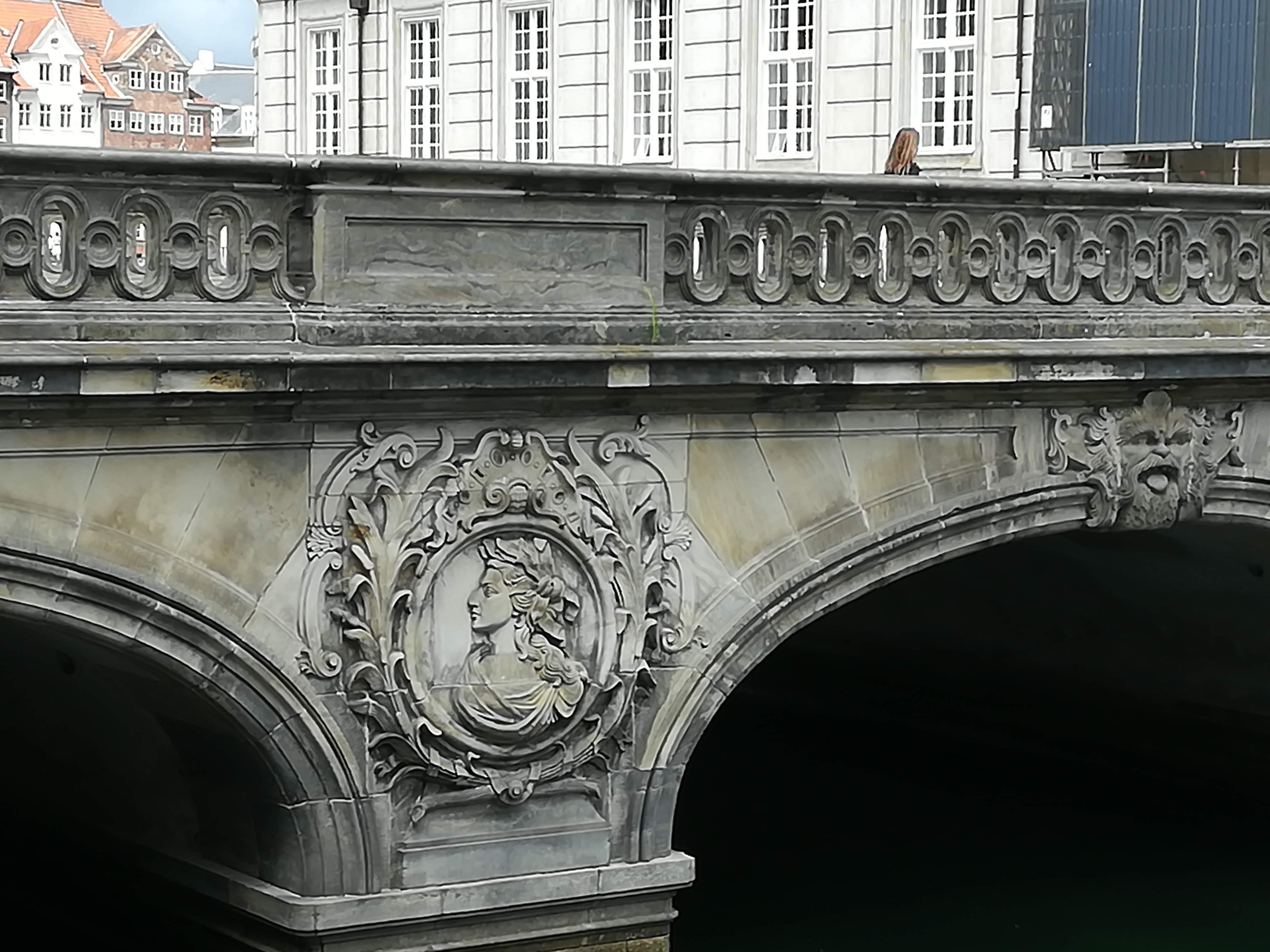
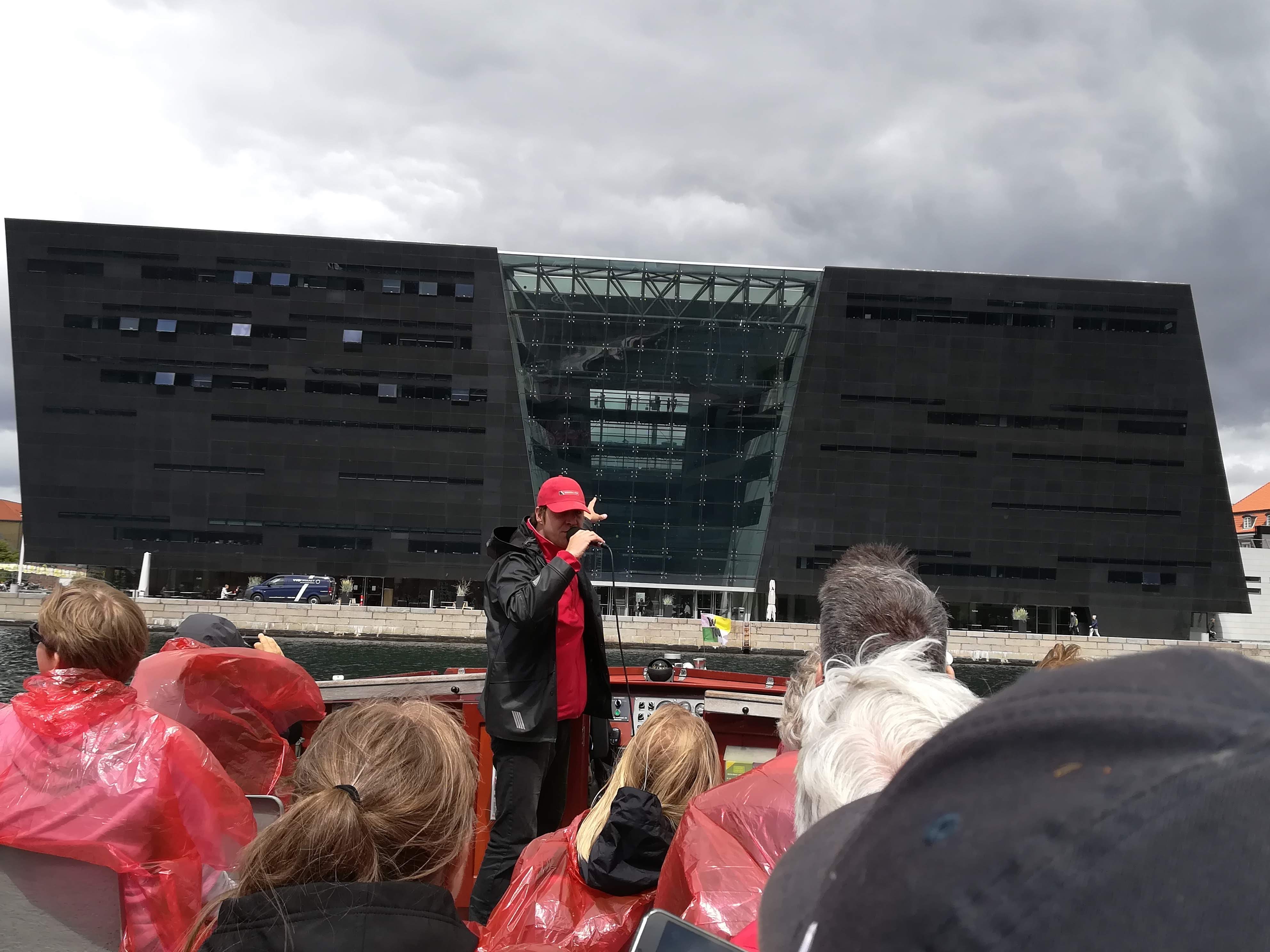
Yet another city built around a harbour and canals – we took a canalboat tour and enjoyed the banter of the guide (in three languages) and his historical input. Nyhavn is probably the most photographed area, and quite rightly so – attractively coloured houses adorn the canal sides, with numerous cafes to quench your thirst. If you’re thinking of visiting Copenhagen by the way, make sure you take out a second mortgage – it is NOT cheap!! But it has its charms. Beautiful squares, and splendid buildings most of which have been rebuilt or restored since a huge fire swept through the whole city in the 1700’s.
Nyhavn Canal in CopenhagenFrederik’s church near the Royal Palace in CopenhagenCanal Boat tours setting offBeautiful carving on the ONLY bridge to survive the great fire that swept through the city in the 1700’s
Copenhagen is famous for its up-and-coming designs – many of its buildings endorse this. Rain showers made photography a bit grey at times, but when the sun is out, the light here is wonderful.
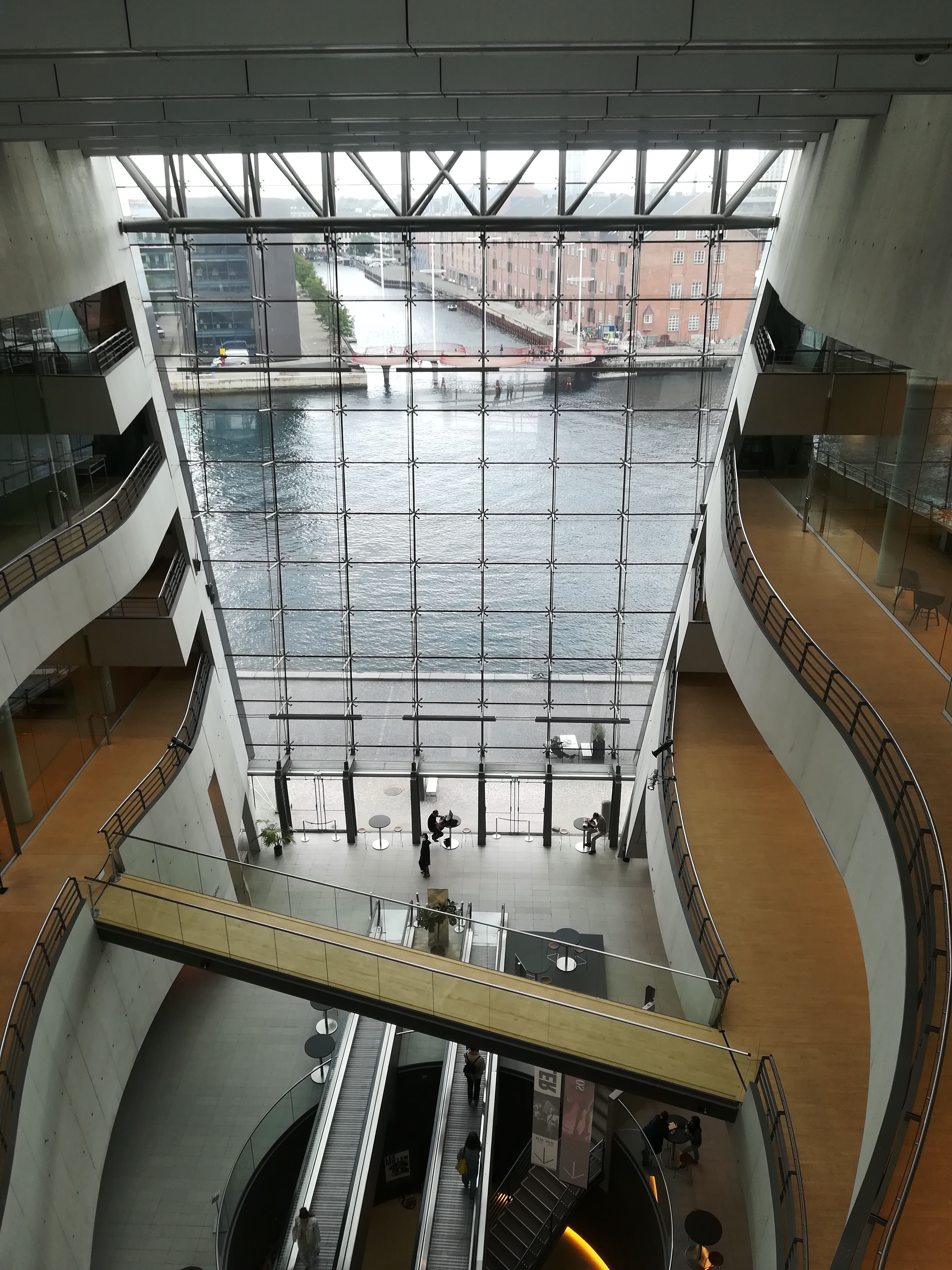
The city library – known as the Black Diamond – the glass sparkles, like a diamond,when the sun shines on the waterView from inside the Black Diamond (top floor) out onto the canals below
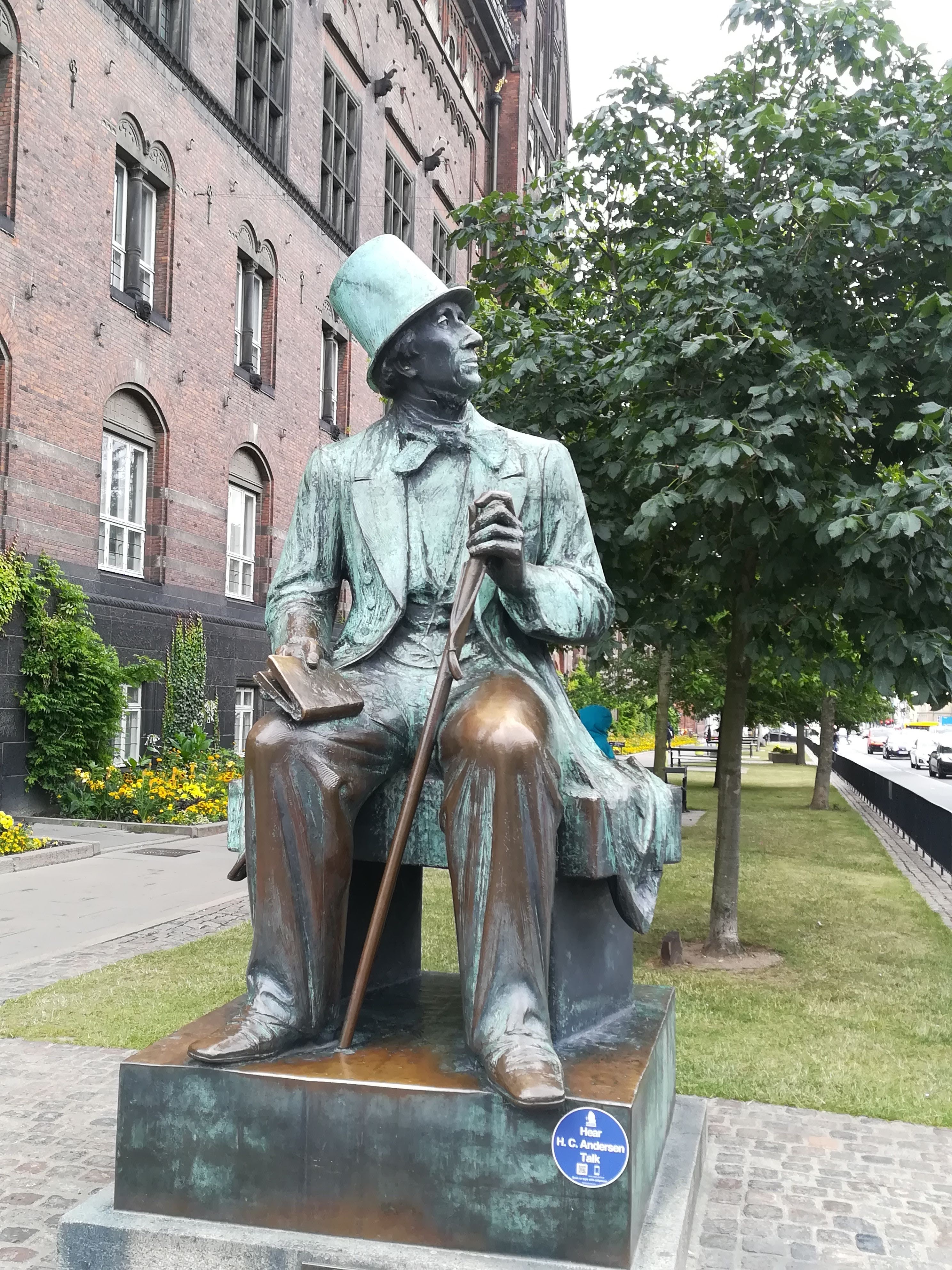
It is also known for its Little Mermaid statue that ‘greets’ anyone entering the harbour (rather like the Statue of Liberty in New York). Sadly, this little Mermaid has been badly maimed by vandals and demonstrators alike over the years and is more of an eyesore than an icon these days! However Hans Christian Anderson himself is not forgotten . . . .
Hans Christian Anderson
Having been blown away by the bicycle culture in The Netherlands, we were astonished to discover an even greater cycle culture in Denmark. Known as the world’s best city for cycling, more than half the workers in Copenhagen do their daily commute by bicycle. Huge investment has been made in cycle lanes, next to bus lanes, next to road lanes. The cycle lanes are used to the full because they are safe. Visitors using their ‘old-fashioned legs’ quickly learn to ‘look both ways’ for cyclists!
The cycle commute!
By sheer coincidence we followed this year’s Tour de France route west from Copenhagen and over the Great Belt Bridge which connects Zealand to Furen. This link features a 256 metre high suspension bridge, followed by a box-girder bridge – the entire link totalling 11 miles in length! Bicycles are not normally allowed to use this link (they have to cross by bus or train) but the link was closed to traffic for the Tour de France – the wind is VERY STRONG across the entire link – it must have been very hard work for the cyclists!
The Great Belt Bridge – the entire link is 11 miles long
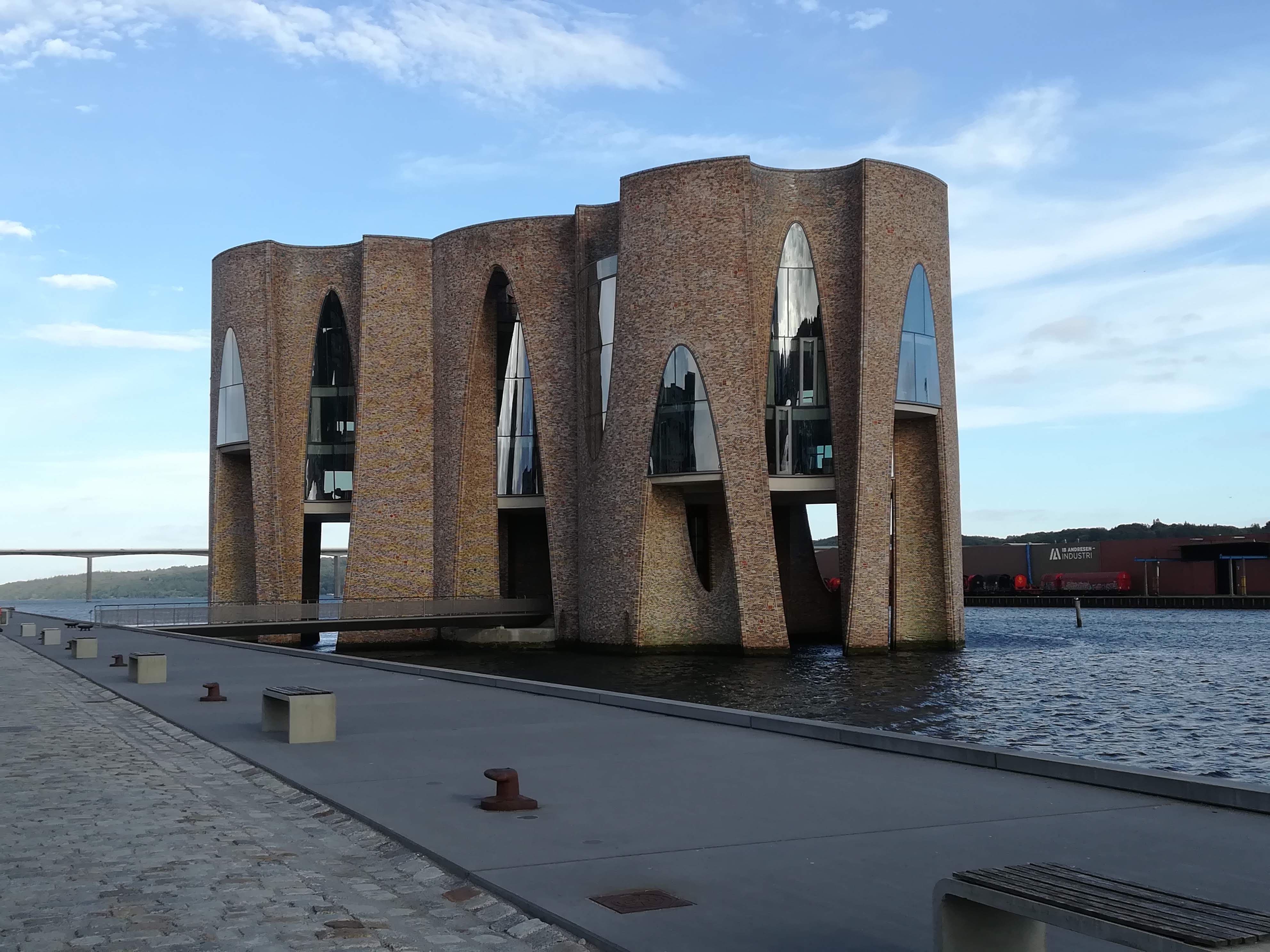
We spent a night near the town of Vejle – a starting point for another leg of the TDF. Vejle makes an easy weekend getaway from Copenhagen (less than 2 hrs by motorway ), The town had lots of thriving restaurants, a marina full of boats (the cost of which would make your eyes water!), and some of the latest designs in modern apartment blocks.
‘The Wave’ apartments in VejleImagine having to cross a drawbridge to get to your apartment! Vejle town centre & restaurant area
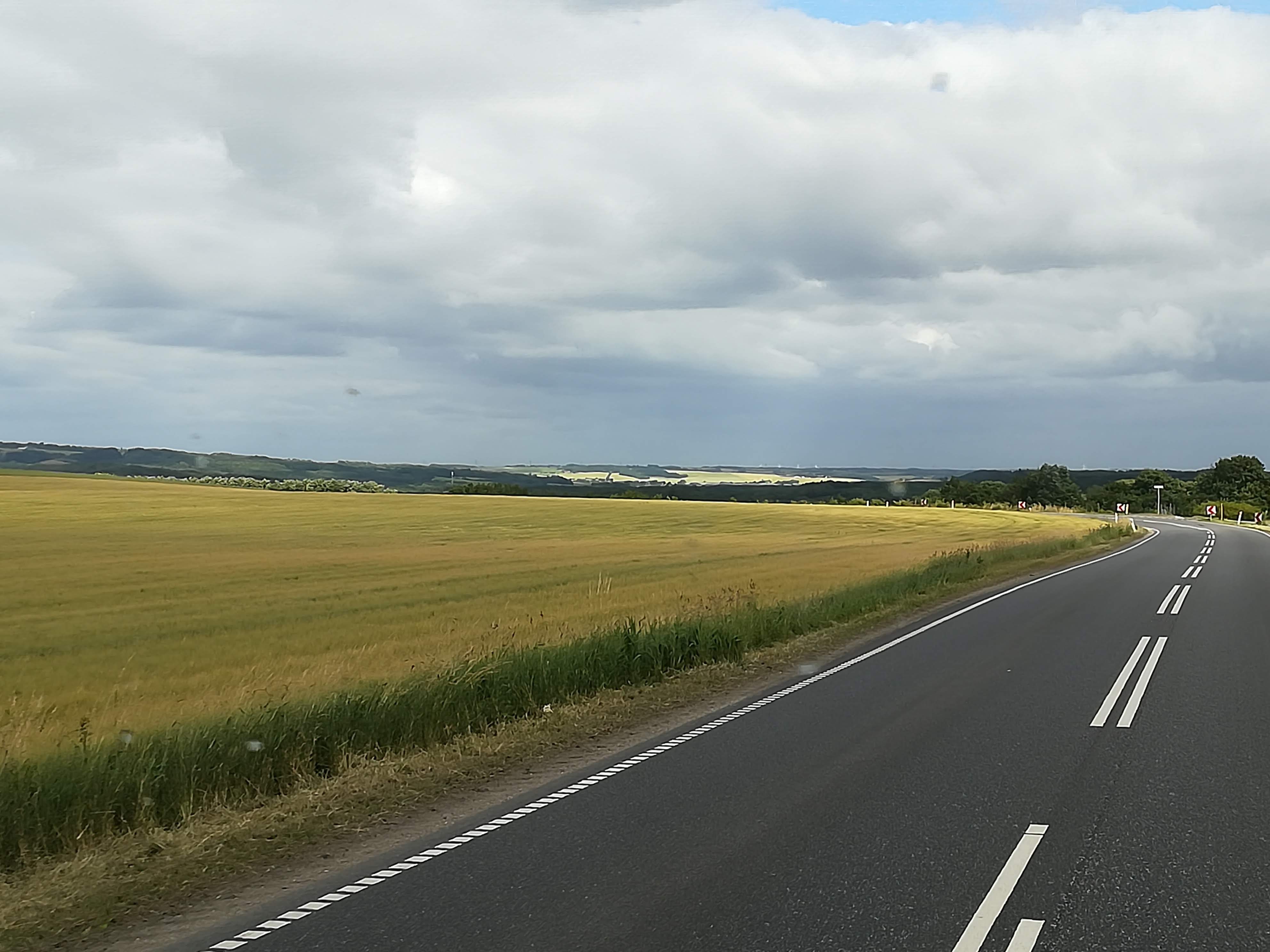
We’ve reached our furthest point north today – in the little town of Auning. We’re on the quiet eastern peninsula which juts out into the Kattegat. For those of you who love maps we’re at 56.5N (latitude), which happens to be parallel to Dundee in Scotland! We have spent the day enjoying quiet country roads. Huge open vistas of golden crops and enormous piles of timber from the abundant forested areas – all this interlaced with tiny villages. Having decided we are ‘citied-out’, we avoided the summer crowds in Aarhus (sorry Ian), and plan a quiet day’s walking locally tomorrow before beginning our journey back south.
Good road surfaces and far reaching views – highest point in Denmark is only 170 metres above sea levelLovely straight back roads – very little traffic.
We have three more nights in Denmark which I’ll cover in next week’s blog.
My apologies to those who missed a notification about the North Holland blog – I can never tell who’s received it as this is in the hands of WordPress! Hopefully you can catch up this week. . . . .
Crossing the border into Germany went almost unnoticed – there was no ‘Welcome to Germany’ sign, just a sign for a change of province. However, just as we tend to notice a difference between counties in UK, there were noticeable differences in the countryside in Germany. Houses seemed bigger and appeared to be on bigger plots. The crops were no longer all those vegetables which end up in UK supermarkets. Now we saw grains of every type, as far as the eye could see. Wheat, oats, barley, and maize. AND . . . .very slight inclines in the landscape began to appear – the total flatness had disappeared. Large, wooded areas became the norm, in contrast to The Netherlands, where it seems that every square metre of ground is used to grow things for market.
We stopped and made coffee (as we do!), then took the opportunity to take a walk in the woods . . . .
Enjoying a walk in the dabbled sunshine
As mentioned before, all campsites have been prebooked for this journey, as we were warned that it was high season (only two have asked for a deposit in advance, so if we change our route for some reason, we can ring and cancel). Imagine our surprise when we found ourselves on a German Camping Club site! A tiny, wooded site in the middle of nowhere (very much our sort of site!) with 9 caravans parked for the summer. Danny, with whom Peter had been communicating, had been quick at answering emails and was keen to welcome us. However, he spoke no English and had pressed ‘translate to English’ on every email. Lunch in the clubhouse was just ending, and a kind chap, who spoke some English, stepped forward to give us the site information. We relaxed in the sunshine for a couple of hours but were then driven inside as the mosquitoes came out!! The grass was not cut short – in fact, we were very much in a field! We had a disturbed night thanks to the bugs and then a HUGE thunderstorm awoke us at 5am – all part of the excitement, but at least we were up and away in good time.
German Autobahn driving has been interesting – 130km speed limit feels SO FAST when Molly is running along sedately at about 100. Even so, a 60 km loop to the south of Bremen seemed to take us no time. We then returned to our beloved back roads through lovely wooded areas and spacious, tidy villages. Our campsite on the edge of Hamburg, had lovely big spaces and good facilities – all of which made up (just about!) for the constant noise of the motorway which was right beside the site. Luckily two long days of sightseeing in Hamburg meant we slept through any background noise!
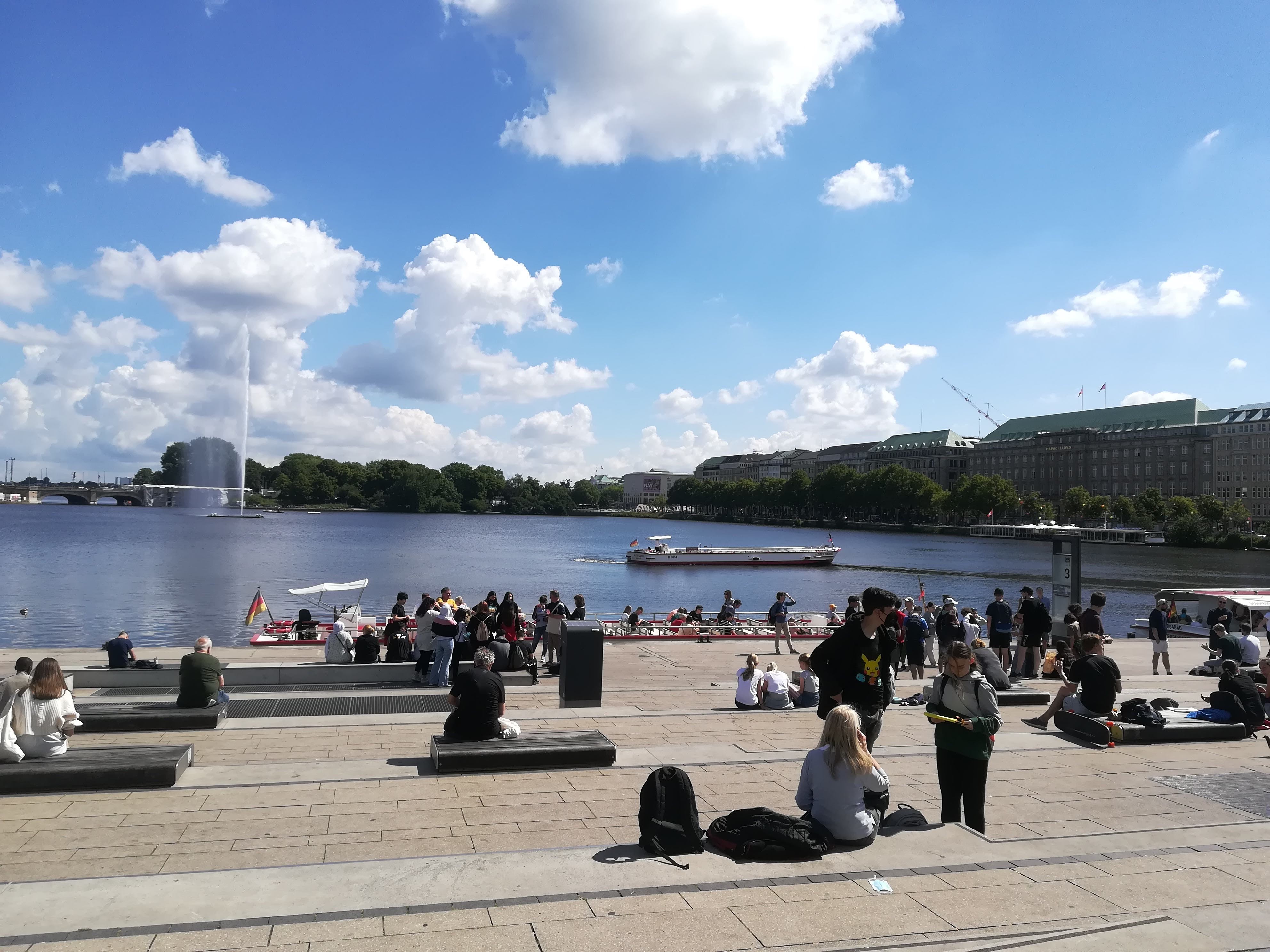
And so, to Hamburg – another city, in another country, and very different from Amsterdam. Hamburg is a city of two lakes – the Inner Alster and the Outer Alster – which were created when the Alster river was dammed during the 12th century.
Our first view of Hamburg as we exited the Metro – Inner Alster
There is a maze of very wide canals which link the lakes to the River Elbe, which flows out to the North Sea – hence the canals are tidal. Hamburg has more bridges inside its city limits than any other city in the world and more canals than both Amsterdam and Venice! It is the country’s largest port and apparently, the third busiest port in the world.
A busy port – ferries & freight – note cruise liner in dry-dock top left (British P&O cruise liner)
Monuments and interesting buildings abound, so I will cover just a few.
Wide Canals, warehouses are now luxury flats
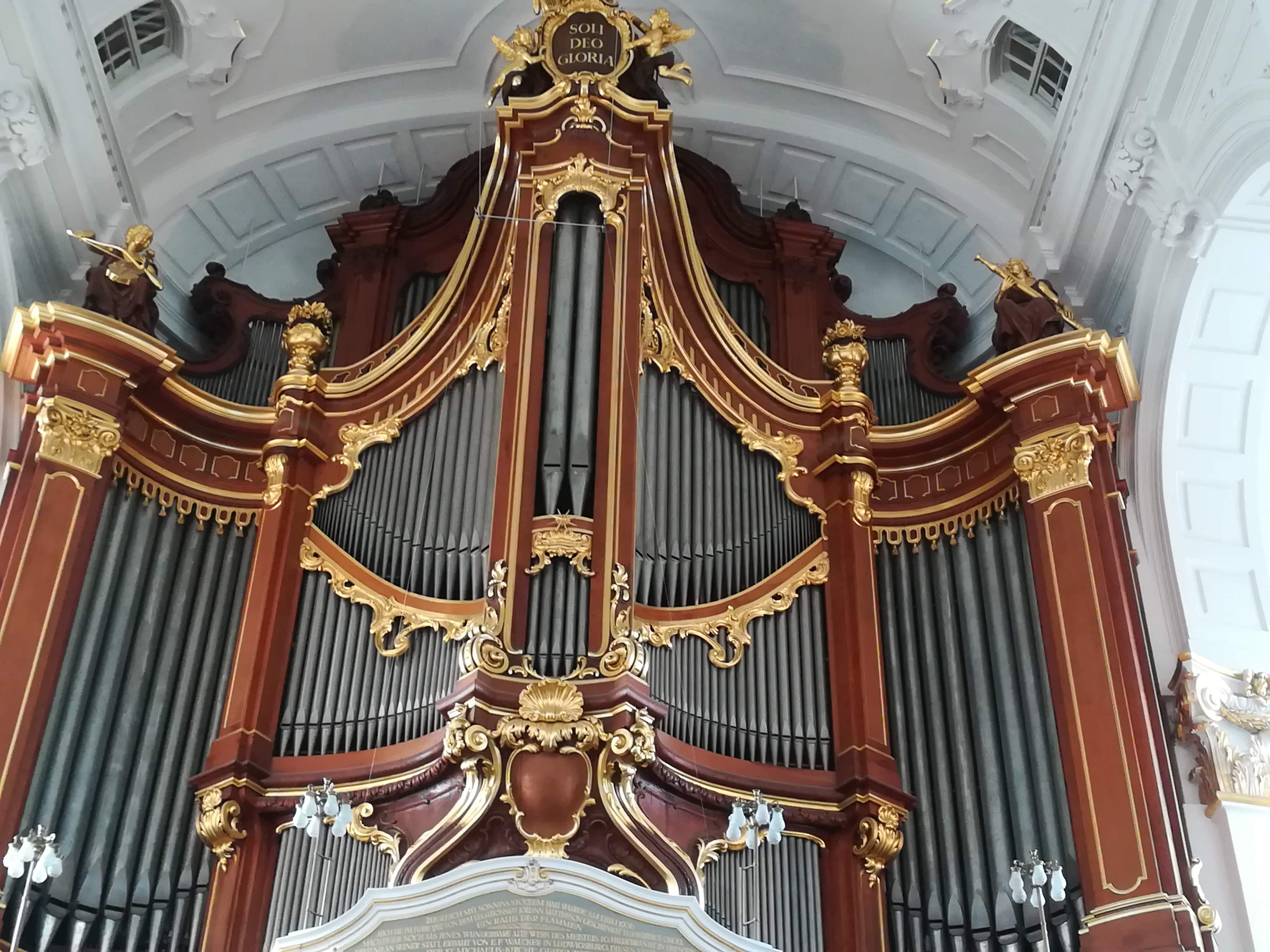
St Michael’s church is one of the famous landmarks in the city. We were lucky enough to hear one of the six (yes, six!) organs being played in rehearsal for a concert.
St Michael’s Church -InteriorOne of the SIX organs at St Michaels
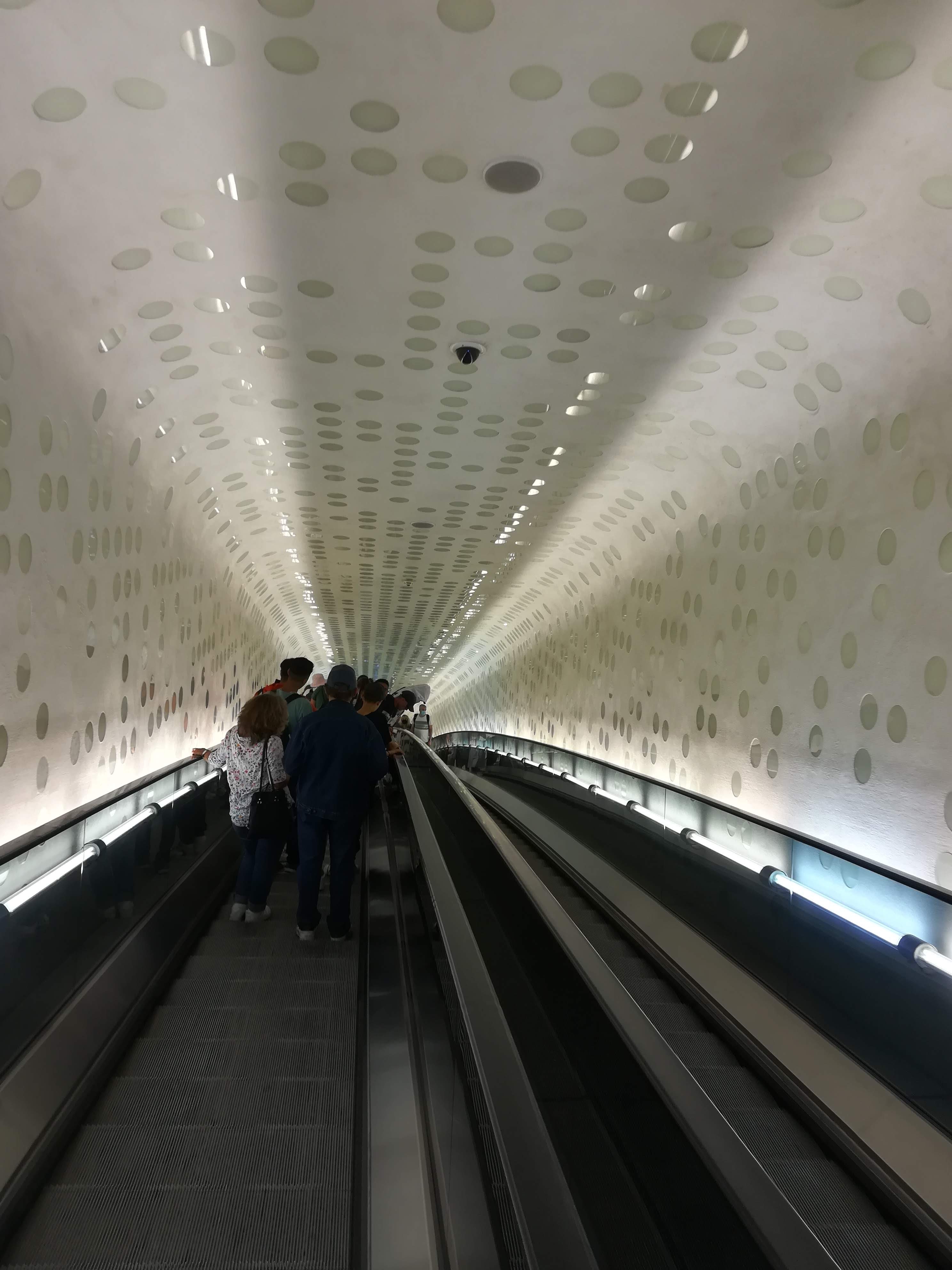
Hamburg is being rebuilt in every direction and on every street. Many of the old warehouses along the canals are being transformed into luxury apartments. One set of warehouses forms the base of the Elbe Philharmonic Concert Hall, an amazing architectural feat with 1047 panes of glass. There is a spectacular plaza at ‘top of warehouse’ height with far-reaching views of the city. Visitors are taken there via a splendid 80-metre-long arched escalator. The journey takes two and a half minutes and at no point can you see both the top and the bottom at the same time – amazing!
Elbe Philharmonic Concert Hall – built on top of a warehouseArched escalator at the Philharmonic hall
One of the main modes of transport are the ferries. We enjoyed joining the locals on their way to or from work and found it a good way to enjoy views of the various parts of the city.
A Hamburg ferryA view from the ferry
Our journey from campsite to city centre involved a 5 min bus ride, followed by a 20 min metro ride. Regulations are still in place here for using facemasks on all public transport. Luckily we still had some on Molly! There are no ticket barriers in stations, on buses, or on ferries – you are required to buy a ticket (luckily we got a very cheap deal) and there are ‘frequent spot checks’. Over two full days in the city, jumping on and off buses, tubes and ferries we never once saw a ticket inspector. I hate to imagine how many thousands of people travel without buying a ticket – or perhaps I’m underestimating the discipline of the Germans!
After the heat and bustle of the city, we found some welcome relief in the shade and trickling streams at the Planten un Blomen – a 47 hectare park of plants and flowers . The roses were stunning, and the fountains gave a dramatic hourly display
Roses at their bestFountains on display
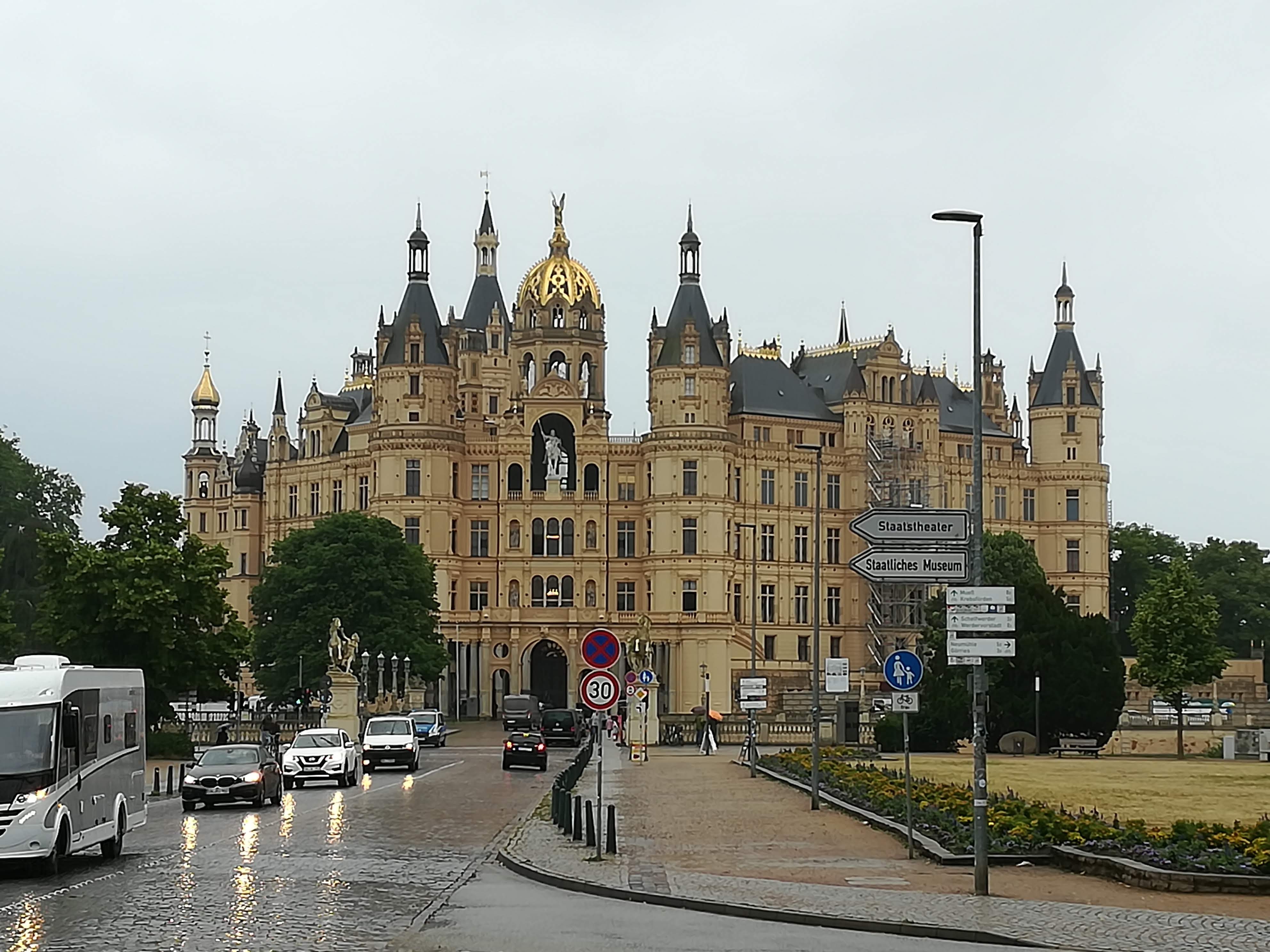
Heading north east, we did a quick visit to Schwerin. Surrounded by seven lakes, the town is known for its castle. Situated on an island in the middle of Lake Schwerin, this frequently restored 14th century building now houses the provincial parliamentary offices. The state rooms provided us with welcome respite on a day of rainy weather.
Schwerin CastleOne of the State Room ceilings
The city of Lubeck lies near the bottom of the Jutland Peninsula (between the North Sea and the Baltic Sea) in the state of Schleswig-Holstein. Known for its role as one of the founding cities of the Hanseatic League, it is FULL of historic buildings, and is recognised as a UNESCO World Heritage Site, despite being badly bombed during WWII. The 14th Century Holstein Gate takes its place of honour at the entrance to the city.
Holstein Gate at Lubeck – notice the sag! (pity about the grey exhibition box blocking the view!)
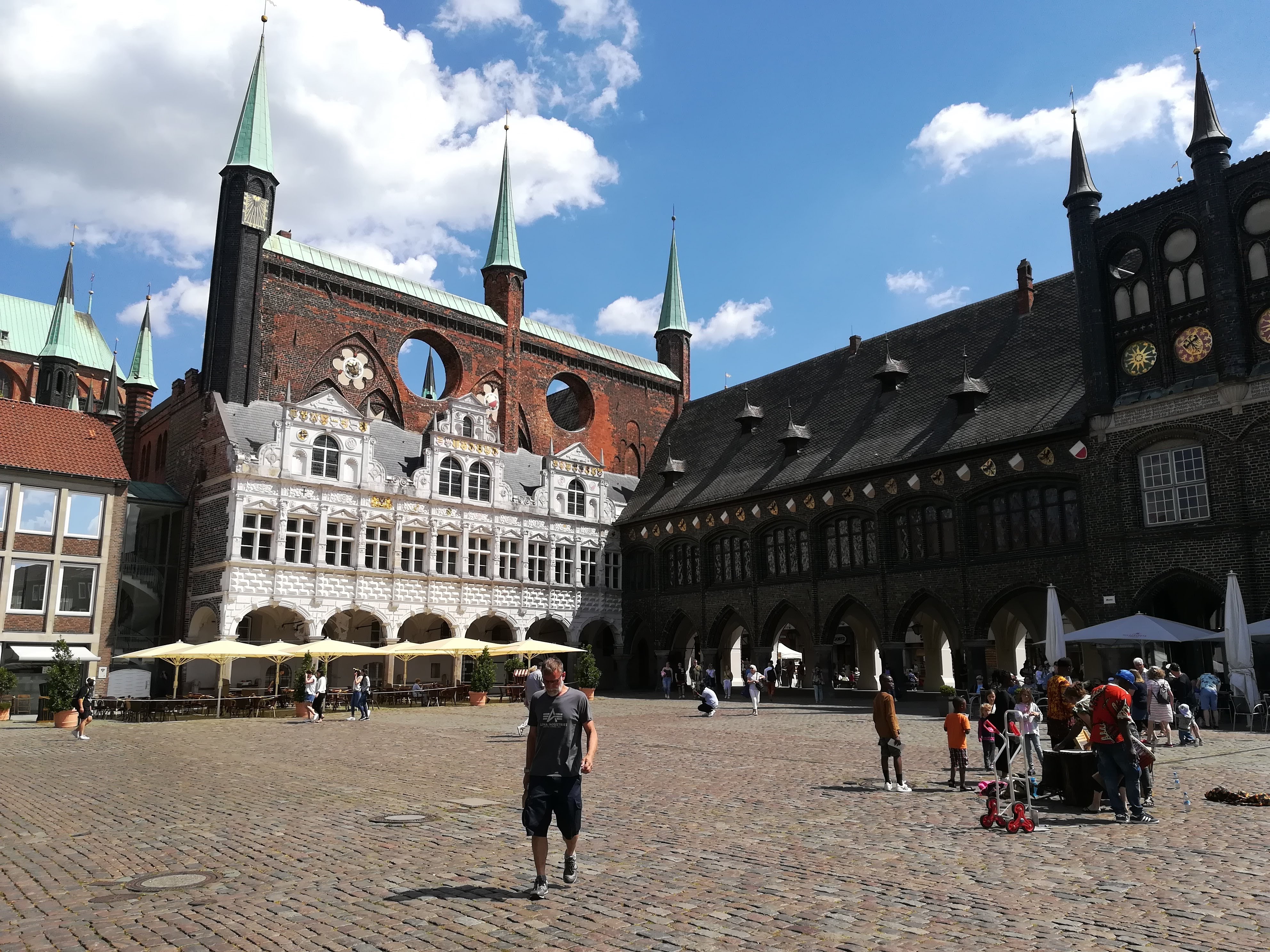
The European Hanseatic Museum gives the full story – well interpreted – what did we do before WIFI & QR codes? Quite apart from the story of the Hanseatic League, I found myself wondering where the word ‘hanse’ comes from? It is derived from an old German word which means ‘group or band of people’. Since the 12th it has been used to denote “communities of long-distance merchants”. (today’s bit of trivia!) Suffice to say, that we spent a pleasant day, in a city very deserving of its UNESCO heritage.
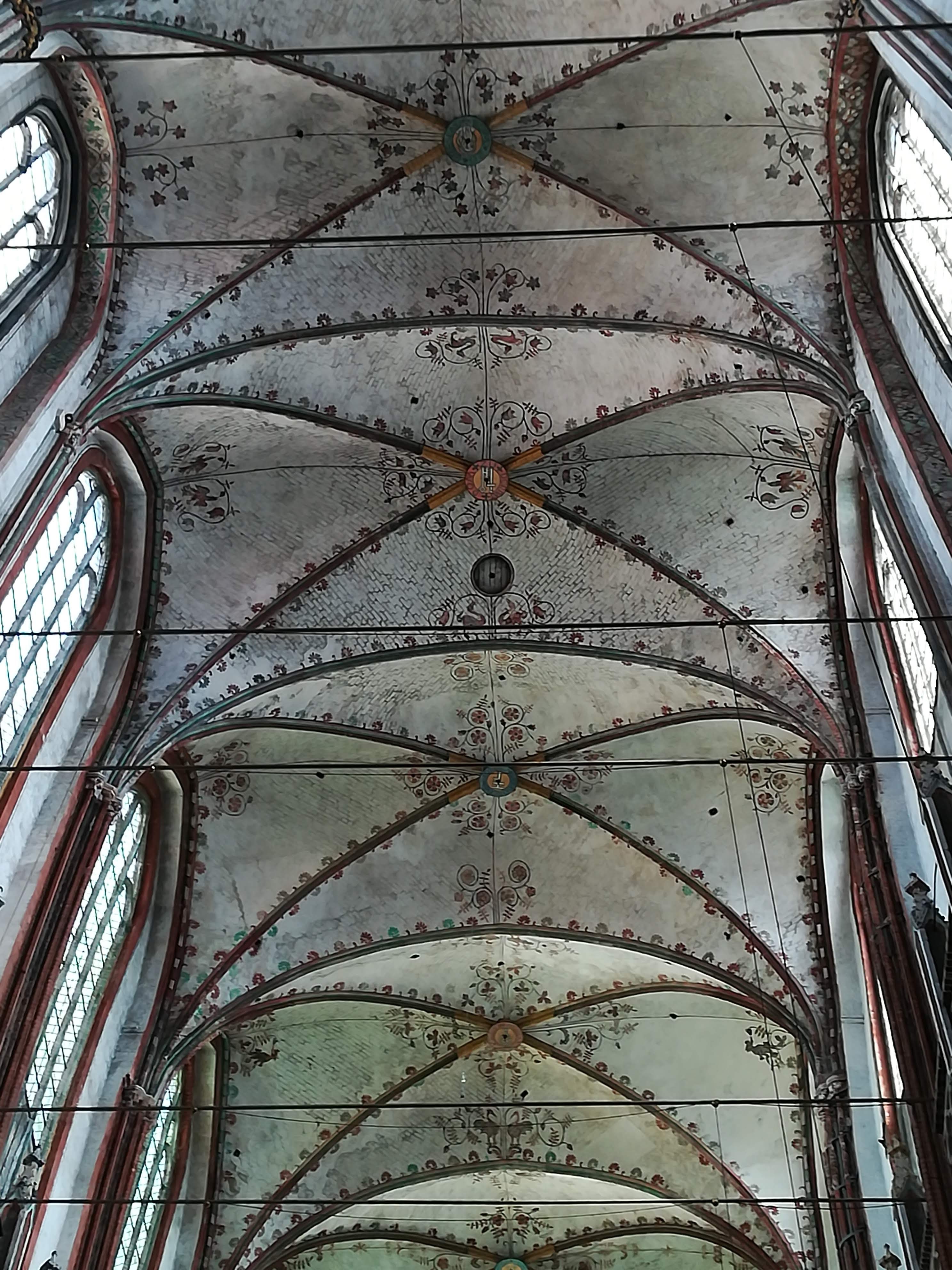
Town Hall & central square – LubeckHoly Spirit Hospital, Lubeck – has been treating patients since the 12th century. The pretty square in front of it, is a quiet place to rest and de-stress, full of herbs and flowersSt Mary’s Basillica was badly bombed during WWII – it has been rebuilt in a very simple style, painted flowers on concrete for decoration. It can be seen from everywhere, being built on the highest point above the river, and boasting twin towers which are more than 400 ft high. The original church bells remain where they fell during the WWII bombing, as a memorial to all those who lost their lives.
We’ve now crossed an inlet of the Baltic Sea to Denmark. More next week.
Driving north from Amsterdam, we enjoyed a stop with a view point on the coast of Lake Markermeer.
Looking across the Markermeer
To help you understand . . . The North Sea inlet to the northeast of The Netherlands was dammed off in 1932 – the Lake that was formed was called the Zuiderzee. This was further divided in 1976, by a new dam – the southern lake is the Markermeer and the northern one is the Ijsselmeer.
Monnickendam is a gorgeous little town, conveniently situated just 1.5 hrs from Amsterdam, and therefore a good place to moor your gin-palace! Molly sat in a carpark on the edge of town, whilst we meandered down the cobbled streets admiring the many beautiful gardens. Everywhere is beautifully kept and with the exception of Amsterdam itself, we have seen NO LITTER anywhere.
Pretty canals in MonnickenhamA good year for roses in Monnickenham – just as in UK!
As the motor homers among you will know, we prefer small, quiet campsites and are grateful to our neighbour in Penrice who knows Germany and The Netherlands well. Armed with his suggestions, we made our way to a campsite at Slootdorp (well, we had to go for the name alone!) “I don’t take bookings, just turn up” related the owner on the phone. What a lovely surprise! We were able to choose a space with far reaching views and no ‘neighbours’.
Molly’s view at Slootdorp
We had found ourselves on a huge tulip farm. They started digging the bulbs for this year’s foreign market the day we left. Apparently they are peeled, and then some sold as bulbs whilst others are planted into their greenhouses which then produce thousands upon thousands of tulips. Upwards of 40 immigrants work during the season – picking 10,000 blooms a day!
Acres of tulips – now ready to be dug for the bulbs
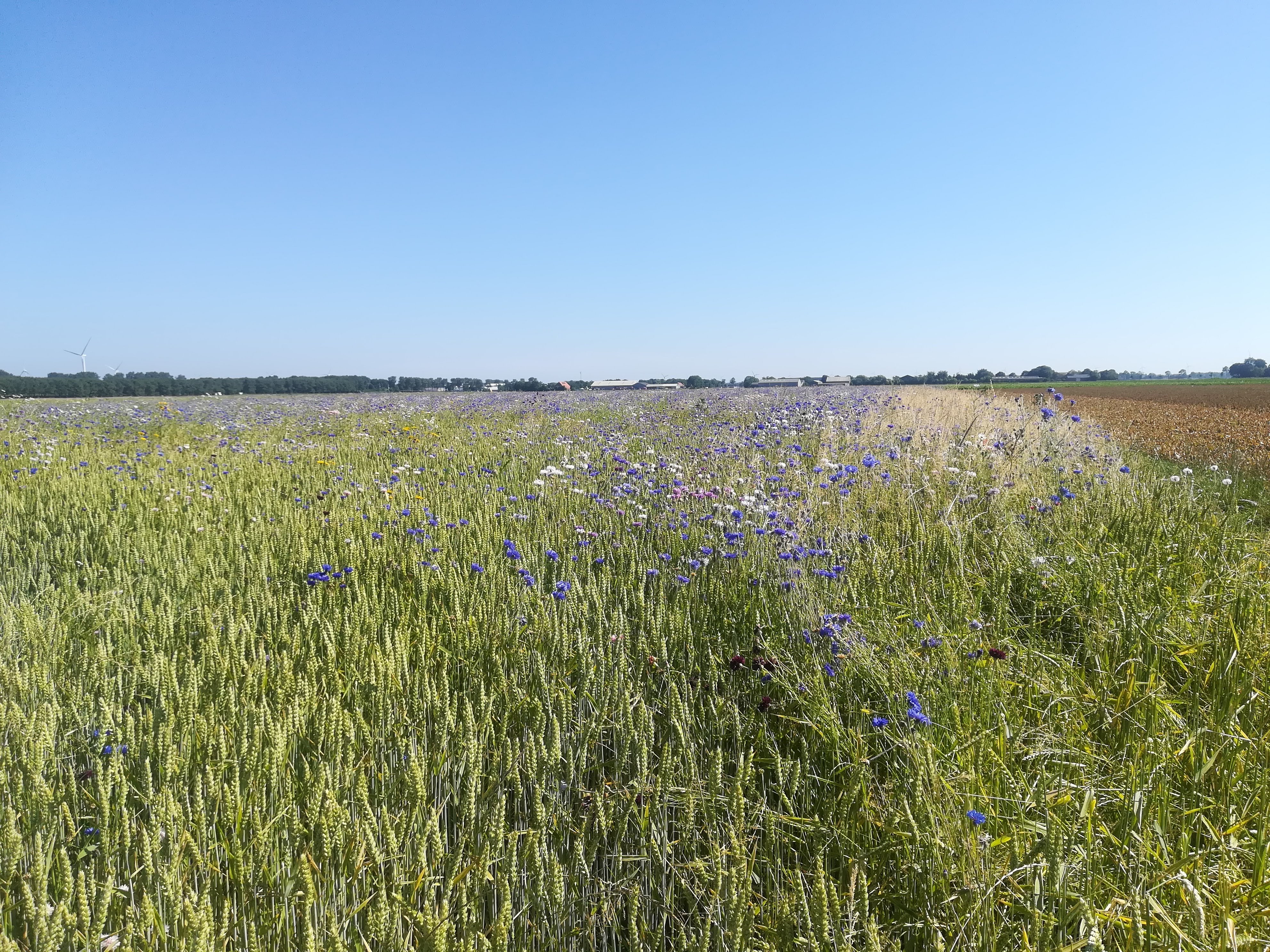
In tune with the forward thinking of the Dutch, the field in front of Molly was all about Biodiversity. Planted specifically to encourage birds and insects, the wheat will not be harvested but just left to bloom, drop seed and dry out – and then be ploughed back into the soil. Cornflowers, poppies and cow parsley enhanced the wheat ears – just beautiful.
Biodiversity at its best
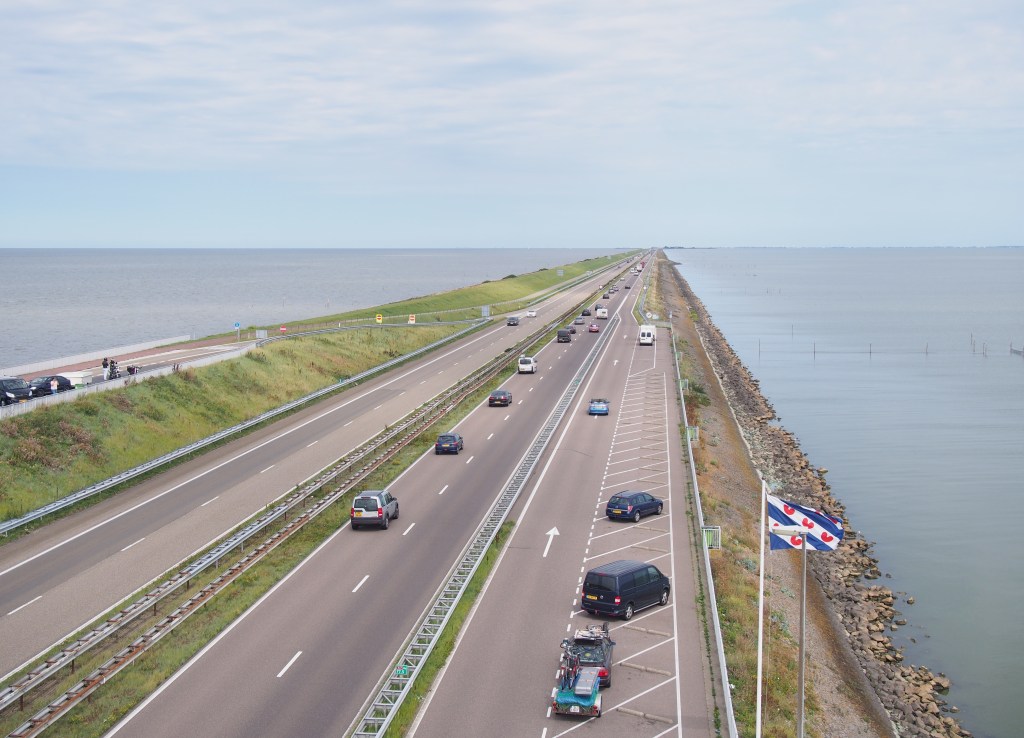
The province of North Holland is joined to the province of Friesland by the enormous, 32 km Afsluitdijk dam and causeway. It was constructed in the early 1930’s with a width of 90 metres (sufficient for a dual carriageway) and an initial height of 7.25 metres. In effect, this dams off the North Sea, and creates the freshwater lake of Ijsselmeer. It is being strengthened at present, making all viewpoints and carparks out of bounds.
The causeway (internet photo) – diggers and dredgers everywhere at present!
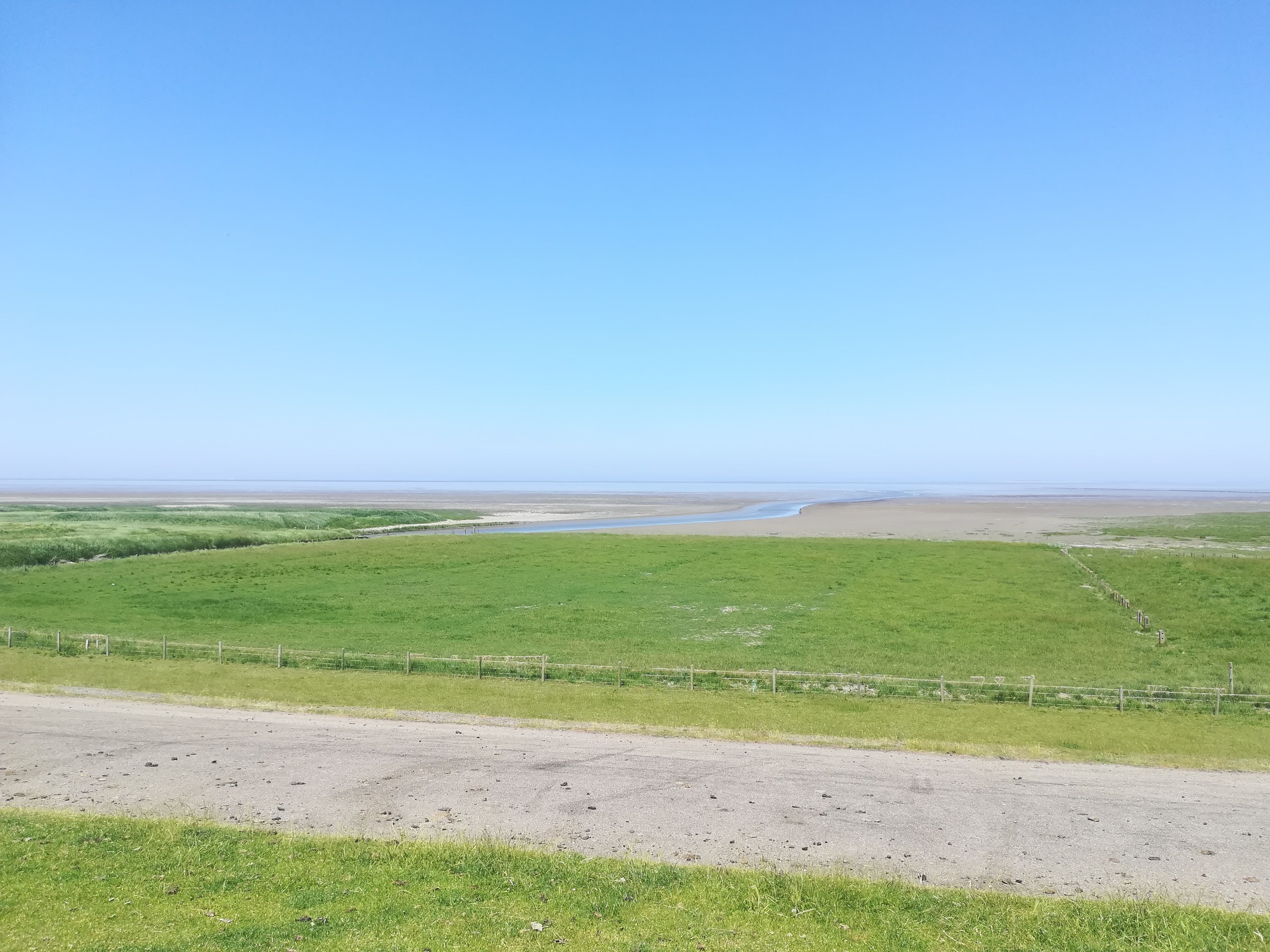
Using back roads as much as possible, we found our way to Zwarte Hann – a wonderful viewpoint overlooking the Wadden Sea. The huge tidal range here, makes a perfect bird sanctuary.
Wadden Sea with its huge tidal range
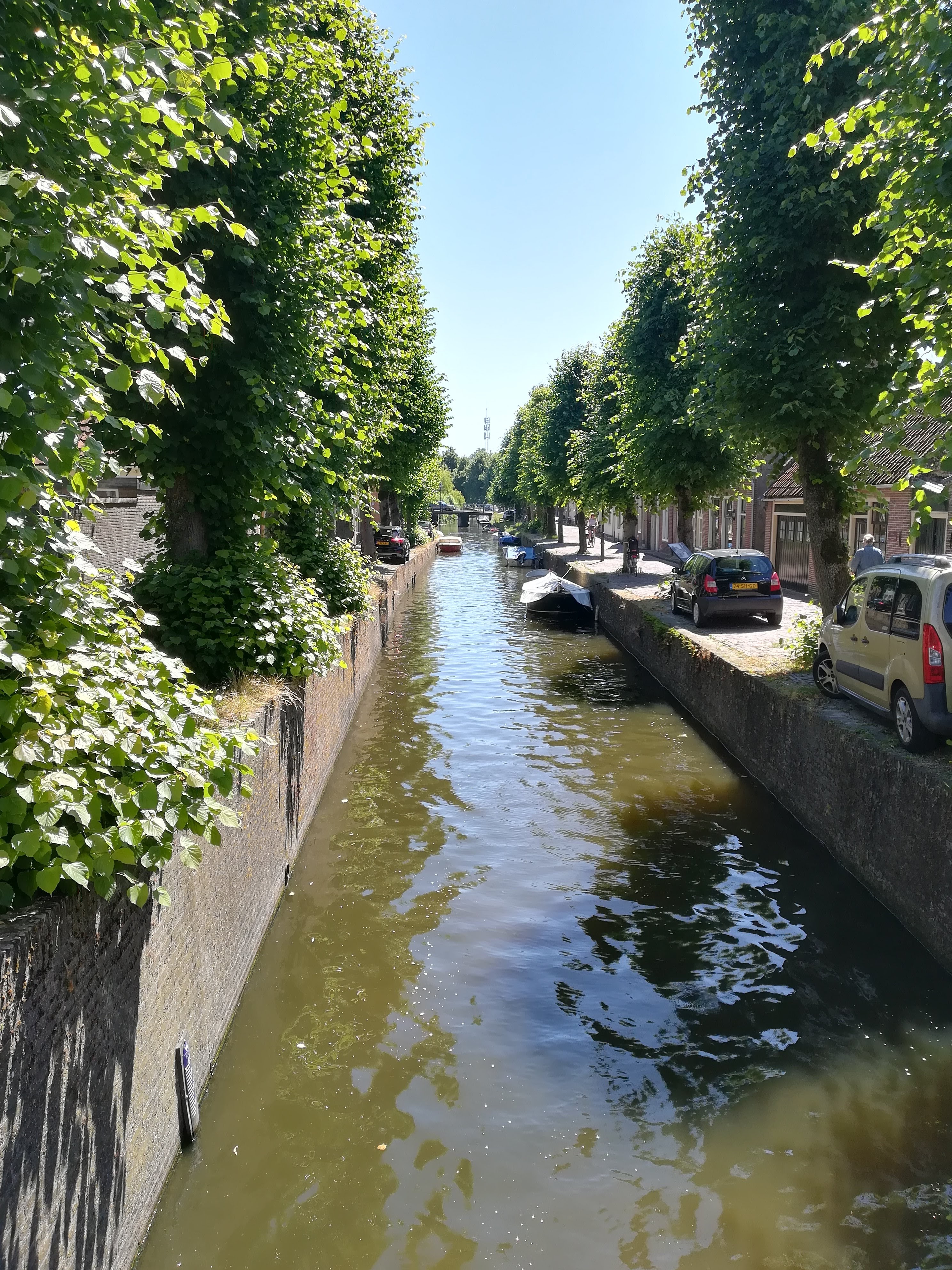
The northern province of Friesland is delightful. Quiet back roads through glorious countryside and tree-lined boulevards, interspersed with well kept villages.
Quiet backroads – glorious!Tree-lined roads – narrow in places – Molly’s right wheel goes along the white dotted line!
The tiny town of Anjum is built around it’s 17th century windmill. This ‘smock’ mill was rebuilt following a fire in 1889 – (you will gather there are different styles) It has 8 sloping sides, around its five storey base – the ‘stage’ is at 4th floor level (a good 9 metres above ground level). The ‘smock’ and the cap are thatched. Four huge sails have a span of 22 metres. We were fascinated to climb all the way to the top floor, and enjoyed the various exhibitions set up on each floor, both of local artwork AND the actual workings of the mill. In this case the mill was used to grind corn and barley. Depending on their location, windmills were also used for pumping water and for sawing wood. (Not many photos taken as it was pouring with rain!)
Anjum Windmill
Again, the local campsite served us well – easy walk into town, or surrounding countryside, marvellous sunsets – and all run by a very chirpy girl called Marilyn from Belfast!! (Well! You couldn’t do better, could you?)
Stunning sunsets from our site at Anjum
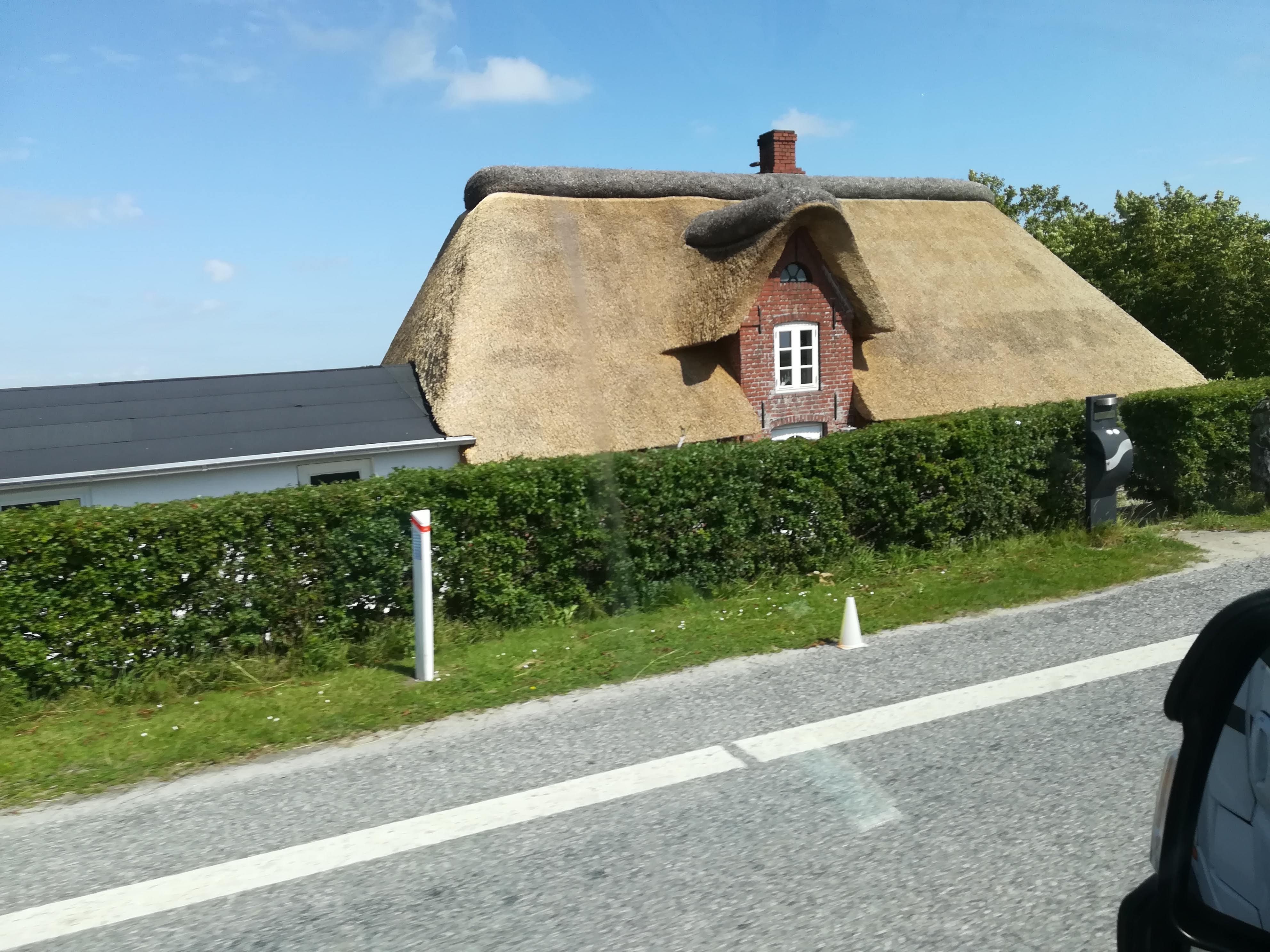
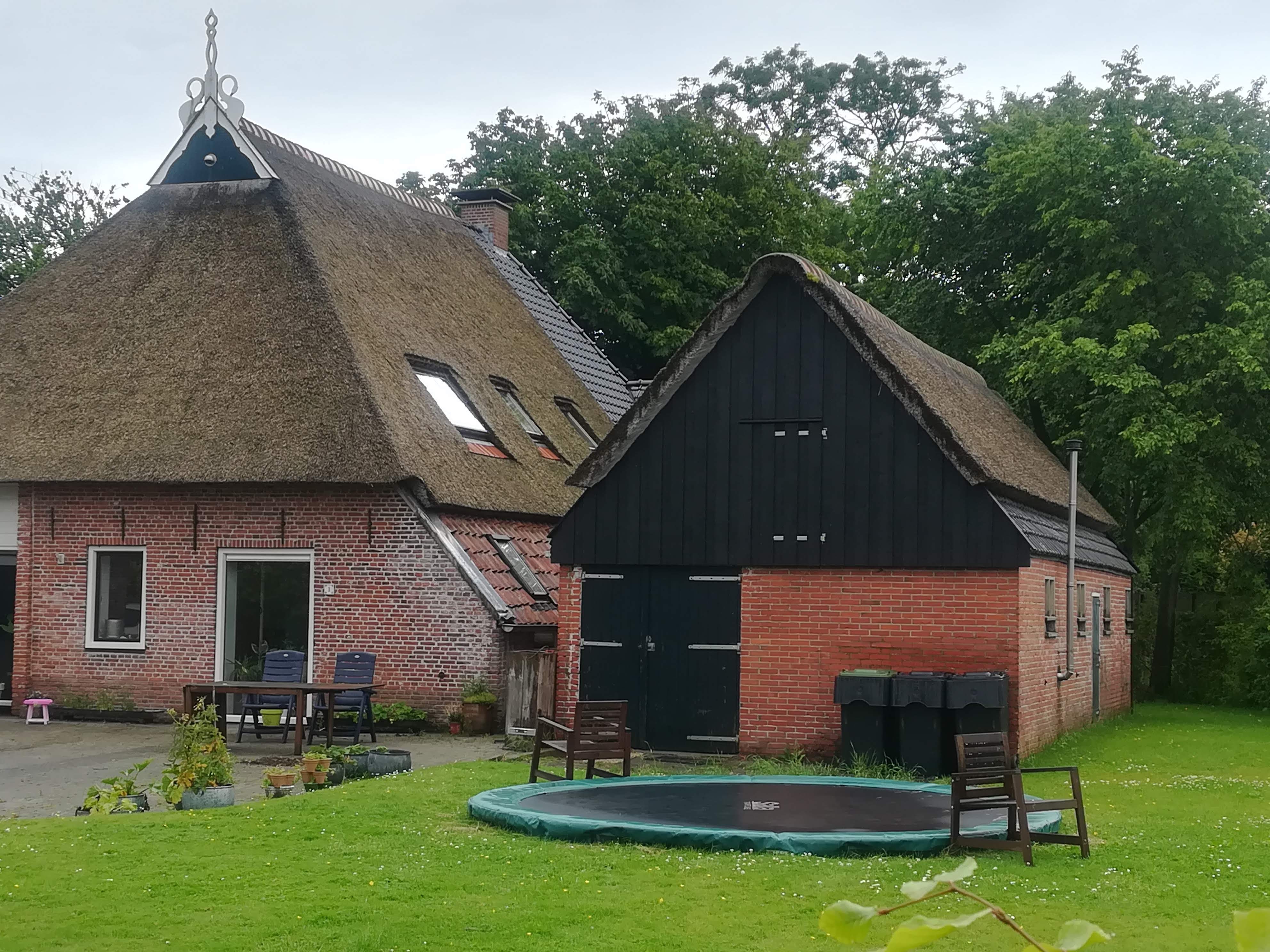
A feature that has taken my eye, particularly in this area of North Netherlands, are the many stunning thatched roofs, particularly on farm buildings. On looking into it, I discover that thatch is becoming a status symbol (having almost disappeared over the years). It is normal here for the farm buildings to join onto the family home. In many cases the thatch spreads over the barns, then part way over the house. Coveted as having high insulation values as well as being rainproof, the thatch is made from the local reeds which grow along the canals. Despite it being a local commodity, it is extremely expensive to have it professionally applied – but then lasts at least thirty years. Also of note are the very steeply pitched roofs – this ensures that heavy snow does not settle, but falls off due to the angle.
Impressive thatch on the ‘farm building’ attached to the houseMore thatch – in parts!
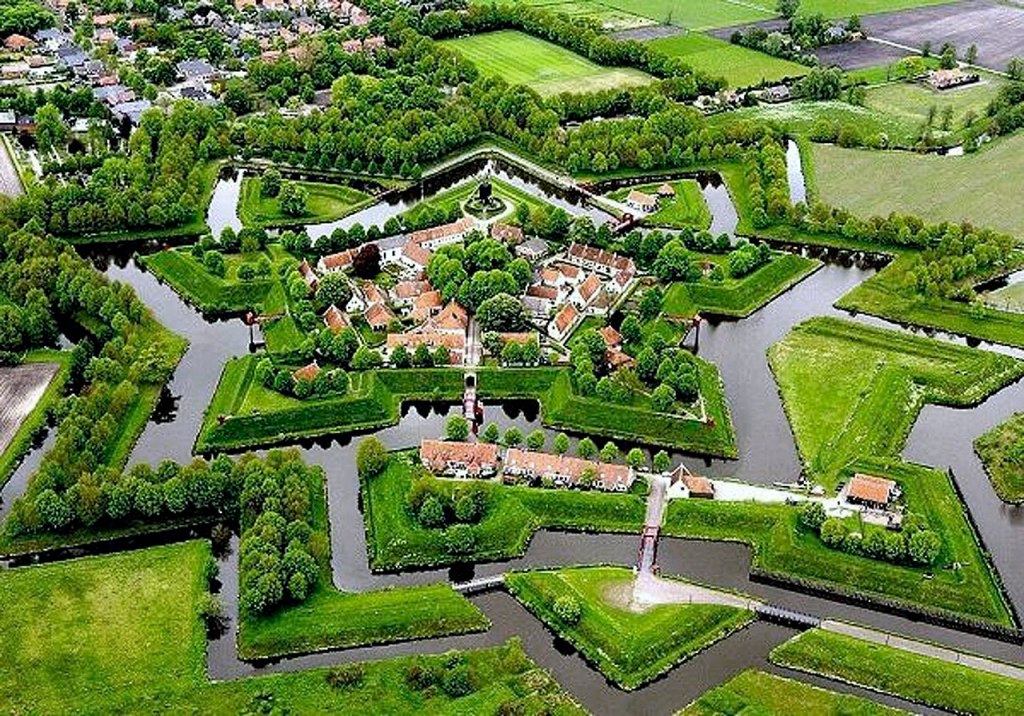
Our final day in The Netherlands for this leg of the trip, brought us to Bourtange, very near the German border. This tiny village is renowned for its Fort which was completed in 1593, the original purpose being to take control of the only road between Germany and the city of Groningen, just south of here. This was during the Eighty Years War when the Spaniards were trying to occupy the country. It continued to serve as part of the defensive network on the German border until 1851 when it was converted to a village. Various parts of the village are now part of the historical museum which not only brings in the coffers to help maintain the ramparts, but also gives employment and a sense of purpose the villagers.
The overnight ferry from Harwich to Hook of Holland, with Stena Lines, is very comfortable. We cooked & ate our supper sitting in the queue (advantages of motor homing!) – we were almost the last on and, you guessed it, almost the last off! With new Brexit rules for not carrying meat or dairy into Europe, our first stop was a supermarket to stock up. Lovely fresh food and marvellous vegetables and fruit – no surprises there, as it’s all grown here!
Our route took us around the perimeter of Rotterdam with its enormous shipping port. Molly took to driving on the right with no problems (‘tis useful having a Canadian driver!) and the ring roads took us to the east.
Joining the quieter back roads, we were quickly immersed in the pretty countryside – beautiful green fields, tree-lined avenues, cattle and/or sheep (mostly Jacobs) grazing peacefully in the fields. But what really stands out, of course, is the flat terrain. Alongside each and every field is a canal, in some cases just an irrigation channel, in the case of towns and cities they can be the width of a river!
Wetlands
A quick history lesson for those of you who’ve forgotten (like me!) The Netherlands (the word means “low-lying country) lie mostly below sea level. The Dutch built dykes to hold the water and used the canals for travel and irrigation. The freshwater in the canals comes from the River Rhine, which originates in Germany and has its delta on the Dutch coast. Abundant rainfall levels help to keep the canals full. Sluices are opened towards the sea when flooding is threatened. Easily irrigated agricultural land stretches as far as the eye can see.
In an attempt to find the Windmill Museum at Kinderdijk, we found ourselves being led 2 km away to park Molly. We settled for a pleasant walk in the sunshine, where we viewed the windmills from afar, but came across lots of wildlife.
Wetlands and wildlifeCanals & Windmills
Our first stop (2 nights) was at a peaceful campsite in Otterlo in the province of Gelderland. The Kroller Muller museum was the magnet that drew us to this gorgeous little town. Situated in the middle of 5,500 hectares of the Hoge Veluwe National Park, this gem is the brainchild of Helena Kroller Muller who, along with her husband, collected 11,500 pieces of art in the early 1900’s. She realized her dream of sharing her collection with the public by opening the museum in 1938. It holds the second biggest collection of works by Van Gogh, alongside many other well-known artists. Even to our untrained eyes, it was very impressive.
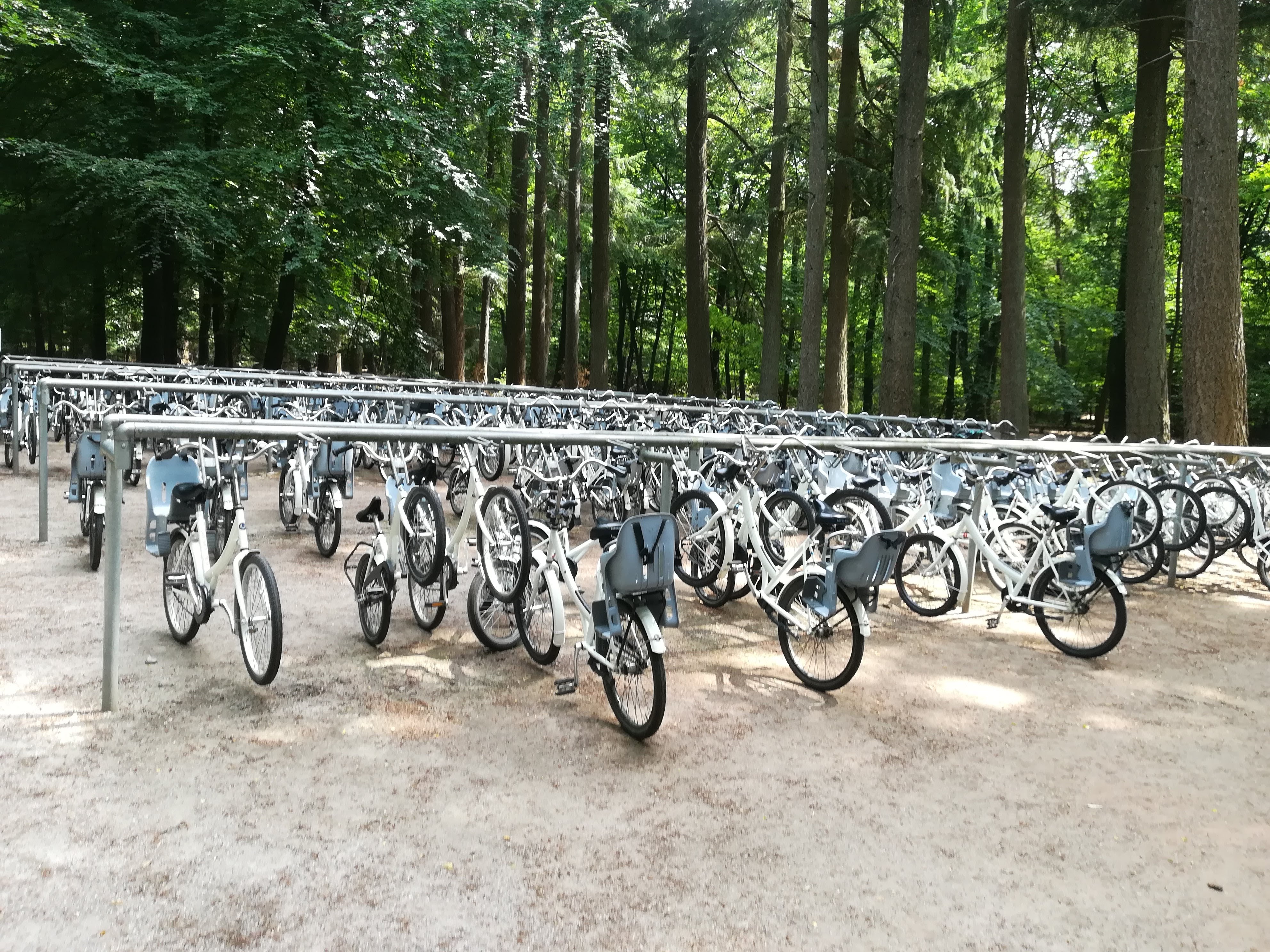
One of highlights was actually getting there. A 25-minute walk from the campsite took us to the park entrance, where 100’s (yes, I mean 100’s!) of white bikes are provided free of charge. There are several bike stations around the park, where you leave one bike and pick up another as you leave. Very simple bikes – no gears, no brakes – but remember this is FLAT land, and there are cycle paths EVERYWHERE EXCEPT THE MOTORWAYS.
One of the white bike stations in the parkCyclepaths everywhere!
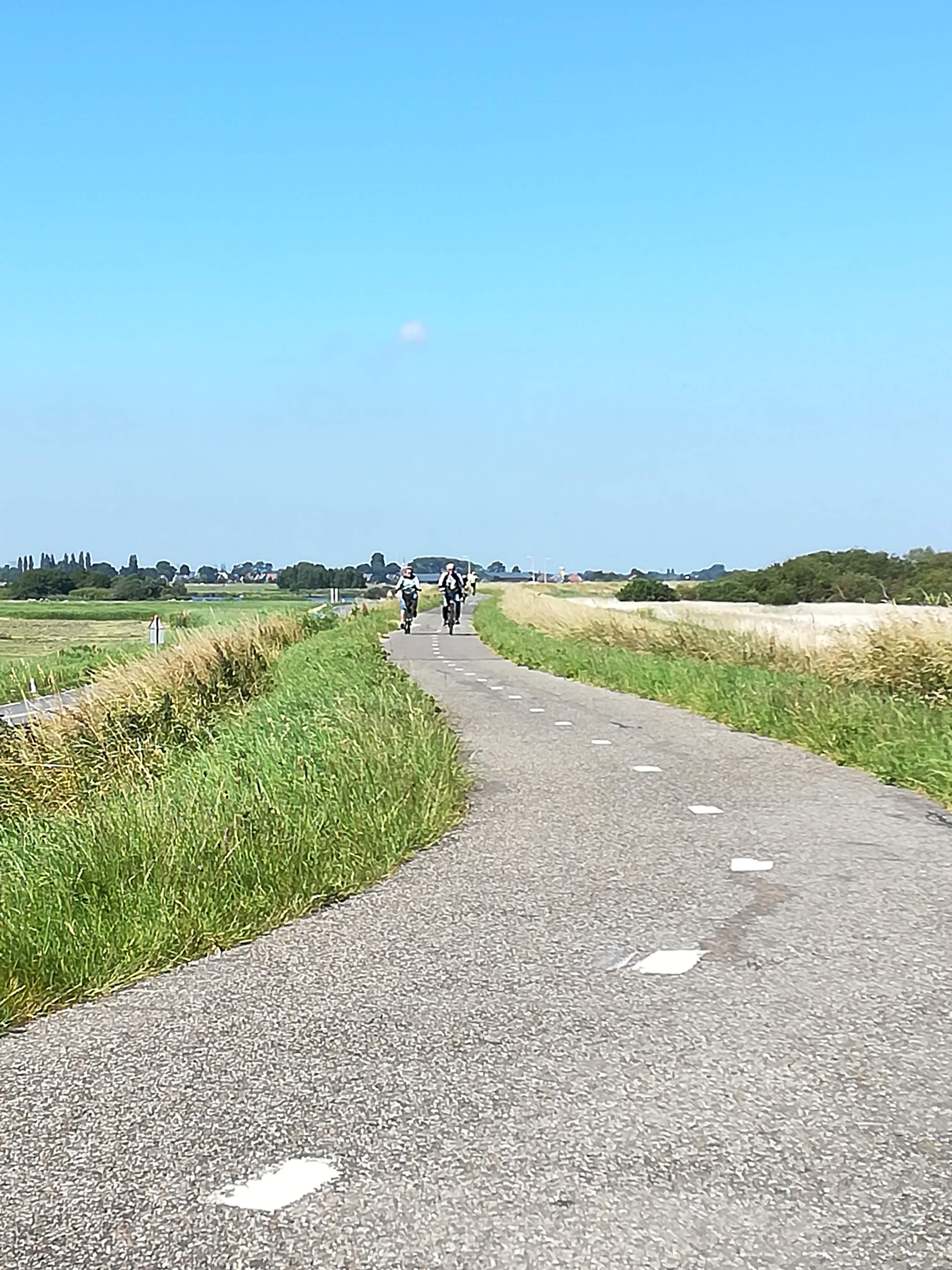
Well laid out, smooth, two-way cycle paths. EVERYONE uses a bike – for the dentist, for the shops, to visit friends, for a night out. All manner of clothes grace a bicycle! Only the keen racing cyclers wear lycra and partake of a helmet. It is very normal to ride alongside your friend, chatting away, hair billowing out behind you. Dogs ride along in a specially adapted dog carrier which goes on the front of the bike. (you could put a child in there too!)
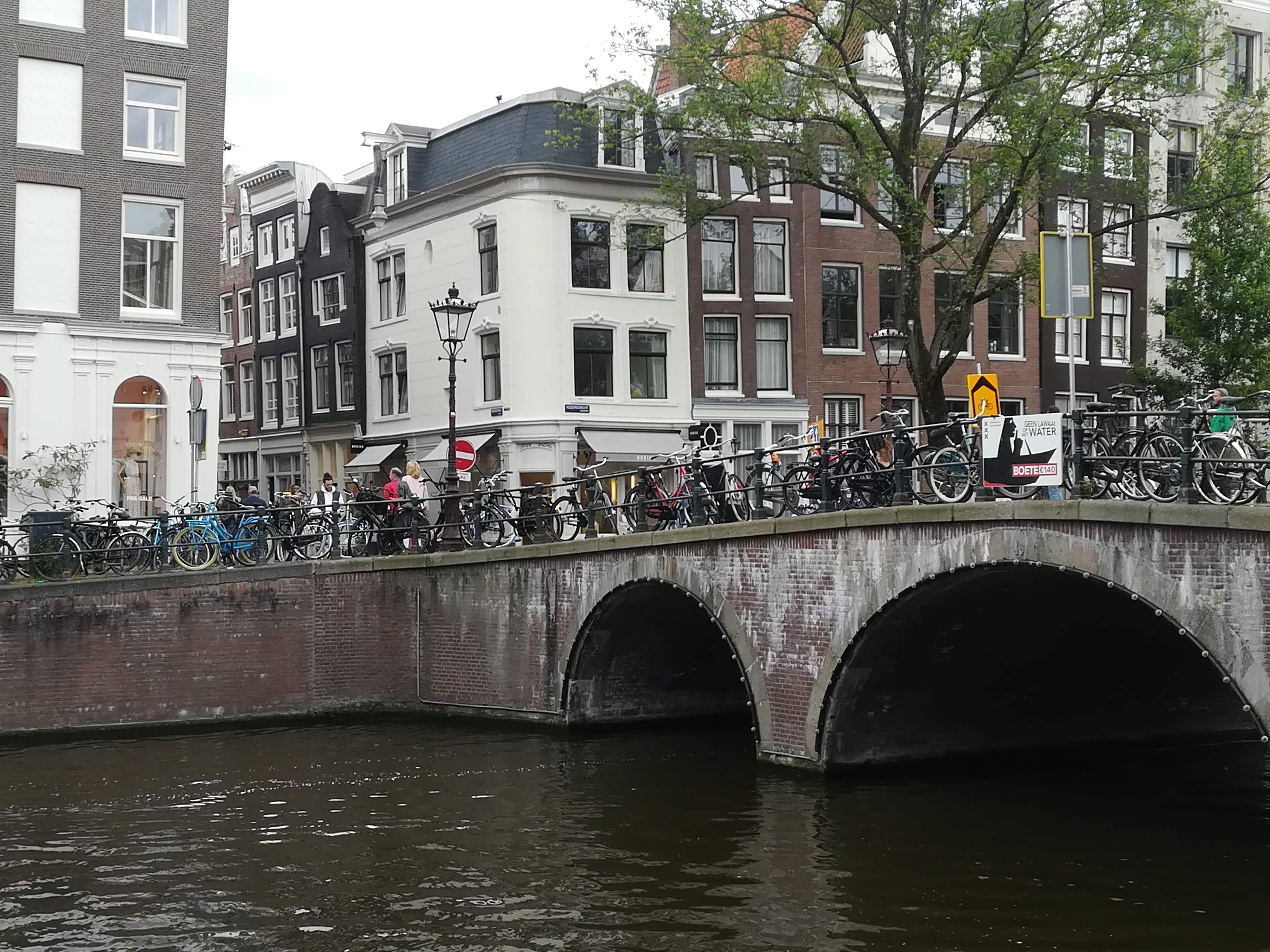
Thanks to a Camping & Motorhome Club recommendation, we moved to Gaasperplas Camping on the outskirts of Amsterdam. A convenient 10-minute walk from a Metro station, then 25 mins on the Metro took us to Central Station in the middle of Amsterdam city. Despite its checkered history – prosperous 17th century, economic decline in the 18th century, re-emergence of wealth in the 19th century, growing inequalities & emancipation, along with war and repression in the 20th century – Amsterdam is now a truly vibrant city. Pretty canal bridges are adorned with flowers, fascinating architecture (see more below) wherever you look. Bicycles and trams are the main mode of transport, and we needed ‘eyes in the backs of our heads’ to avoid bicycles coming from behind, in front and to either side. BICYCLES HAVE RIGHT OF WAY here, and it takes some getting used to.
Bicycles on every bridgeMind out!
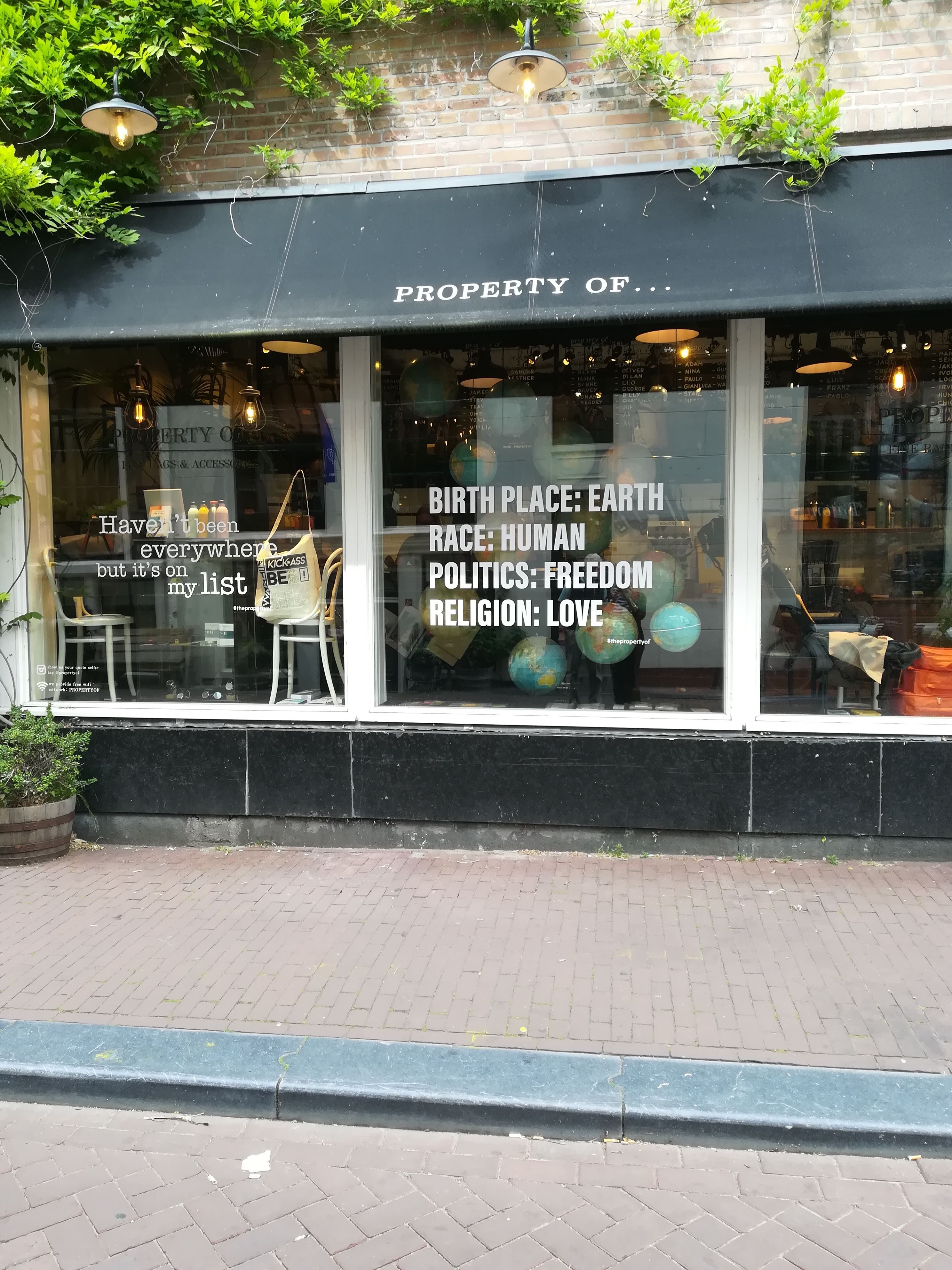
The average age in Amsterdam is just 38 yrs, and it shows. Youngsters flood here for employment, and in pursuit of freedom. The Dutch live their lives with the firm belief that everyone can just be themselves and do as they wish. No doubt the cultural leniency towards sex and drugs adds to the appeal!
The Amsterdam Scene
On a sunny Sunday afternoon, the streets were full of live music – a different beat on every corner – people enjoying conversation with friends – and the sound of MANY different languages being spoken as the city enjoys a booming tourist trade.
Random Street theatre on a Sunday afternoon
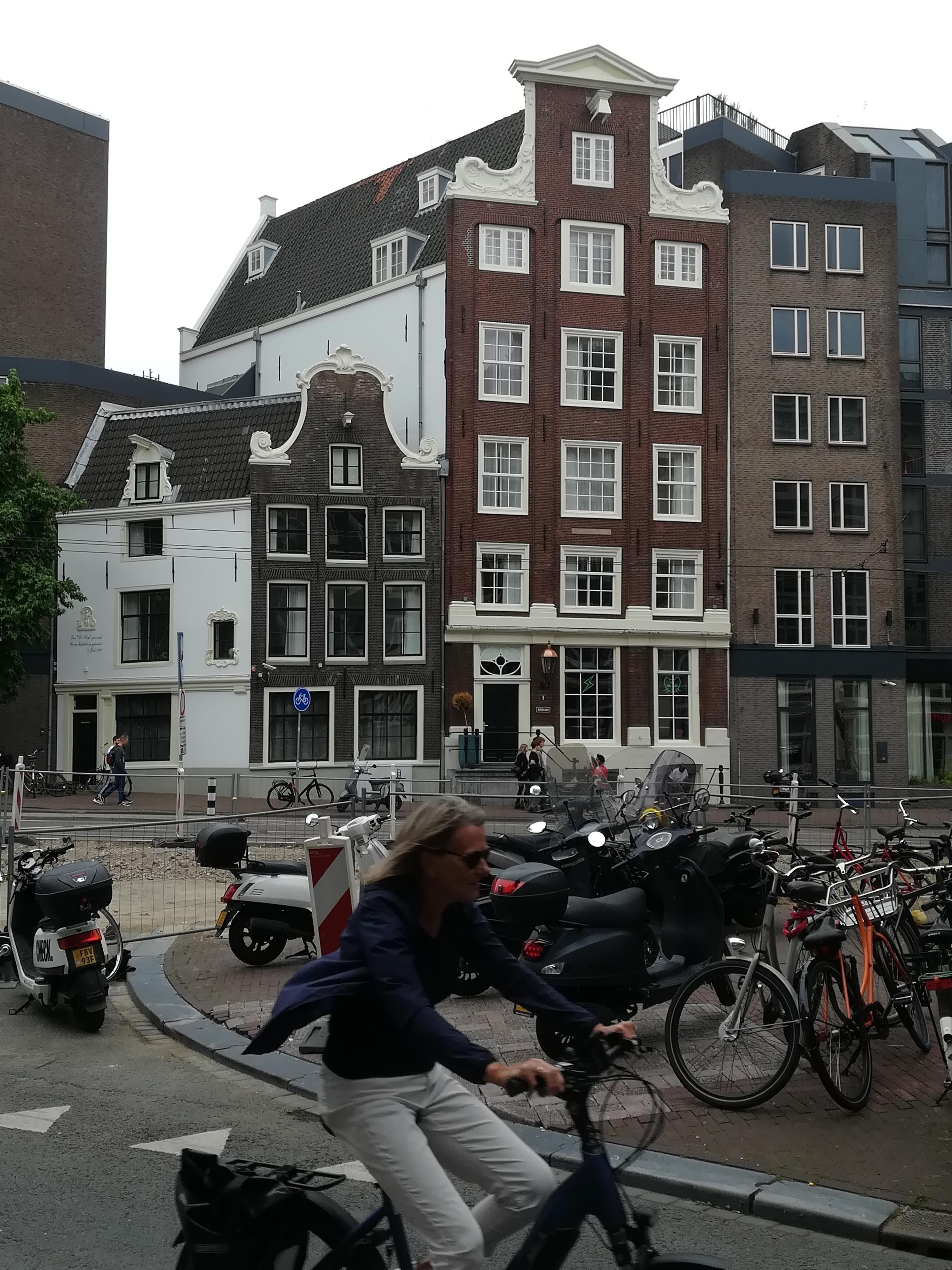
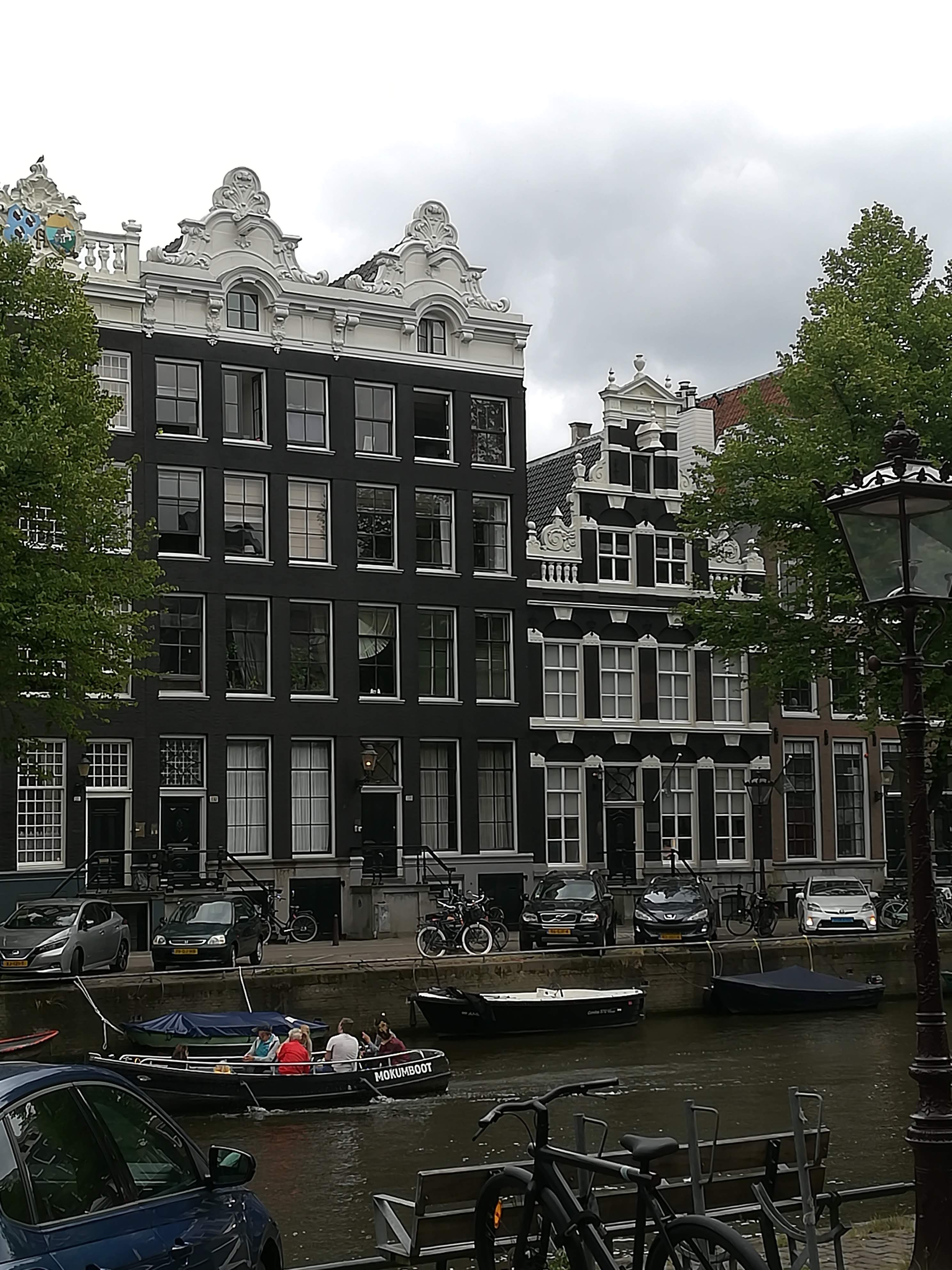
The beautiful old canal houses were built on poles sunk many metres into the sandy marsh – as long as the wooden poles stay wet, they won’t rot. Hmmm? Lots of properties have funny angles as they tilt to one side or the other. Many were built with their facades leaning forwards to enable pullies to move furniture to the top floors without the platforms knocking the front walls. Canal houses were always very narrow, as owners had to pay very high taxes on the waterside walls – hence the houses were always tall and deep, spreading a long way backwards and always with a garden – growing food has always been encouraged. Highly ornate gables signalled the opulence of the owners.
Canalside houses – note the tilted oneOpulent Gables
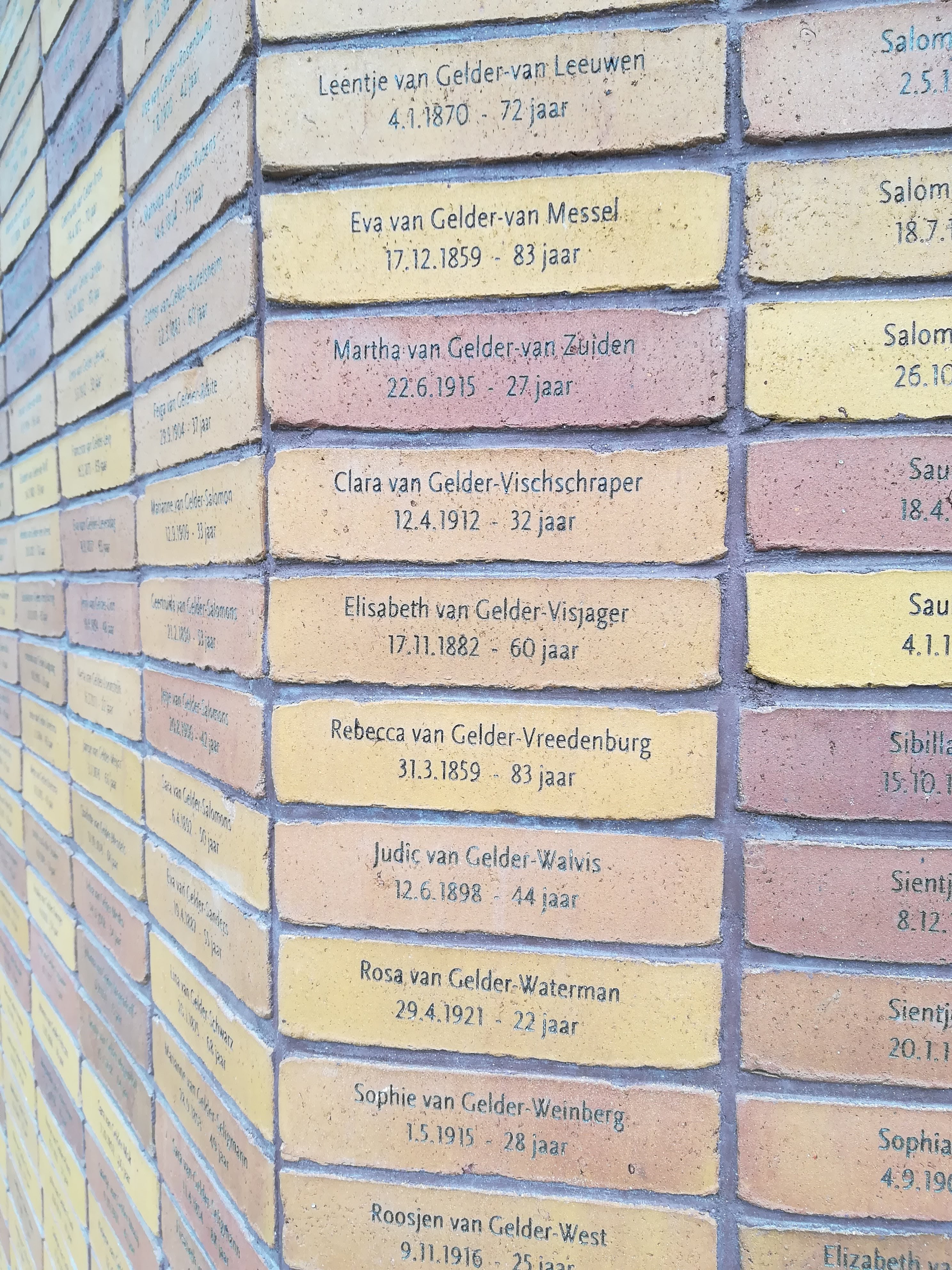
Though the city was never bombed during the war, it did suffer terrible repression. Some 80% of the Jewish community were killed by the Germans – approximately 120,000 people. The impressive Holocaust Memorial ensures that those people are never forgotten. Every individual is named on a brick which is cleverly displayed under huge curving mirrors. We will always think of Amsterdam as being vibrant and forward thinking, and yet its history must never be disregarded.
Holocaust MemorialNames on individual bricks
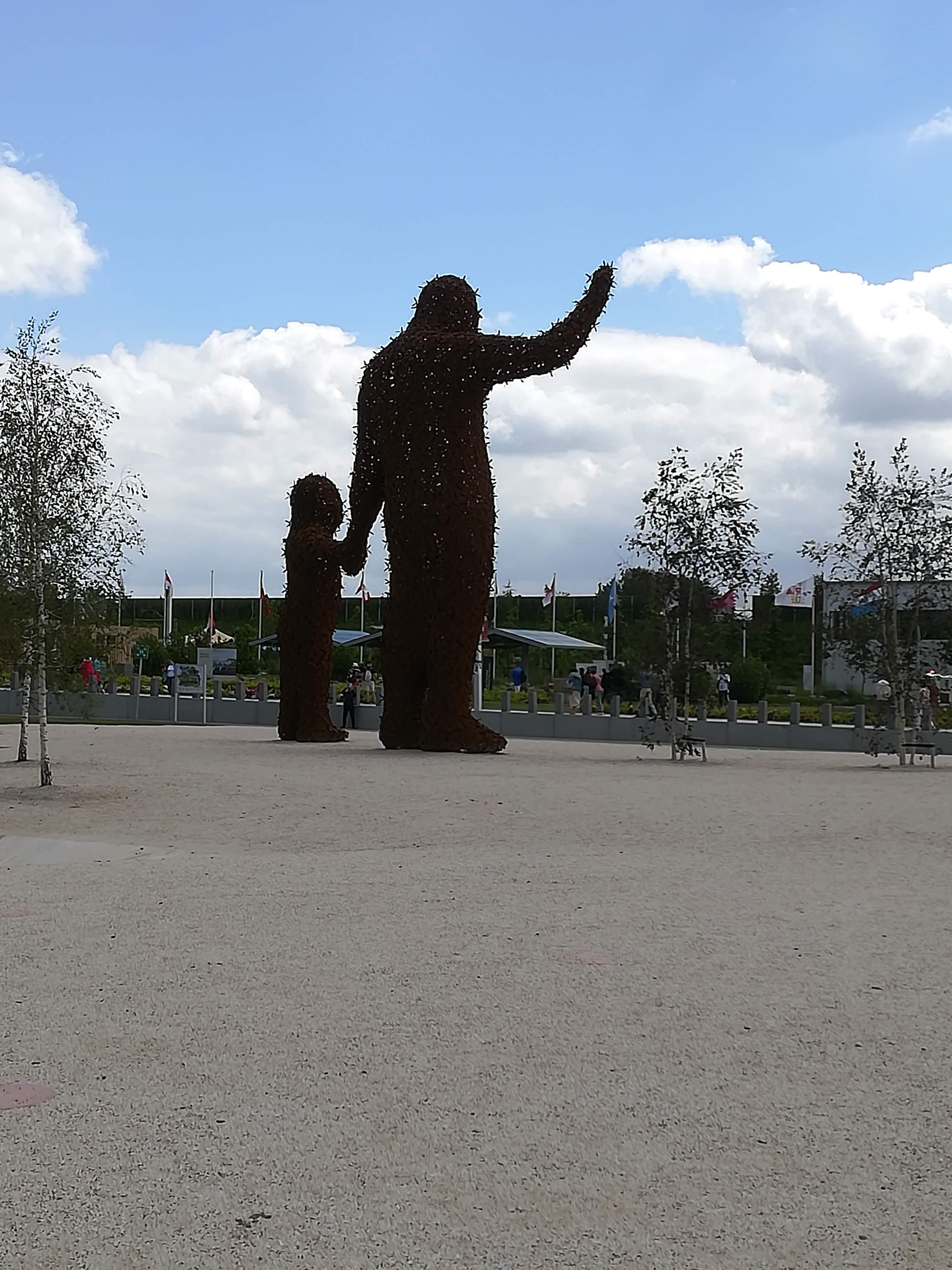
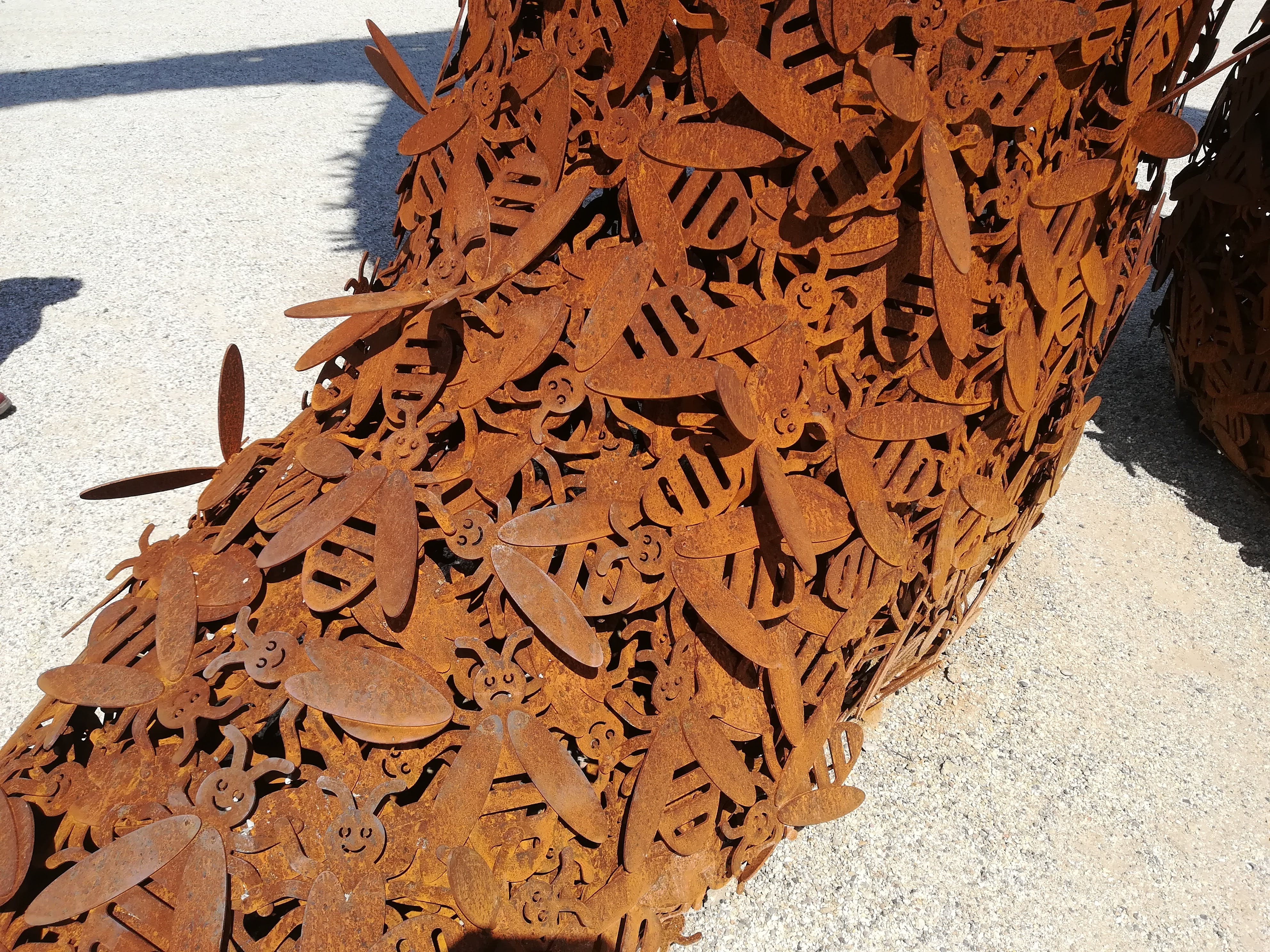
Our proximity to Amsterdam, meant that we were able to take a day visiting Floriade. This enormous International Horticultural Show which takes place every ten years in a different place in The Netherlands, allows the Dutch to show off their agricultural prowess and more importantly, their forward thinking. The 850-metre cable car ride gave us a birds-eye view of the 60 hectare site in Almere (about 20 mins by train to the east of Amsterdam). Within the theme of ‘Growing Green Cities’, we were shown various innovations and solutions, which inspired us to enrich our own garden, and try to live a greener way of life. The site itself will become a ‘green city’, with eco houses built on large plots to allow owners to ‘grow their own’. In the meantime, we enjoyed some beautiful gardens with lots of vibrant colour.
‘Beehold’ – 12 metres high – symbolises relationship between bees and humanityCloseup of man’s leg – the whole structure is constructed of small metal beesWildflower gardens everywhereAbundant greenhouse flowers
We are now heading north and east through The Netherlands to the border with Germany. See you next time . . . .
With Covid restrictions being relaxed, we feel it’s time to explore a bit further afield. We will shortly be ‘crossing the water’ to Europe, and exploring three countries that we’ve never visited before. Holland, Northern Germany and Denmark. Given that it’s high season (i.e. school holidays) in these countries, we have been advised to prebook our campsites to avoid disappointment. After much head scratching and studying of the Lonely Planet Guides we have planned a route. No doubt there will be the odd ‘blip’ and a few challenges on the way – but that’s all part of the fun!
Our proposed route
Follow us as we go – I shall add some news each week. Molly is raring to go (I wonder if she knows how much diesel prices have risen?) and we’re looking forward to seeing something new. See you on the other side . . . .
Leaving the Outer Hebrides, we caught the ferry from Tarbert to Uig on the Isle of Skye. Once again, we were blessed with calm waters – phew!
Skye is the largest of the Inner Hebrides and is 50 miles long and only 5 miles wide at its widest points, thanks to many deep inlets. The people of Skye must have been thrilled to be connected to the mainland via the new bridge (built 1992) – it will have improved the economy in every way. However, the ease of reaching Skye means that the tourist industry is booming. EVERY site of interest is now so crowded that we quickly learned to visit these places very early in the morning. (Reminded us of visiting Lake Louise in Canada!) Car parks are too small and road surfaces are terrible thanks to the increase in traffic from tour buses to motorhomes (yes, I know – that’s us!), from motorcycles to bicycles – they are ALL on the roads! Perhaps we noticed this more keenly, having just had two relatively quiet weeks in the Outer Hebrides!
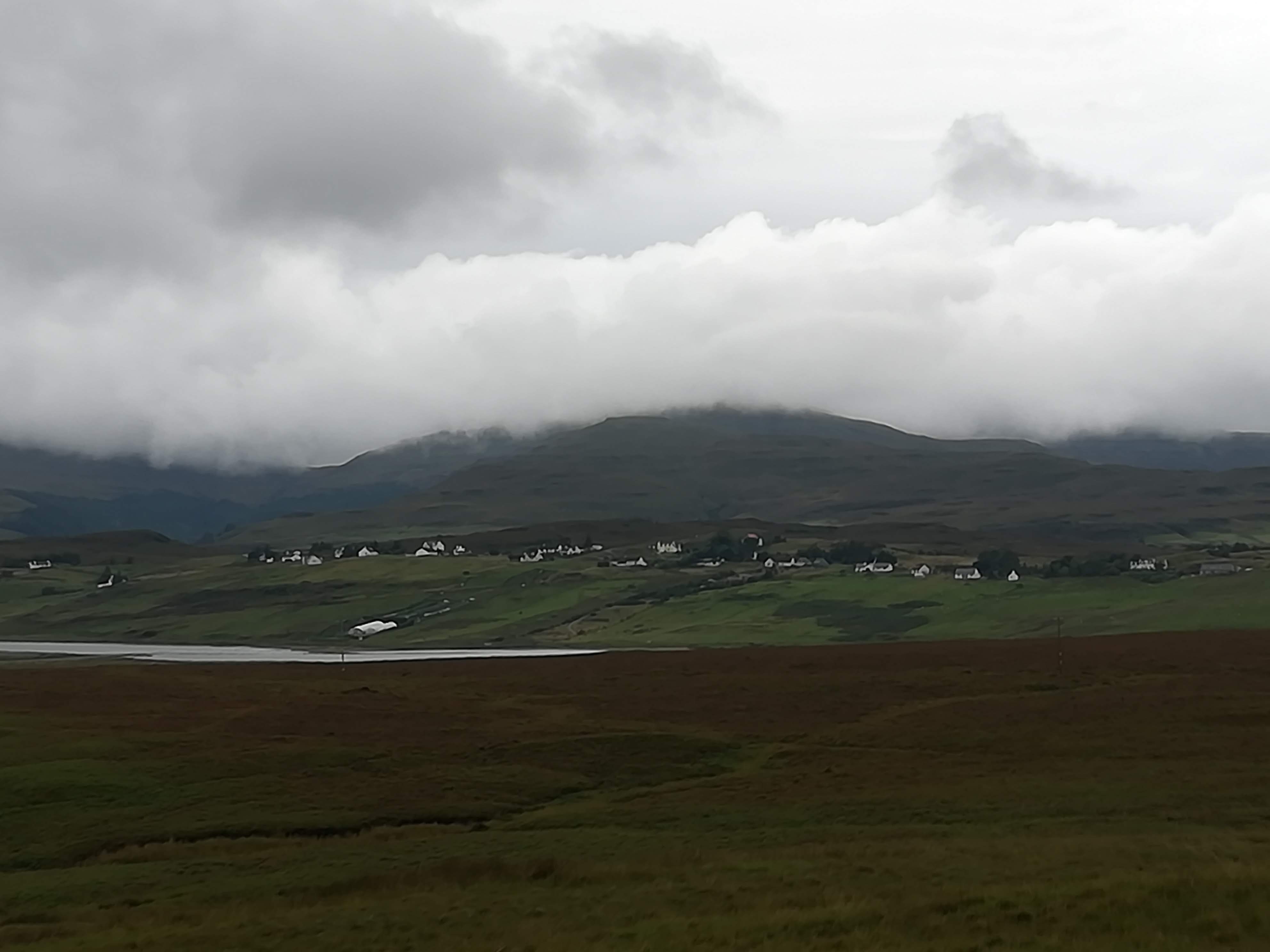
The name Skye translates from the original Norse – meaning ‘island of mist’. Oh dear! You guessed it . . .. we’ve had lots of low cloud and rain!
Heavy cloud on Skye
Highlights:
The ruins of Duntulm Castle on the north-west coast of the island sit on a headland overlooking the Minch. The present ruins date from the 14th century, and it is said that there was once an Iron Age Broch on this site.
Duntulm Castle
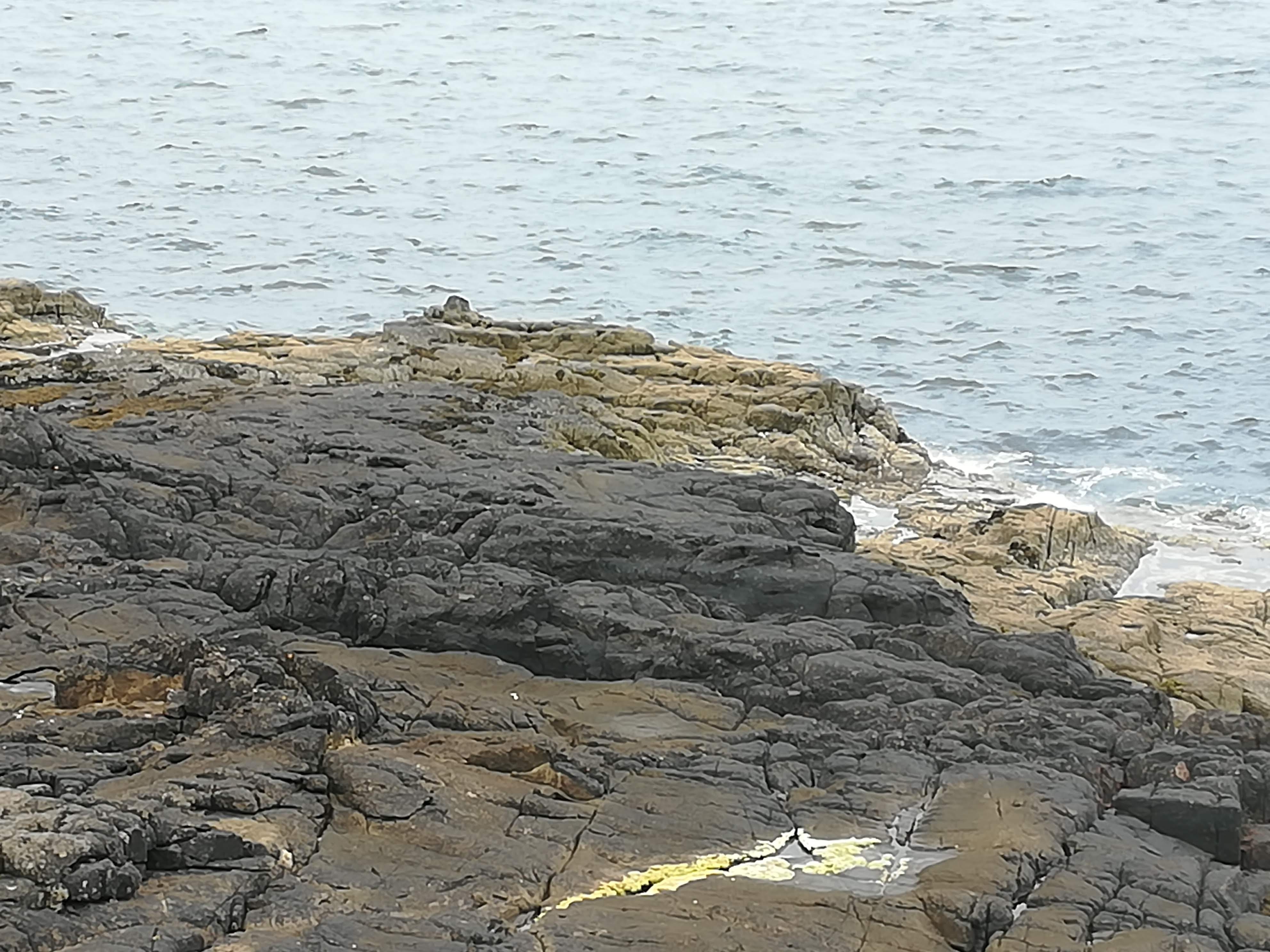
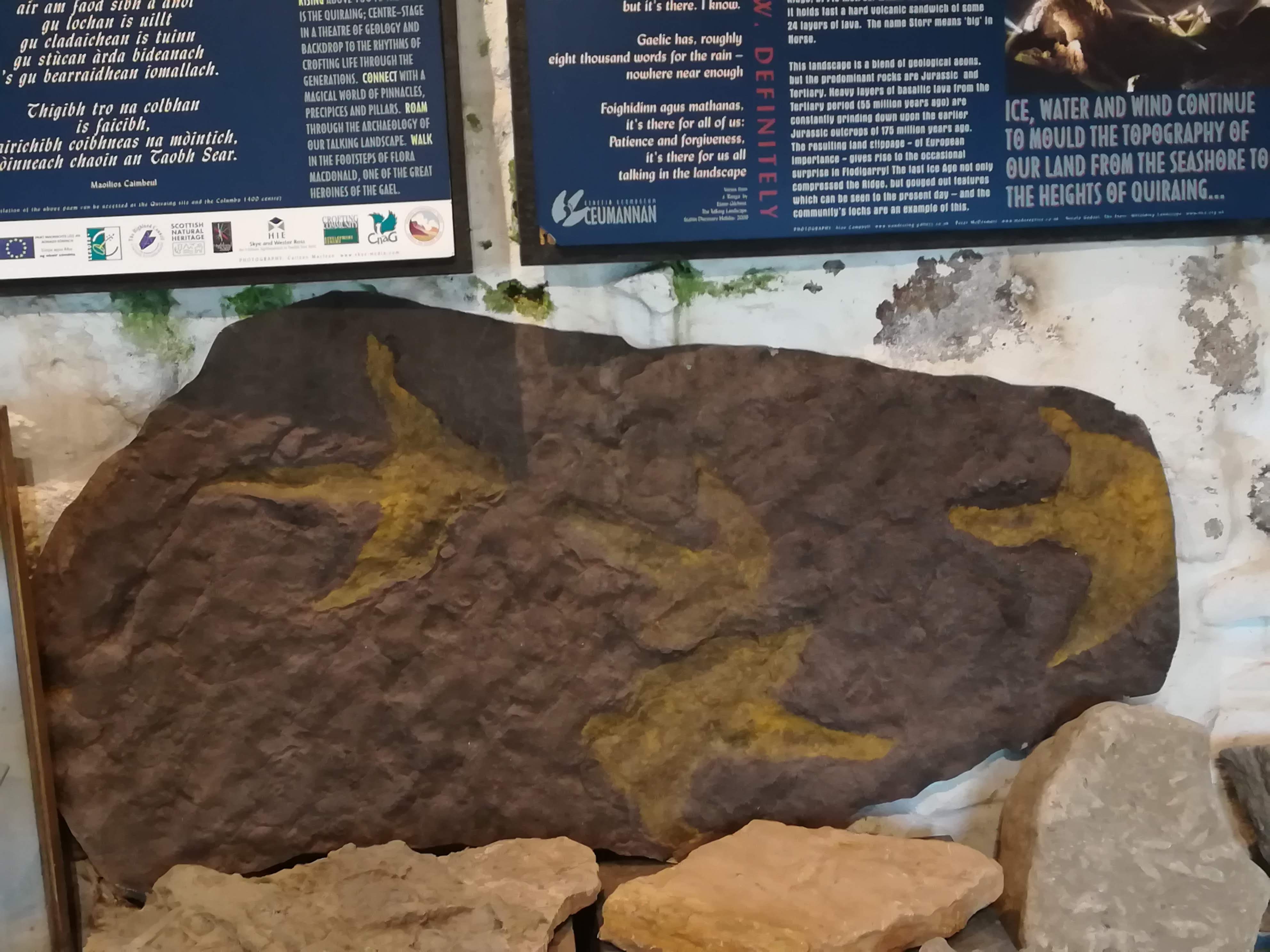
More exciting for us was searching for dinosaur footprints on the shore below the castle. Yes! You read that correctly! These 170-million-year-old fossils have been discovered recently. Apparently, they only appear at low tide when a recent storm has cleaned the rocks of seaweed and shingle. The local museum had some good examples. It is just incredible that something SO OLD can be preserved by the salt water – three cheers for the clever geologists/scientists who discover these things.
Searching for dinosaur footprints at low tide/ A recently found fossil from a beach near Staffin
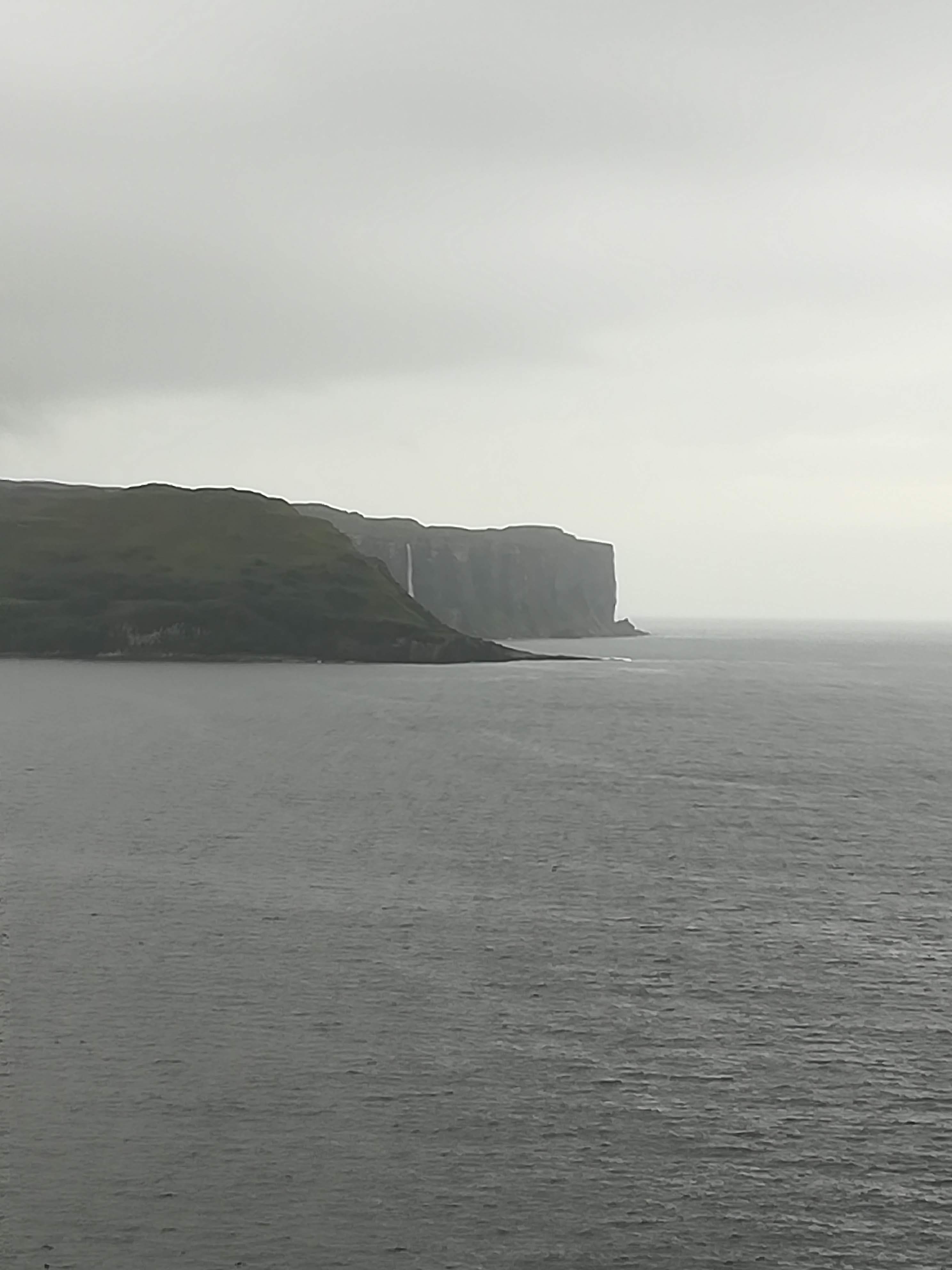
Kilt Rock and Mealt Waterfall – Skye’s coastline has some very steep, columnar cliffs. At Kilt Rock it is said that the rocks resemble the tartan pleats of a kilt (I’ll leave you to decide . . . )
Kilt Rock
The Mealt Waterfall tumbles 55 metres into the sea from an inland loch named Mealt.
Mealt Waterfall
Given the miserable weather and low cloud, a visit to a castle and gardens was a must. Dunvegan Castle dates from the 13th century and is home to the MacLeod clan. It is the oldest continually inhabited castle in Scotland.
Dunvegan Castle
The surrounding gardens date from the 19th century, and have been constantly updated since the 1970’s. The interminable rain stopped for us as we arrived at Dunvegan . . .. . hence, we were able to admire the acres of garden accompanied by – you guessed it – MIDGES!
Dunvegan Castle Gardens
A day of sunshine and clouds was a definite invitation to get out and walk in the mountains of the Trotternish Ridge. I shall leave you to research the geology in greater depth, but suffice to say that basalt lava flows combined with horizontal dolerite sills have created some of the most dramatic landscape in Britain (it says so in the book!)
Stunning scenery on the Quiraing
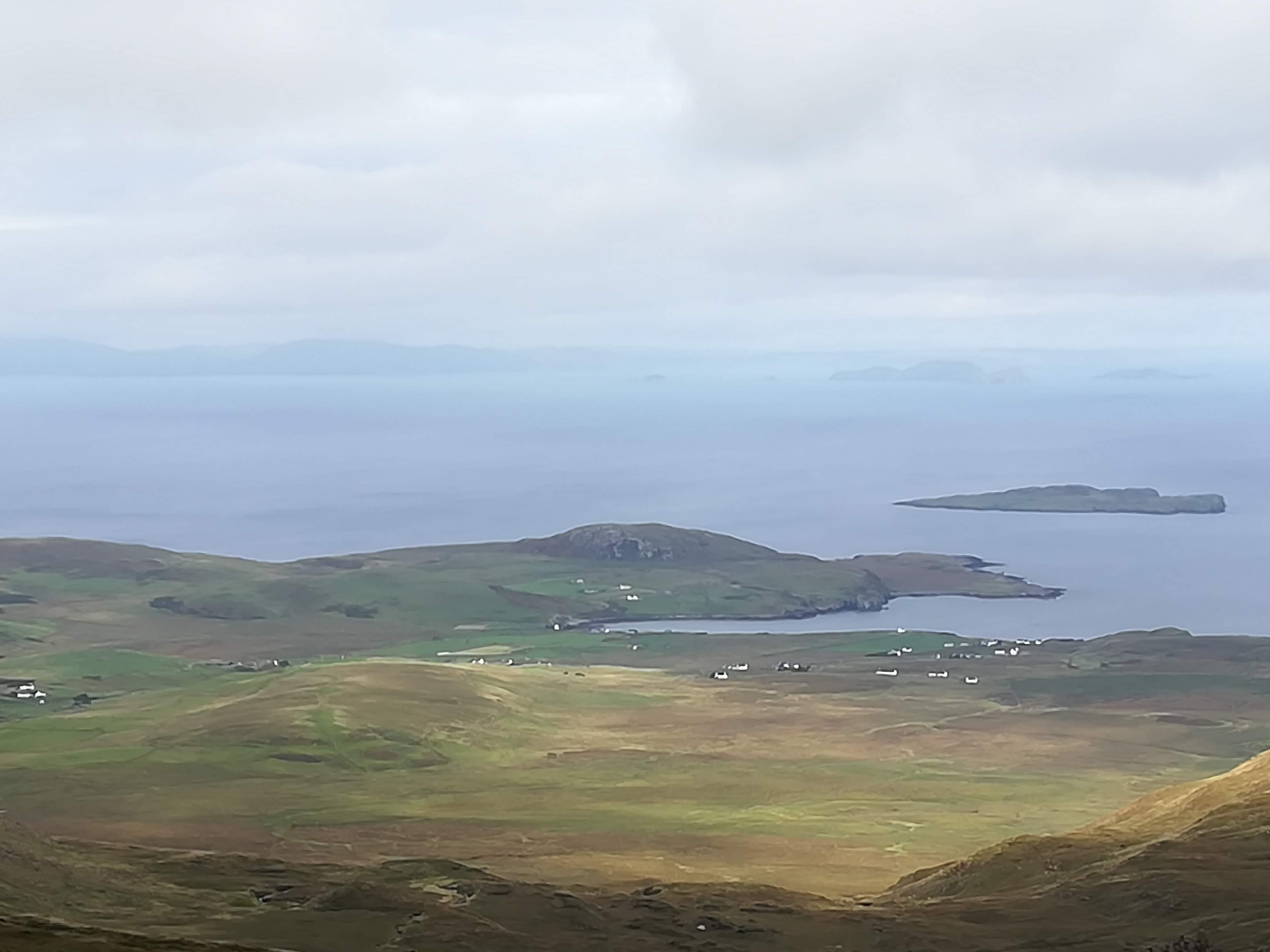
We felt truly blessed to have the stamina (and some sunshine!) to climb the Quiraing (543 m). The views were spectacular in all directions. The clarity and colours were magic. The 8km walk took three hours, not only because of the arduous climb, but because of the numerous stops for photos!
Peter proves that we made it to the top! / far reaching views across to Harris
Not only were we enchanted with the captivating scenery, we were overjoyed to FINALLY see some eagles! No photos . . . they were too far away, but we sat on a rocky outcrop watching them soar overhead – just breath-taking.
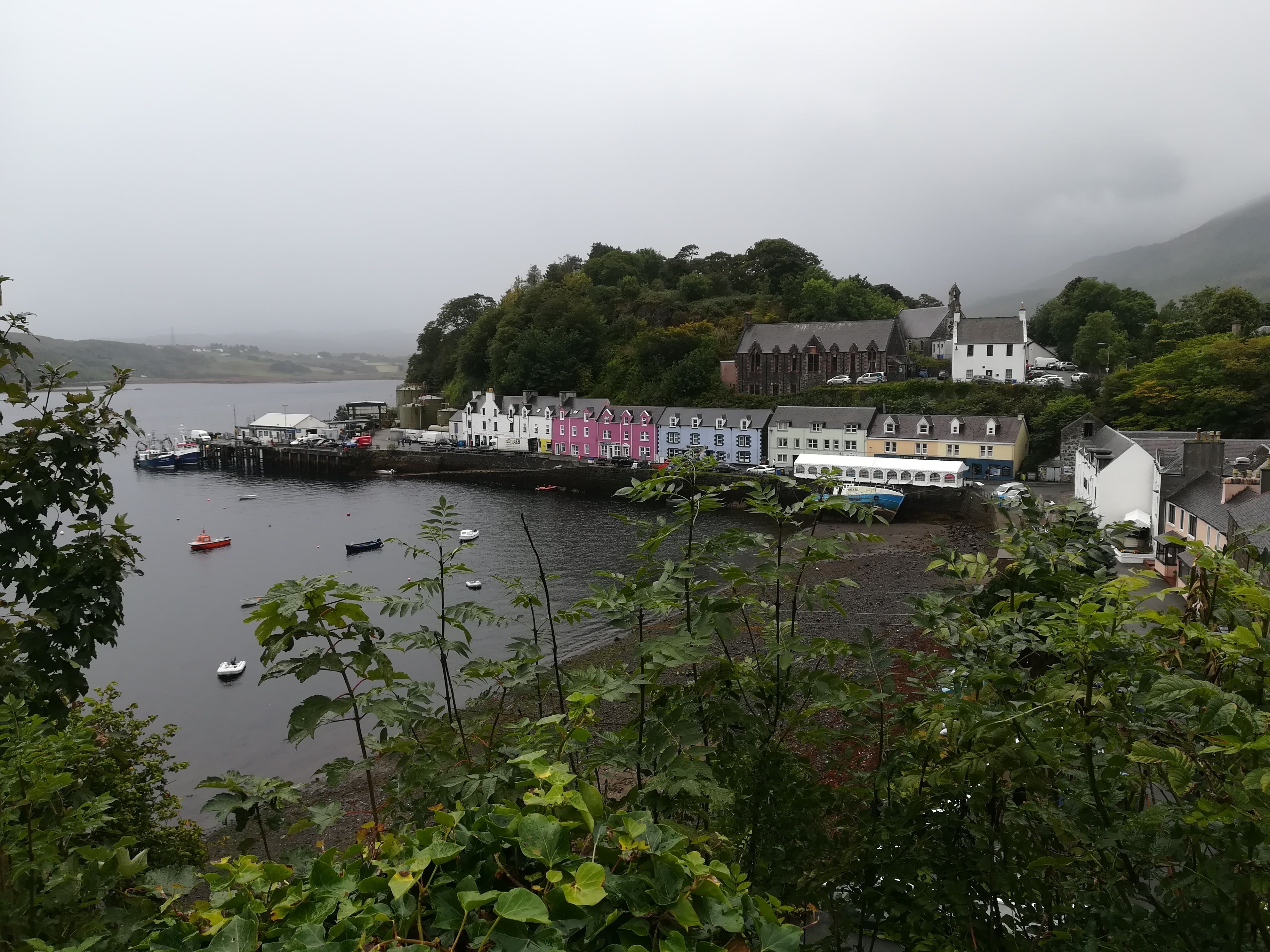
Portree is a pretty seaside town (we missed Charles and Camilla’s visit by a day!) and we enjoyed wasting a few hours in the rain (yes, more rain!) looking in the various shops (Harris Tweed anyone?) as well as replenishing Molly’s food supplies.
Portree
Portalong is at the end of one of the many peninsulas. Single track roads lead to these tiny places where there is always a little car park and a jetty for the fishing boats. We sat watching a seal enjoying the turn of the tide – whilst listening to the rain pitter-pattering on Molly’s roof.
The Coastline near Portalong
One last day on Skye, and the rain held off. An early start gave us an uninterrupted view of the Fairy Falls which tumble down throughout Glen Brittle
Fairy Falls/ The Black Cullin Mountains
Armadale Castle – home to the Macdonald Clan is sadly now a ruin. However, it is surrounded by beautiful gardens and an arboretum full of very impressive trees.
Armadale Castle Ruins/ The surrounding gardens
We begin our journey home tomorrow . . . . . I shall add more to the blog when we go on another interesting holiday!
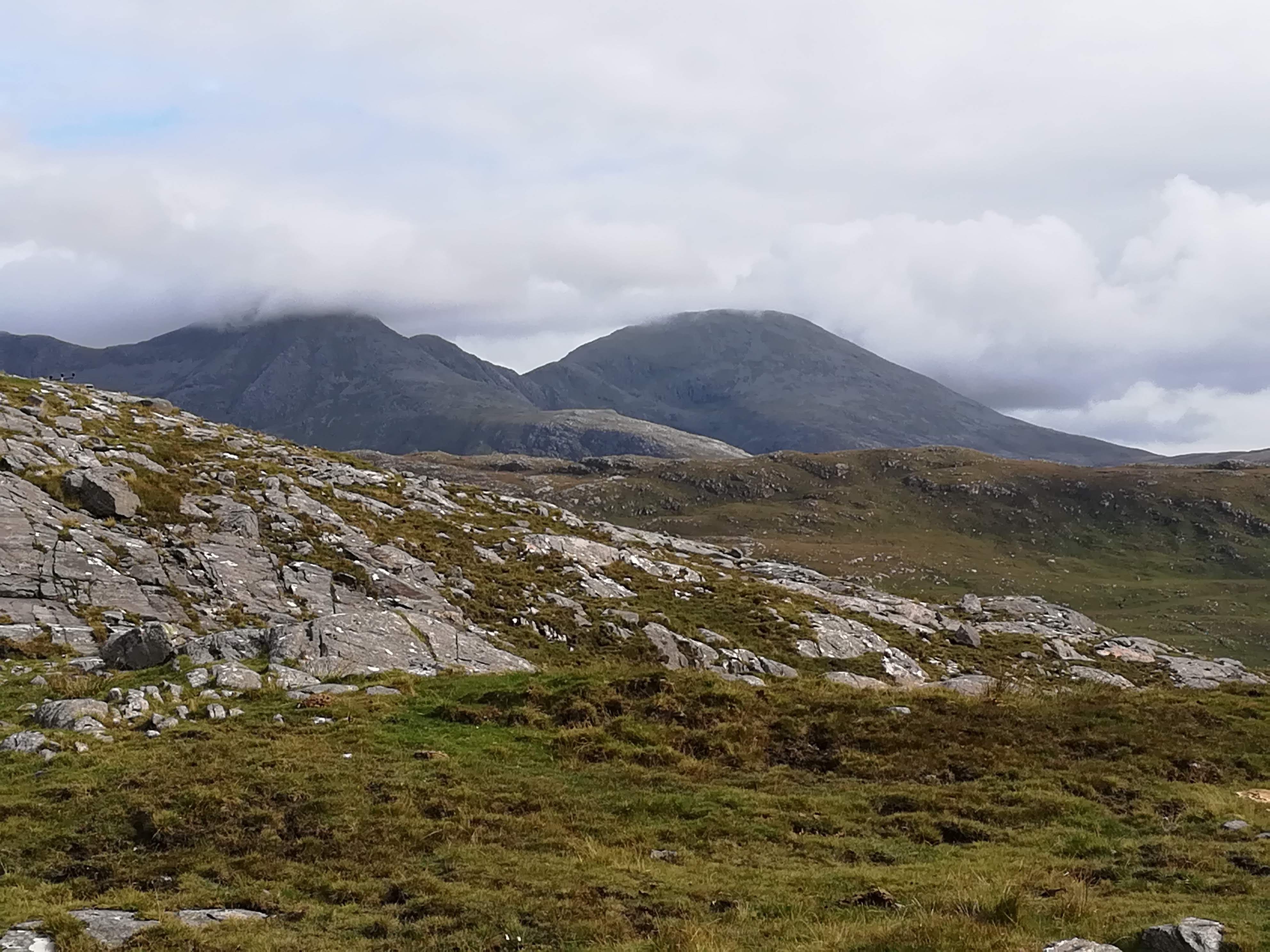
Two days without rain – even a few rays of sunshine – have changed the landscape here beyond belief. Little did we realize how beautiful the mountainous region is – the colours and textures are so vivid – if only I could paint!
Reaching the mountainous area between Lewis and Harris
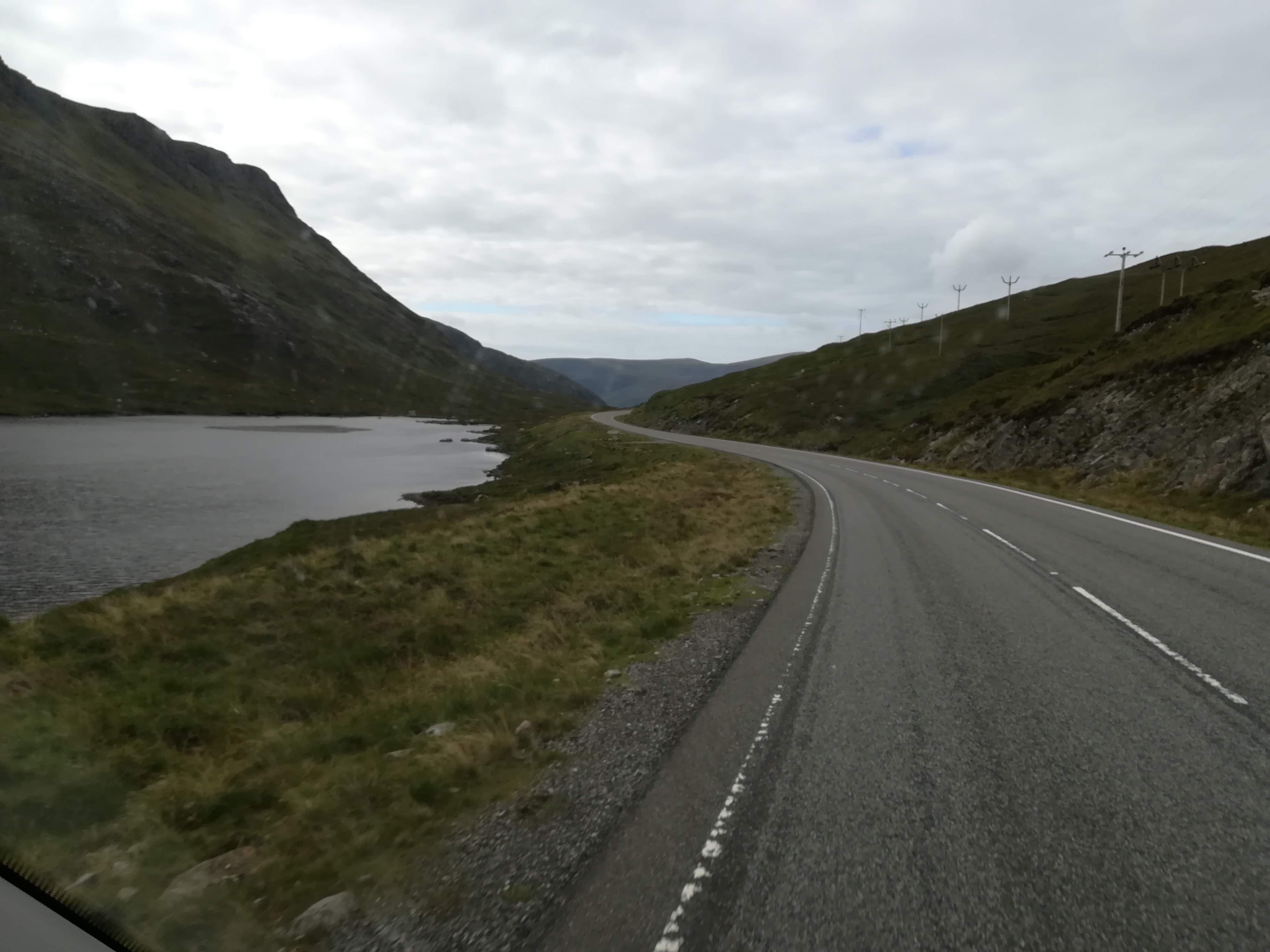
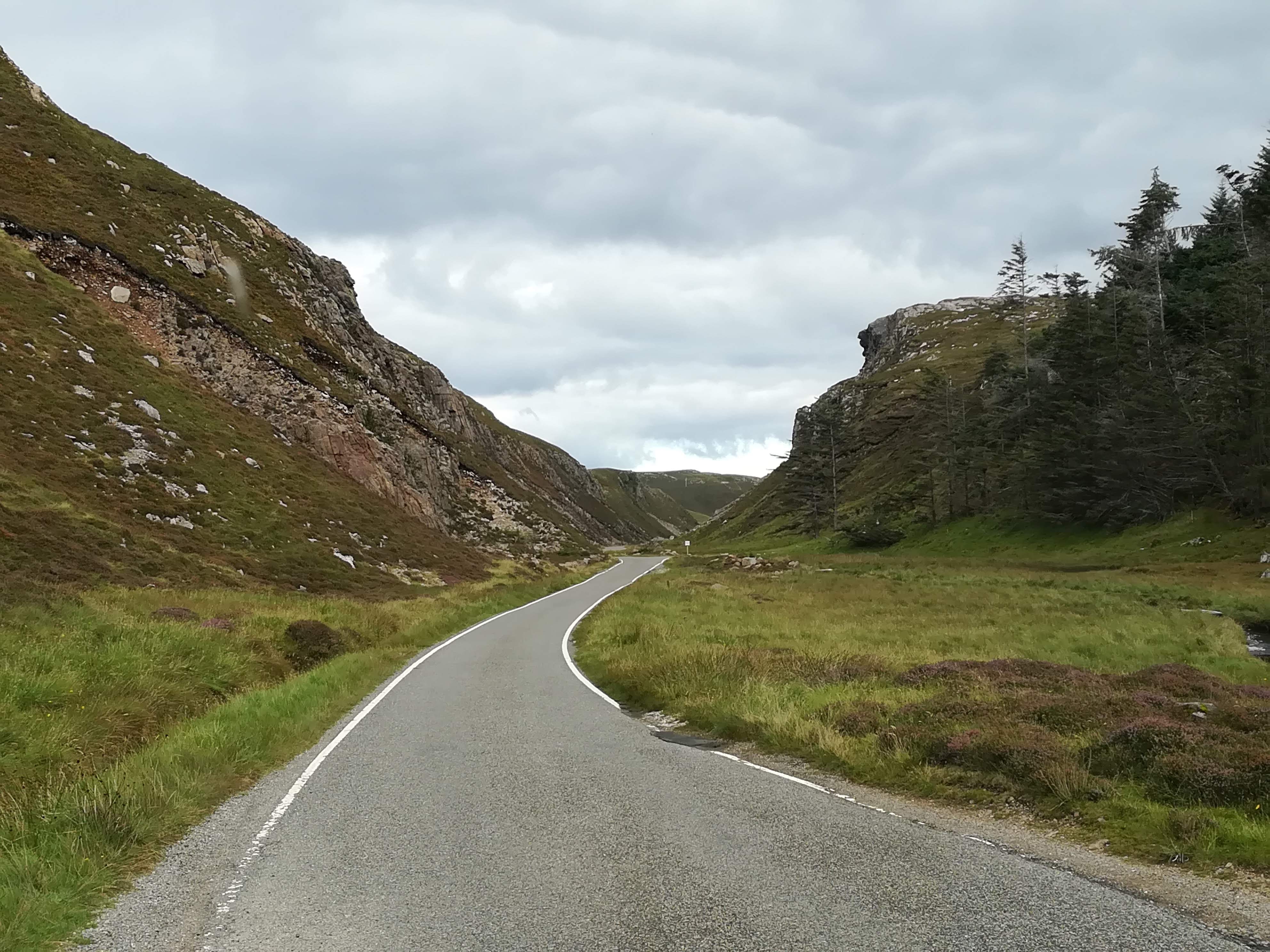
Getting off the main roads is our passion – not that the main roads are particularly busy here. Back roads are much more exciting! They are VERY windy and narrow, with potentially dangerous drops off the pavement into bog or over a cliff! Never ones to be put off , we set ourselves a two-day challenge. The first was to drive Molly westwards to Uig Sands.
Back roads in the Outer Hebrides are narrow – but well surfaced
Coffee break was taken overlooking Loch Suaineabhal, (66.7m) reputed to be the deepest lake in Britain’s offshore islands.
The sun is out over Loch Suanineabhal
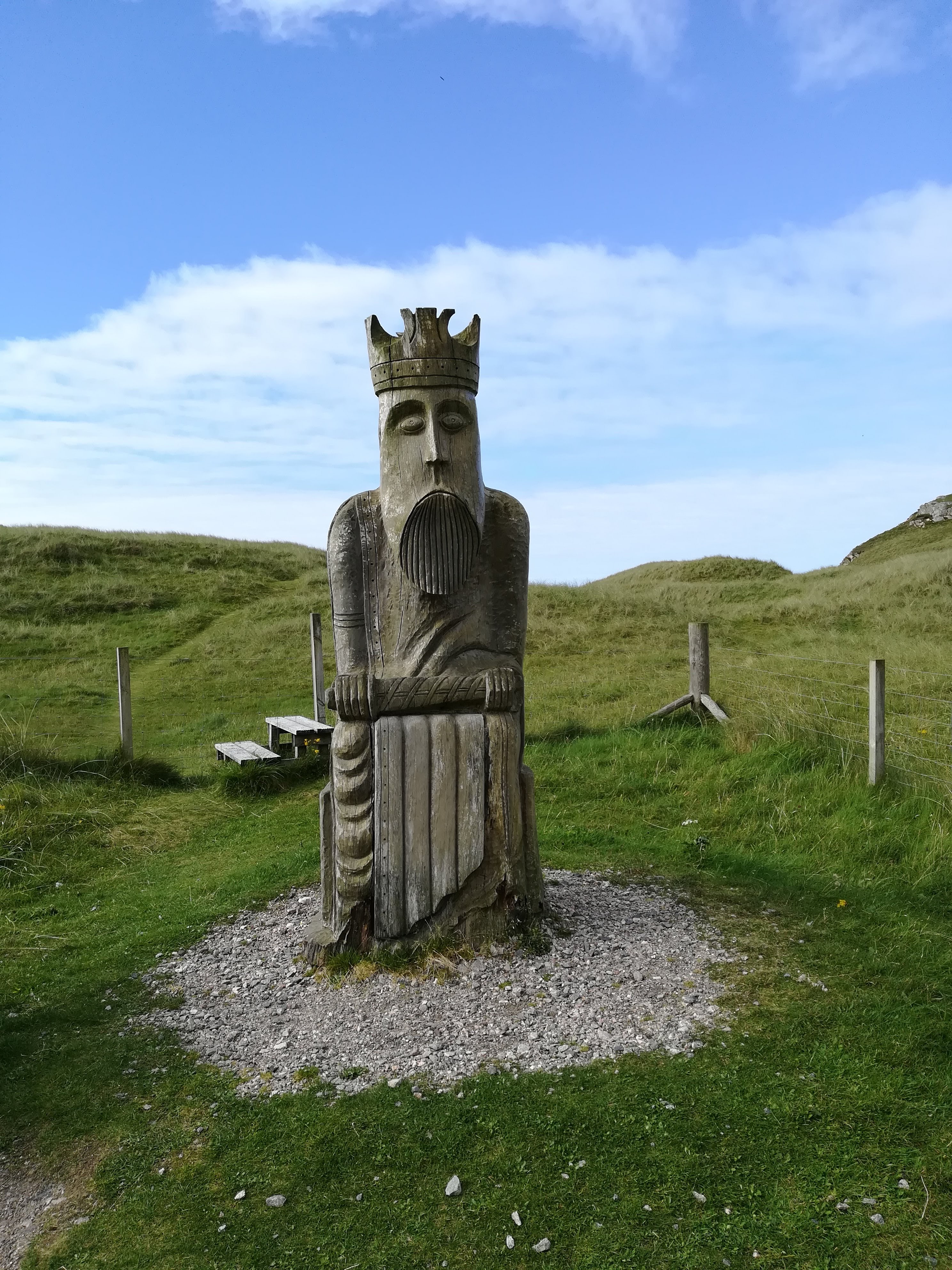
Uig Sands are popular, not least because the Lewis Chessmen are said to have been found here in 1831 amongst the sand dunes. A large wooden statue of the ‘King’ ensures we don’t forget this!
King Chessman – a symbol of the big find!
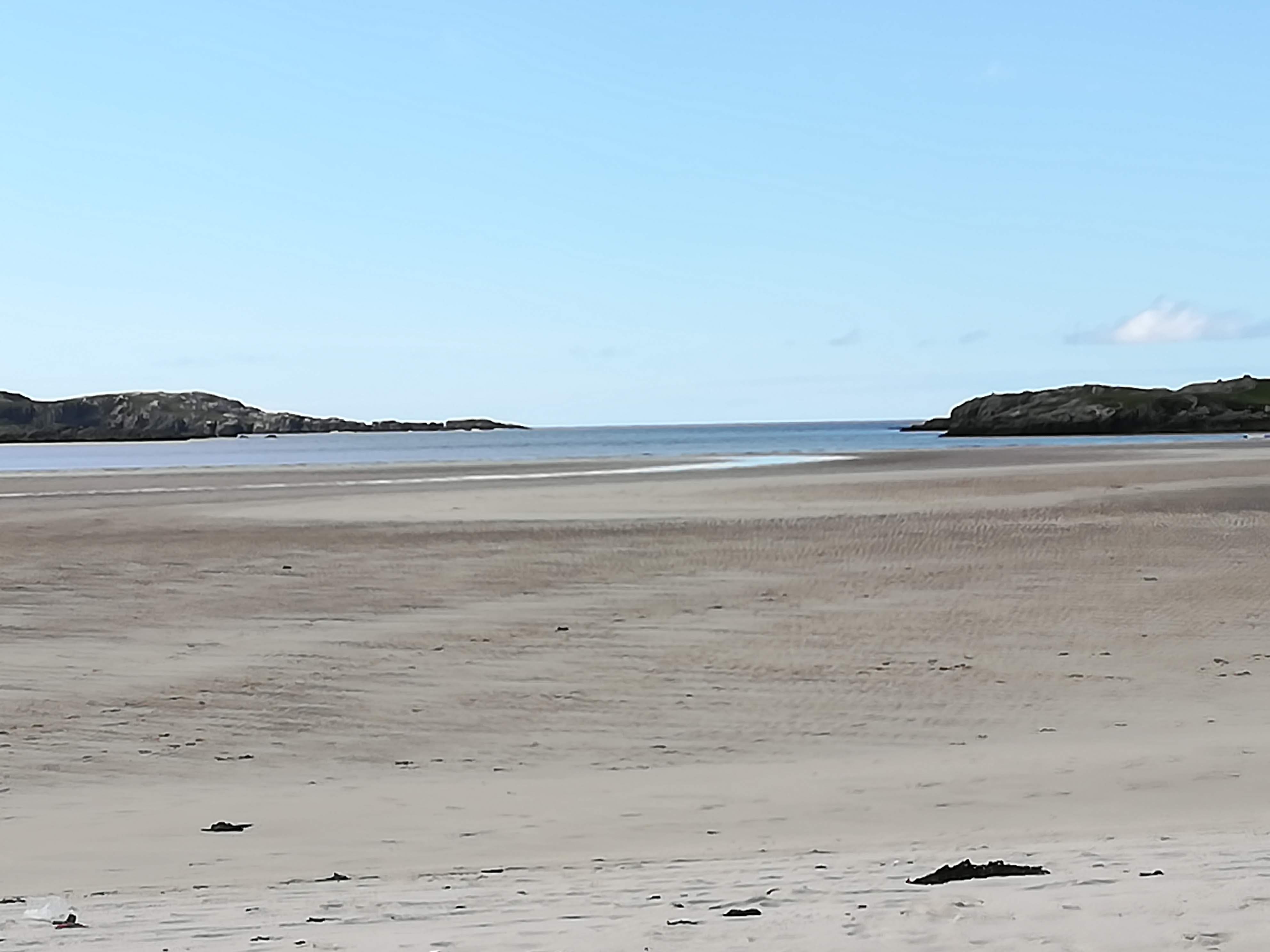
The beach at Uig has an extraordinary tidal range – the distance between low and high tide can be as much as a mile – walking across the sands towards the sea seemed to take forever – but oh, what a joy! Miles and miles of clean white sand!
Uig Sands with the huge tidal range
A quiet spot off the road gave us beautiful views down Loch Rog Beag, where we spent a relaxed night, watching the sea birds as the light dimmed.
Watching the change in light at dusk
Our day two challenge was Huisines – a remote settlement on the west coast of Harris. With only four houses, it is at the end of a 14 mile very narrow single-track road, which twists and rises, in keeping with the contours of the rocky outcrops. Blind summits and tight curves kept us on the edge of our seats – and yes, we shared the driving! But the views were worth it . . . .
Various views from the Huisines road
A brazing walk along the beach was needed to settle the adrenaline rush before we started the journey back.
Huisines Beach
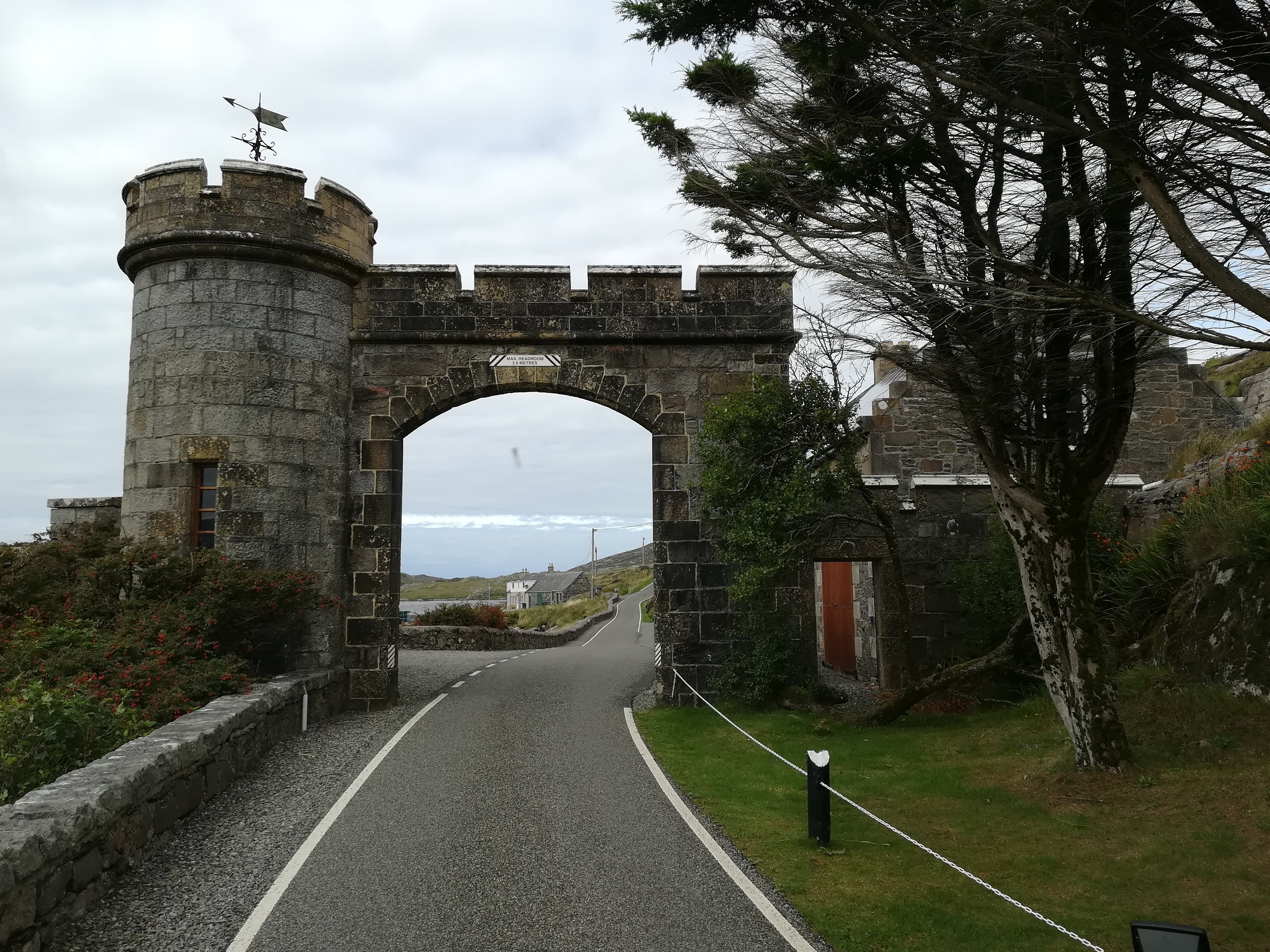
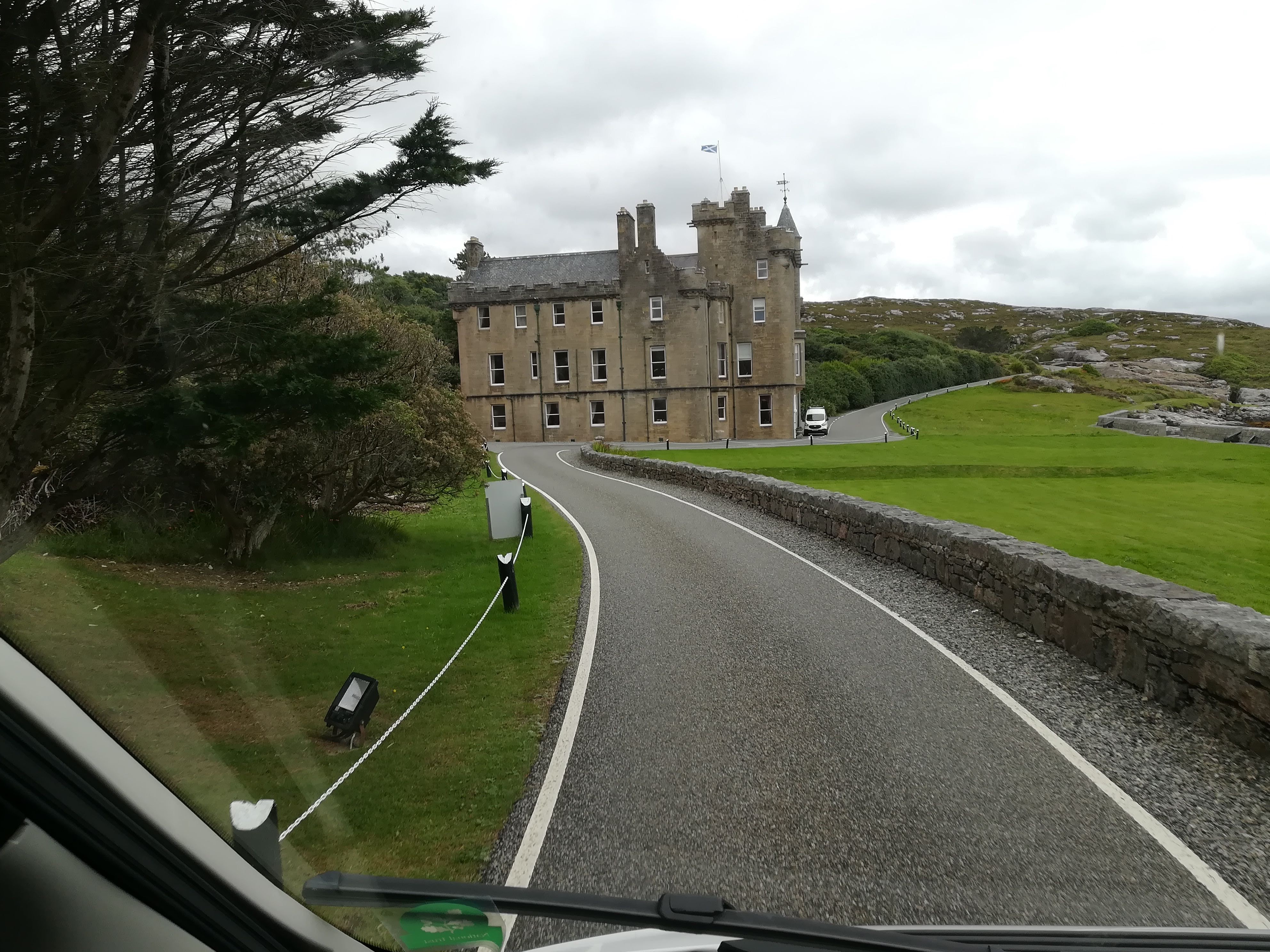
Anhuinnsuidhe Castle
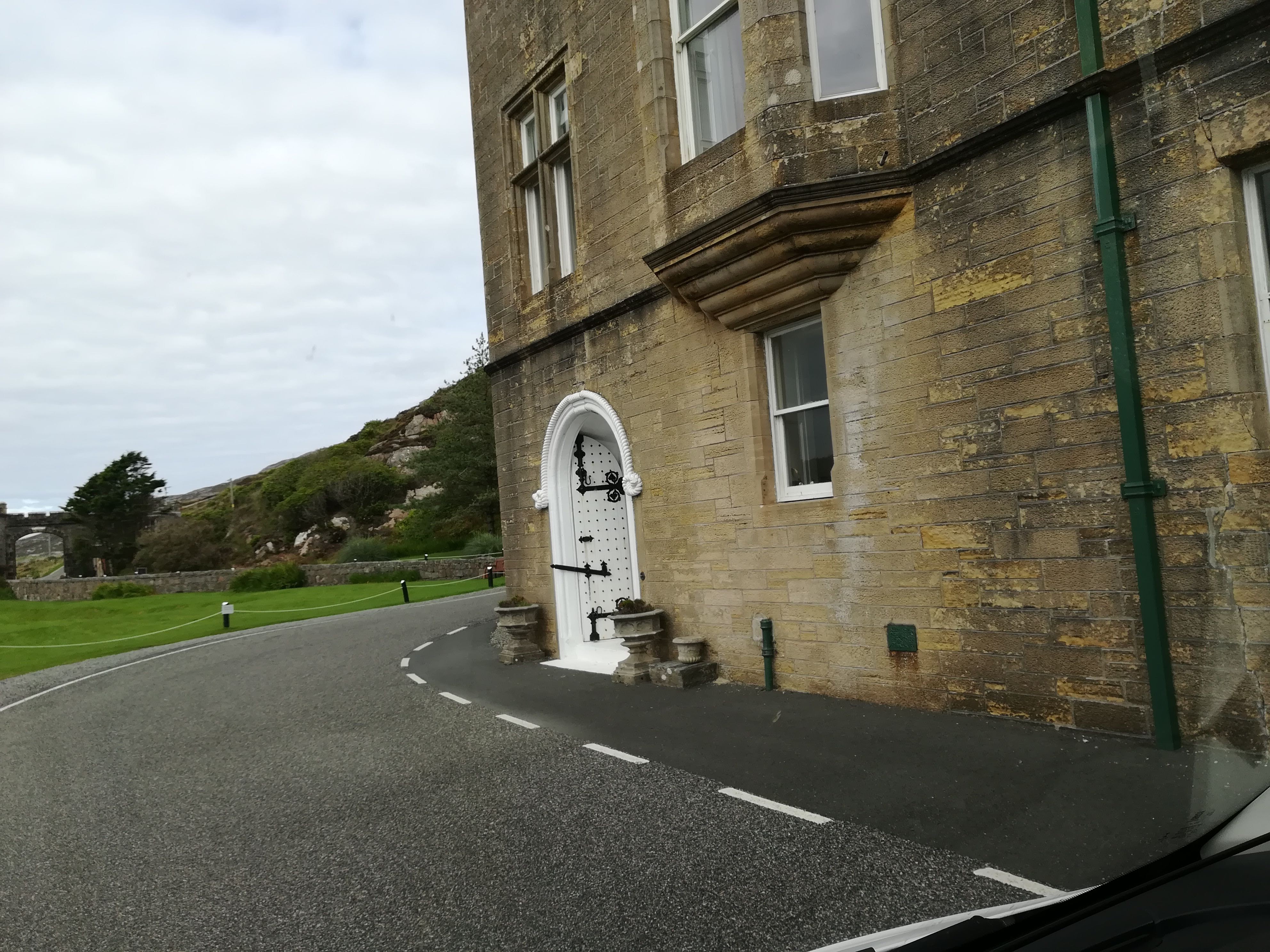
The narrow track to Huisines takes you right past the front door of this castle, built in 1868 by the Earl of Dunmore – we are thankful that the present owners are happy for the road to pass so close to the castle, and through their gardens. Perhaps it is so remote, that the passing of cars (and motorhomes!) reminds them that there is a world out there!
Driving past the front door of the castle!
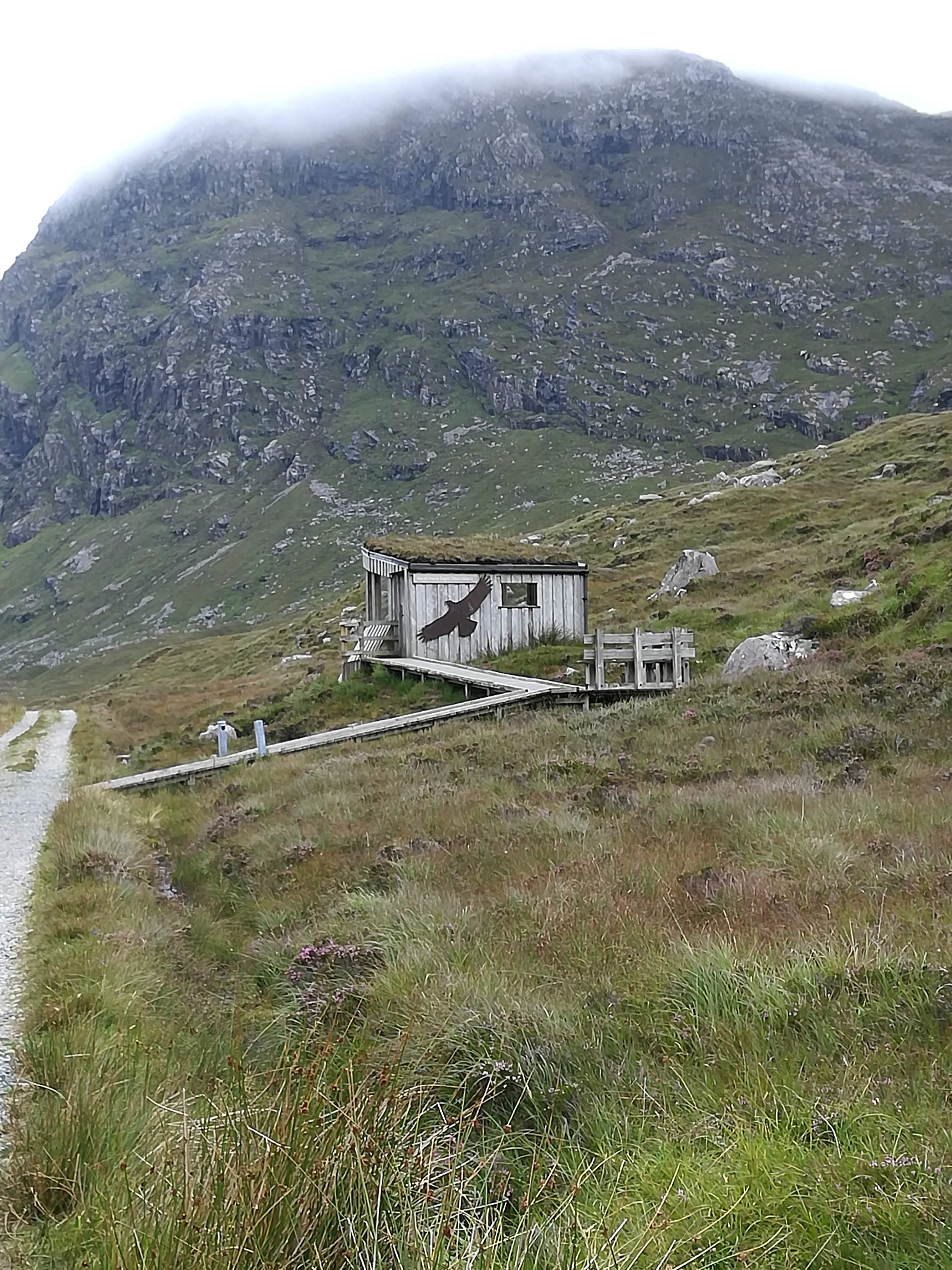
North Harris Eagle Observatory
Given our pathetic record for seeing any wildlife, the Eagle Observatory was like a magnet to us! A 45-minute walk up the valley of the River Mhiabhaig – mostly peat bog on the valley floor, with the mountains rising up on either side. The Reynolds ‘jinx’ took over again . . .. the clouds rolled in over the higher peaks as we approached the ‘observatory’. As you’ll see from the photo, it is a little wooden hide-out – where we sat for some time with our binos – WE DIDN’T SEE ANYTHING! If the eagles were soaring, we couldn’t see them! As we commented on the walk back down the valley, we didn’t even see a rabbit! The valley was silent . . ..
Note cloud on the mountain peaks!
We’ve moved on to Skye today, so I will record a further entry later in the week.
















































 Molly's Folks