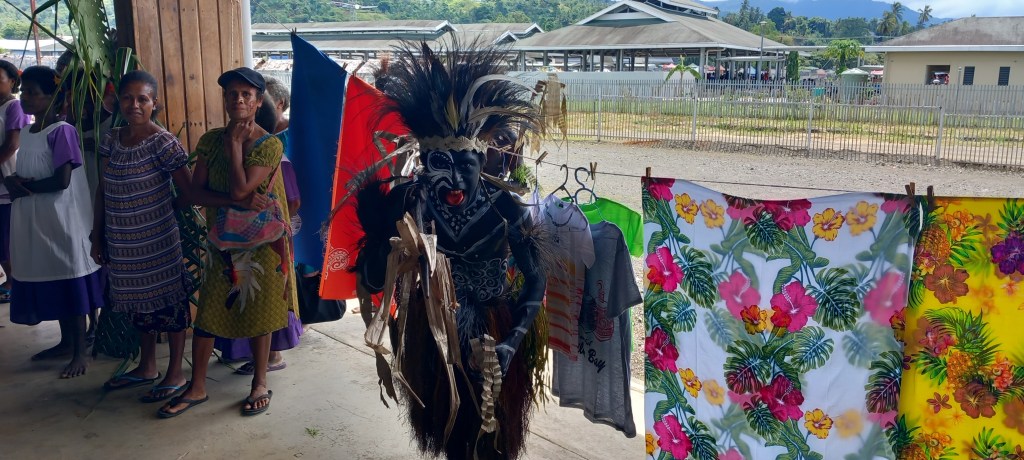
Handsome Helsinki

We arrived in this lovely seaside city after a 30-hour ferry crossing from Travemunde in Northern Germany.  We couldn’t have asked for smoother seas – very little wind and gorgeous sunny skies allowed us to sit/lie out on deck in the sunshine.  The buffet style food was delicious and the beds comfortable – a nice introduction to Finnish culture. 

The Helsinki campsite (Rastila) is a 20 minute ‘Metro’ ride from Helsinki city centre.  We carefully bought a three-day ticket, which allows travel on ANY mode of public transport – Our tickets were never checked.  Locals assured us that they do spot checks from time to time, but rarely during summer holidays! 

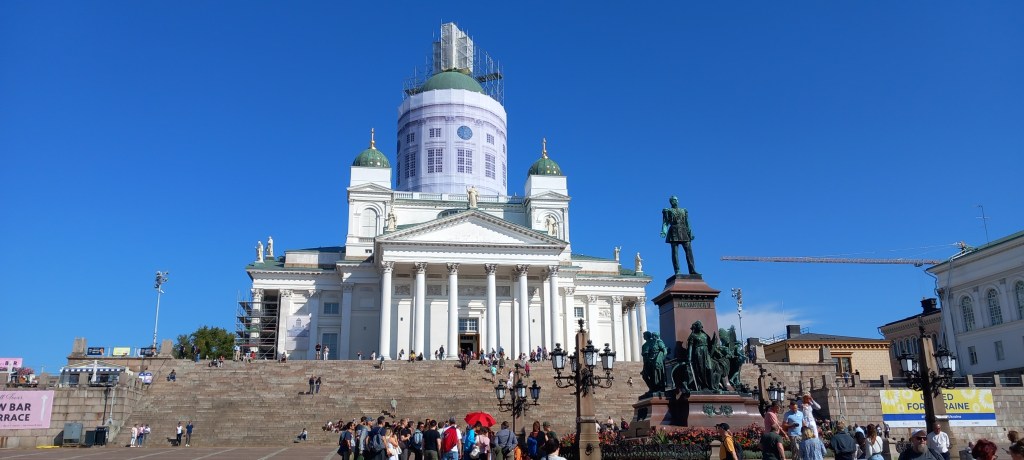
Helsinki boasts a good variety of churches.  The Cathedral dominates the central square – built in 1852 its architecture is very much in the simple Lutheran style.  The outside is being cleaned this summer, so visitors are greeted with the sound of high-pressure machines. 
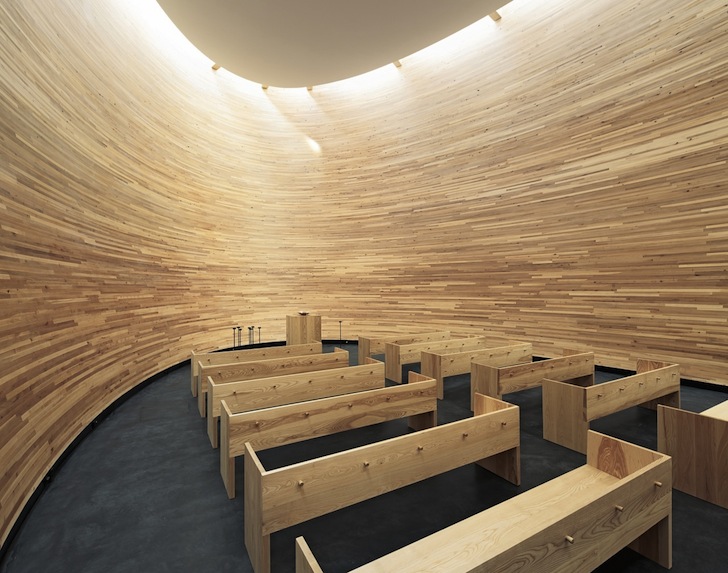
Kampii Chapel was a real treat.  Known as the Chapel of Silence, this gem is very modern, and treated as a place for peace and quiet in the middle of a busy area in the city.  Its unusual conical shape overlooks one of the many city squares.  Three different types of wood were used – the external walls are spruce – the beautiful internal walls are of alder and milled into the curved shape – fittings and doors are made of ash.  The ceiling contains plasterboard which adds to the sound proofing effect – you could have heard a pin drop . . . until the next tourist rustled in! 
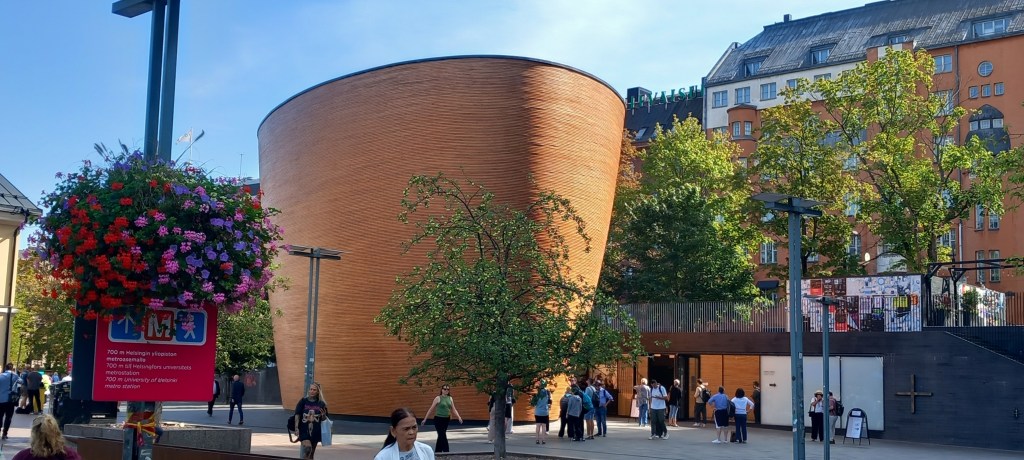
Chapel of Silence
Kampin hiljentymiskappeli – Kamppi chapel of silence in Helsinki, Finland designed by K2S architects.

The Helsinki public move about by tram – tramlines are everywhere and their metallic rumbling sound makes for part of the city experience.    
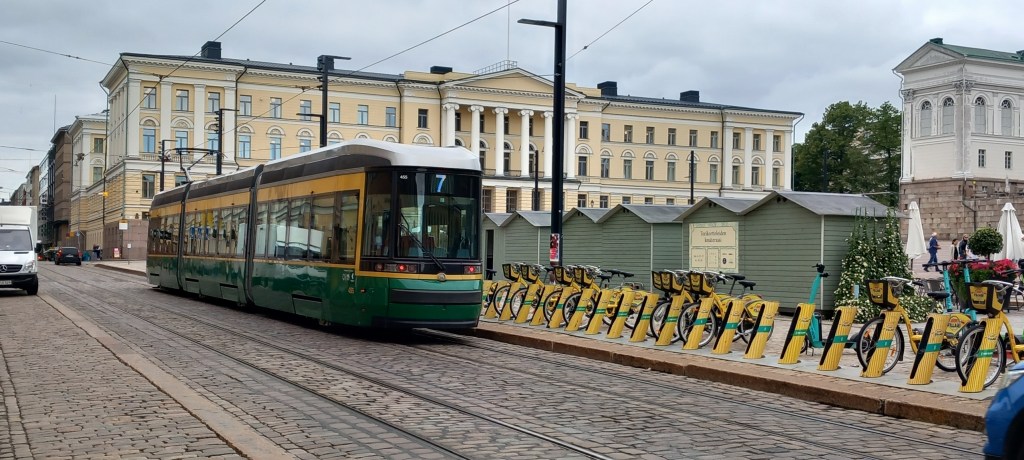
Helsinki Tram

Bicycle is the other mode of transport – one has to be VERY MUCH on the lookout for bikes hurtling past carrying suited gentlemen on their way to work!  There are literally thousands of shops and restaurants and all seemingly doing good business.  The Finns pride themselves on healthy eating – lots of fresh produce – open sandwiches, local cheeses, local fish and the cinnamon buns are to die for!  Wonderful large floral tubs grace every corner.  Finns really enjoy the summer months, as winters are long and very cold.  Every request for help, whether in a shop or the street, has been greeted with a smile and an eagerness to help. 
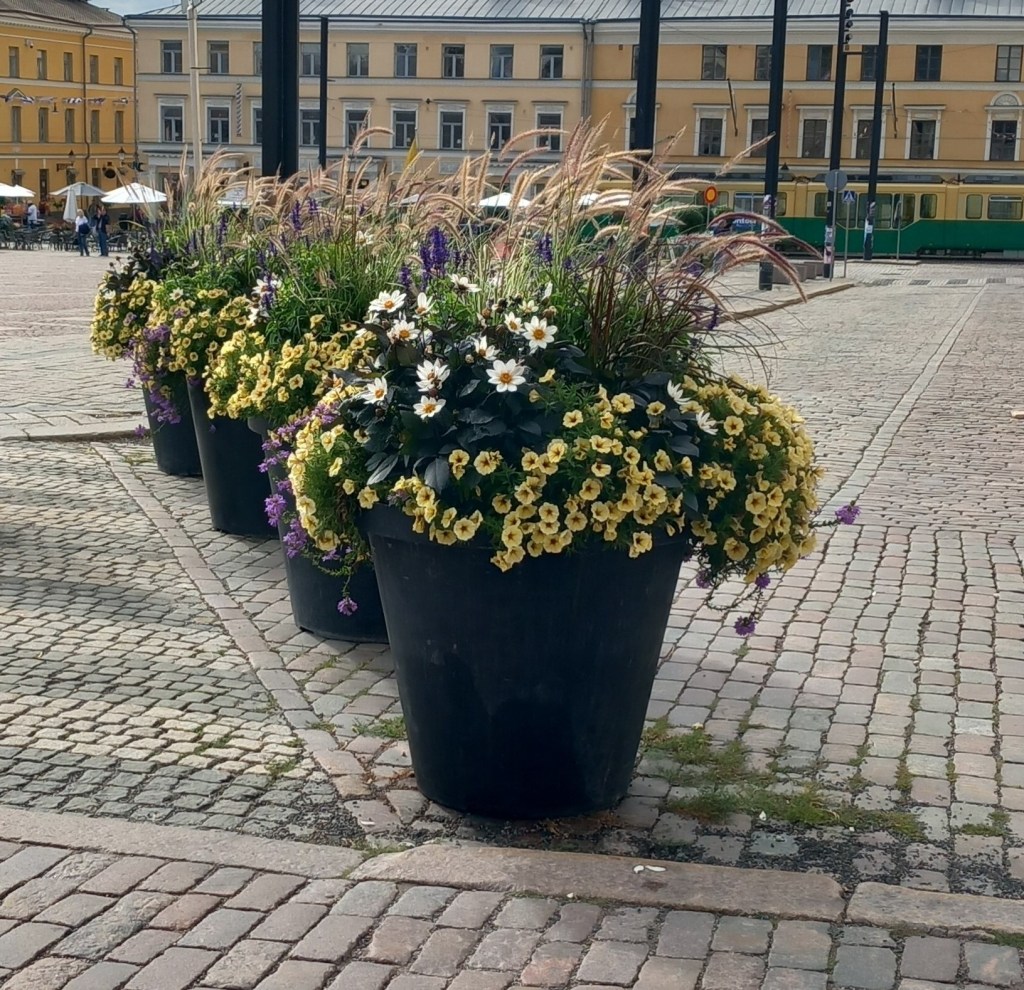
Floral tubs and cobbled streets

Helsinki has 330 islands in its archipelago, making up 130 kilometres of coastline.  Gorgeous weather inspired us to take a 20-minute ferry ride to Suomenlinna Sea Fortress, which was built by the Swedes in the 1740’s, later captured by the Russians, and in 1918 taken over by the Finns. It is now a Unesco World Heritage Site.  Old military barracks, gun powder stores and cannons are dotted amongst the rocky outcrops that make up the island.  Some 800 residents live here throughout the year – their houses cleverly hidden from the marauding tourists.  Miles of pleasant paths, and lots of good sunbathing areas make this a popular place for both locals and we tourists who fancied getting out of the city buzz for a while.
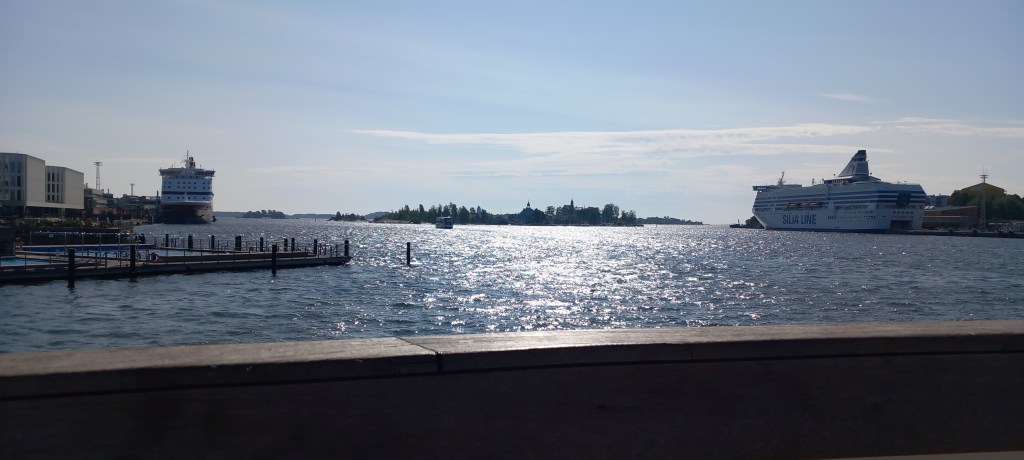
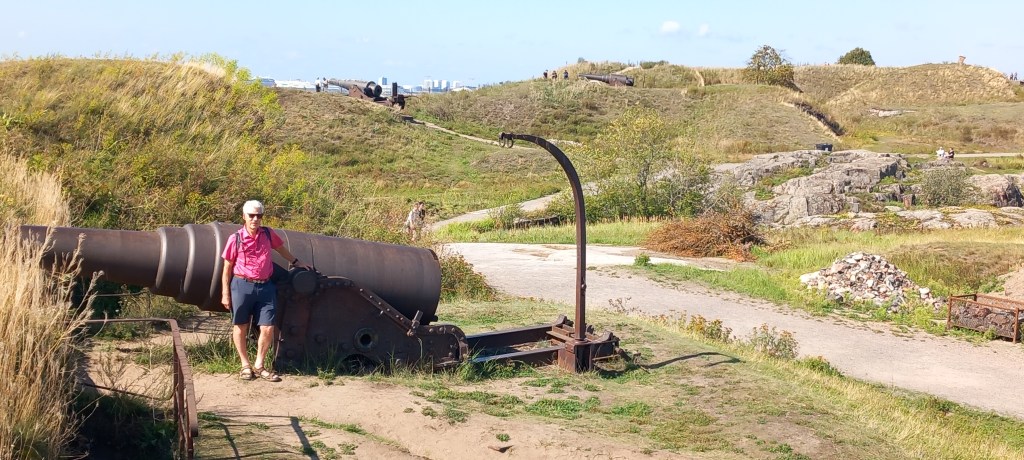
Ferry journey to fortress
Peter enjoying his military history

Uspenski Cathedral is the largest Orthodox Church in both Northern and Western Europe.  After the simplicity of the Lutheran churches,  the extensive décor of Uspenski is almost overwhelming.  Consecrated in 1868, it is built on a hill, overlooking the harbour – its golden cupolas are symbolic of the Russian impact on Finnish History. 
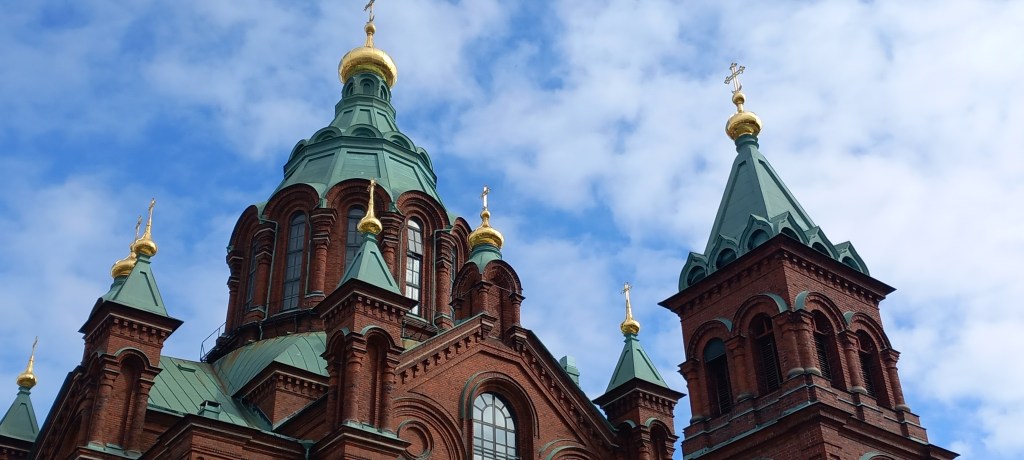
Uspenski Orthodox Cathedral

We could not visit Helsinki without seeing the Sibelius Monument – set in one of the many beautiful parks, the monument consists of some 600 hollow steel pipes welded together in a wave-like pattern – apparently the sculptor’s aim was to capture the essence of Sibelius’ music.  I’ll let you decide what you think . . . . . . .
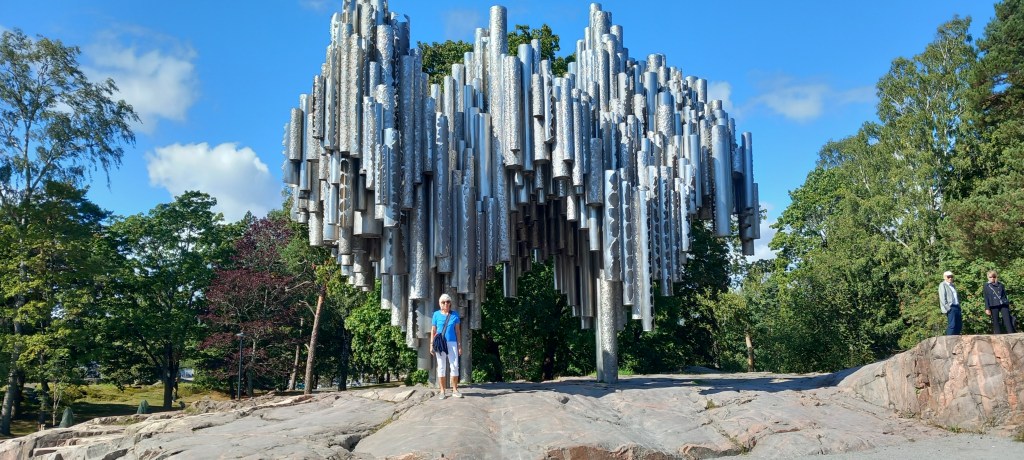
Sibelius Monument

One last church  (this really is the city of churches!) that we wanted to visit is known as the Church of the Rock – and with good reason.  It was excavated and quite literally built into the rock.  Natural surrounding rocks were used to extend the height of the walls, huge skylights atop the walls and a copper plate covered dome makes up the roof.  The internal ceiling is finished with 22 kilometres of copper thread.  The acoustics are marvellous – no microphones necessary!
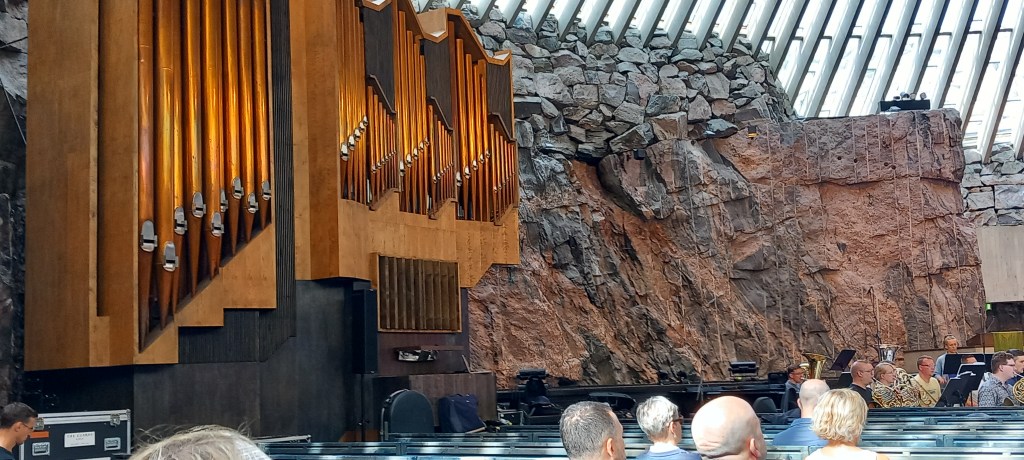
Church of the Rock

All in all, a great city to explore. It would be fun to visit again in the winter, to experience the chilly climate and see the harbour frozen over.

A quick admin message to you all – I know some of you struggle to see the photos. I’m assured that you need to look at the blog on your computer to see the photos at their best – a quick glance at the blog on your phone will not highlight the photos.

We’re heading north-east tomorrow – more anon.
Touring Scandinavia

August 2024

Hello dear followers!

Yes, Peter and Marilyn are off on another adventure!  We plan to explore Finland and Sweden over the next seven weeks.  Molly (our MOHO) is loaded to the gills with four seasons worth of clothes – it may be chilly when we get north of the Arctic Circle! 

We relaxed on the overnight ferry from Harwich to Hook of Holland – it was our lucky day (?night) as we were almost the last to board, but that meant we were third to disembark, and there was a passport control man waiting for us!  .  Brexit rules dictate that we should not bring any meat products, dairy products or plant products into Europe.  Absolutely NO MENTION OR CHECKS of what we had onboard! We would recommend this ferry link – you arrive at 8am, the local supermarkets are already open, you can stock up with delicious Dutch food, and set off on your adventure. 

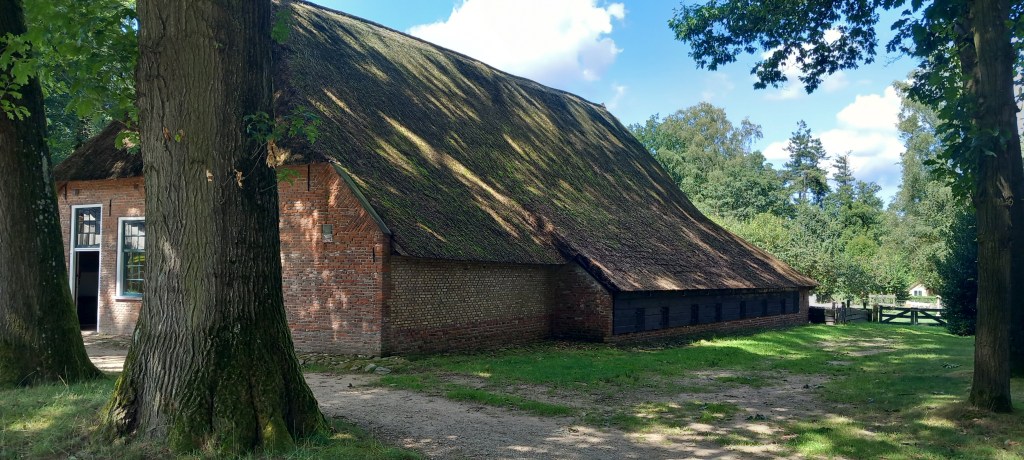
We had forgotten how much we like The Netherlands  – everywhere – even the industrial estates! – are clean, tidy and beautifully kept.  The roads are good, the traffic (even on a Saturday in high season!) is not heavy, in contrast to the dreadful traffic we had in UK yesterday!  There are frequent service areas on all main roads – clean and well laid out with plenty of parking.  Because there are so many, they don’t seem to get overcrowded.  The open countryside is lush and green with huge dairy herds on every farm.  Beautiful weather has added to our enjoyable journey today – we’ve travelled past Rotterdam to Arnhem, where we stopped to visit a very good Open Air Museum. 

We then turned north past Zwolle and Emmen and have stopped for the night at a favourite campsite (used twice in the past) in Bourtang on the Dutch/German border. 

We continue across Northern Germany tomorrow, to catch a ferry from Travemunde to Helsinki.  Lots more to come  – good to have you back with us.

Last Leg – Homeward Bound

Tenerife, Canary Islands

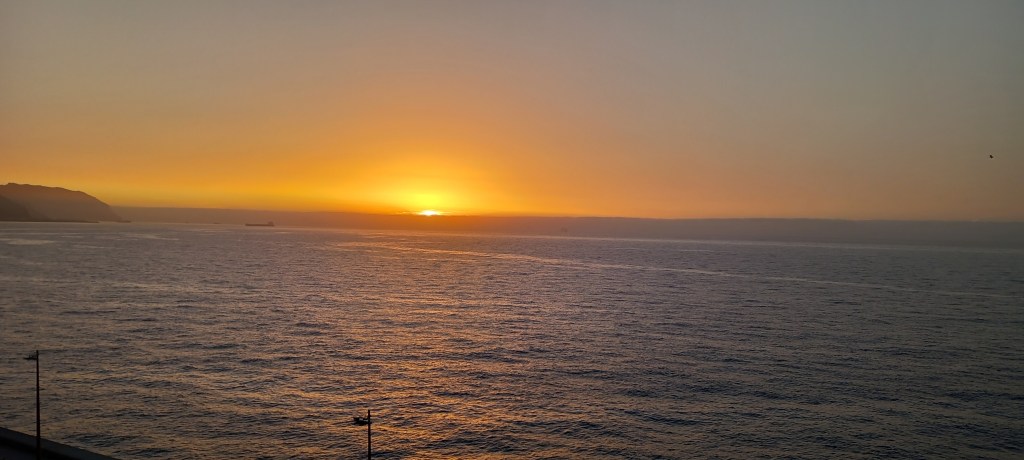
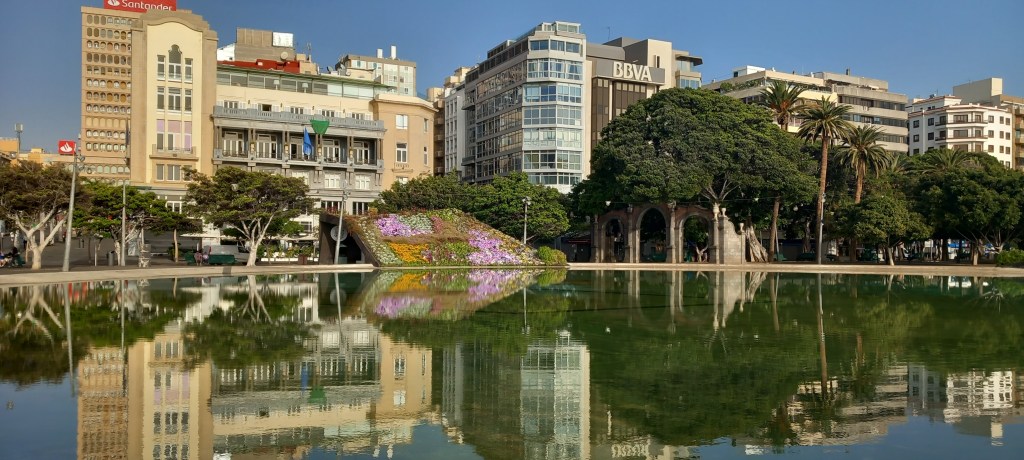
After leaving Cape Verde, a further three days at sea brought us to Tenerife in the Canary Islands.  We chose to wonder the streets and enjoy the pavement cafes.  Santa Cruz comes alive on a sunny Saturday morning.  We were transported back to our eight happy years living in Spain  – good weather and happy people, along with parks and flower troughs full of colour. 

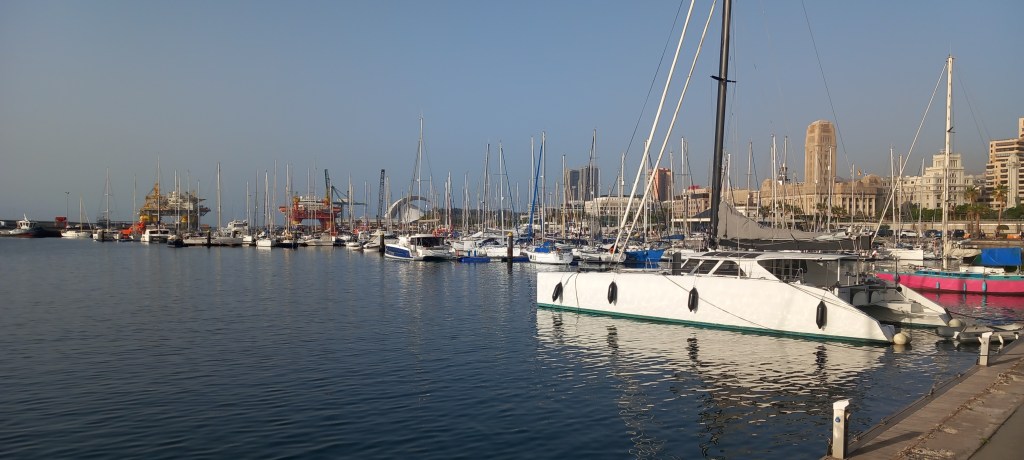
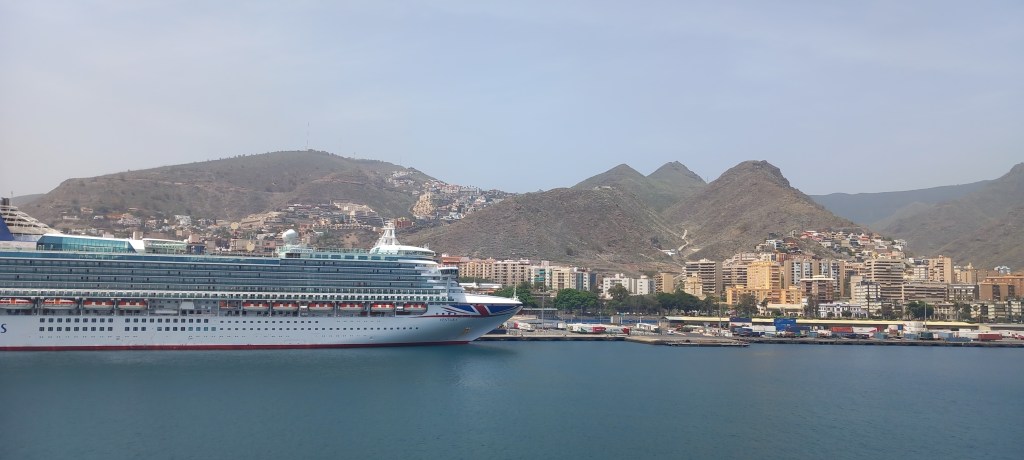
We were one of FIVE cruise ships berthed along the jetty.  A pleasant kilometre’s walk along the ‘blue line’ led us into the centre of town. 

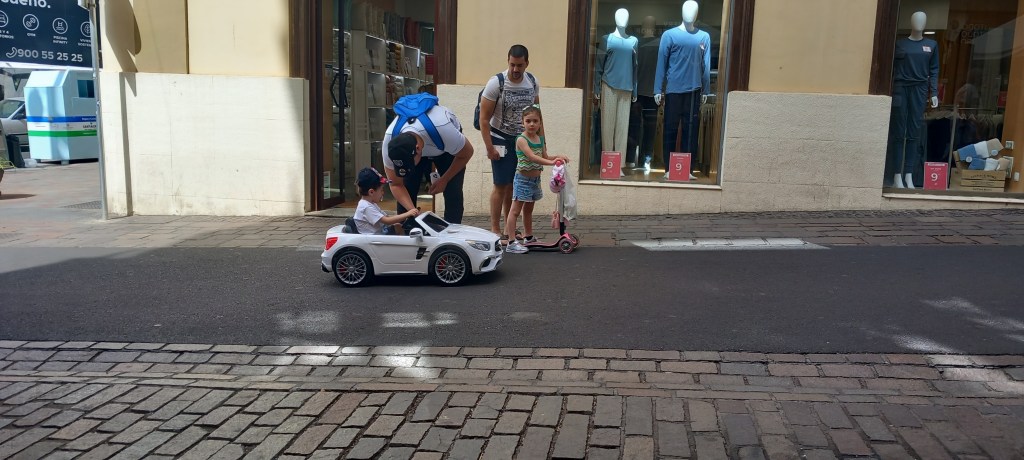
Family life is paramount to the Spanish.  We saw a wonderful example of this when a tiny battery driven car, ably manoeuvred by a little three-year-old, (complete with his car radio blaring!!), drove past us, along with proud father, uncle and sister! 

Our six hour stop over came to an end with Borealis doing a spectacular 360 degree turn within her own length, before we set sail.  Our bows swung very close to another British ship – the Ventura – but without incident, happily confirmed with an exchange of BIG white hand waving and ship’s hoots! 

Homeward Bound:

And so, this wonderful voyage draws to a close – we’re just entering the ‘rock and roll waters’ around Cape Finisterre and we’ve been warned of a bumpy night in bed tonight as we enter the Bay of Biscay.  All this of course, is now ‘old hat’ – we’ve had plenty of time to find our sea legs!  Lots of happy memories to store away, or regale you with for many months to come  – we’ll try not to bore you to death! 

My personal highlight would have to be Snorkelling on the Great Barrier Reef  – a dream come true.  A close second would be our three day safari from the luxury Biyela Lodge where we were ‘up close and personal’ with Africa’s wild animals.  We felt honoured to be amongst them.  The journey has made us even more determined to preserve this wonderful planet for our grandchildren, and many generations to come. 

Thanks for joining me, and for all the lovely comments.  I hope to be with you again in late August, when we plan to take Molly (our motorhome) through Finland and Sweden.  

Cracking Cape Verde

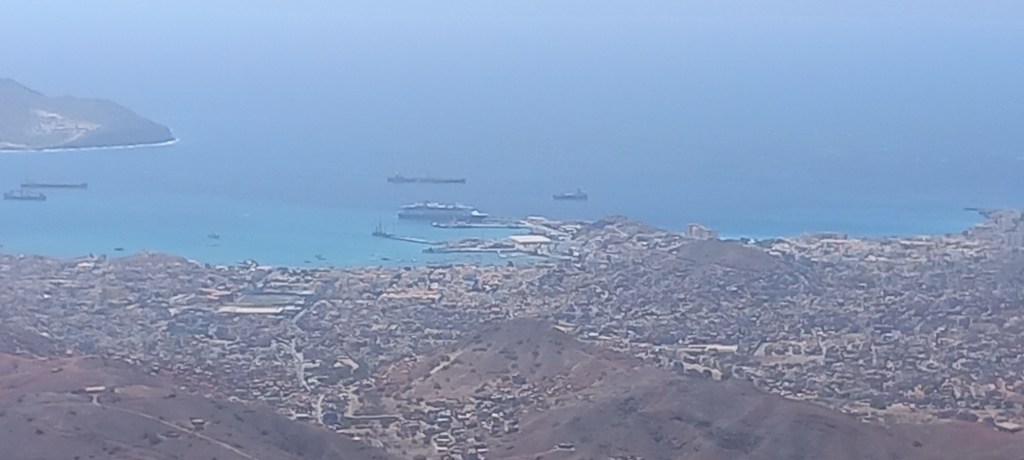
The Cape Verde Islands are an archipelago of ten islands lying in the Atlantic Ocean, 570 miles off the coast of West Africa.  Borealis berthed at the Island of Saint Vincent in the northern port of Mindelo.  St Vincent is one of the driest islands receiving less than five inches of rain per year – and all of that during a short period of three months.  92% of the islands population of 80,000 people live in the town of Mindelo. 

A guided tour of the Island’s highlights gave us a good insight into the history and culture of the area.  Founded by the Portuguese in 1462 and later in 1838 used as a coal depot by the British to supply their ships on the Atlantic routes, the islands boast a mixture of influences – Portuguese, Brazilian, English, African and Spanish being the main ones. 

Water on this small island of only 87.5 square miles area, is produced through desalination units.  Many houses are only half built – the families live on the lower floors until they can afford to pay the higher taxes charged for more area of living space.

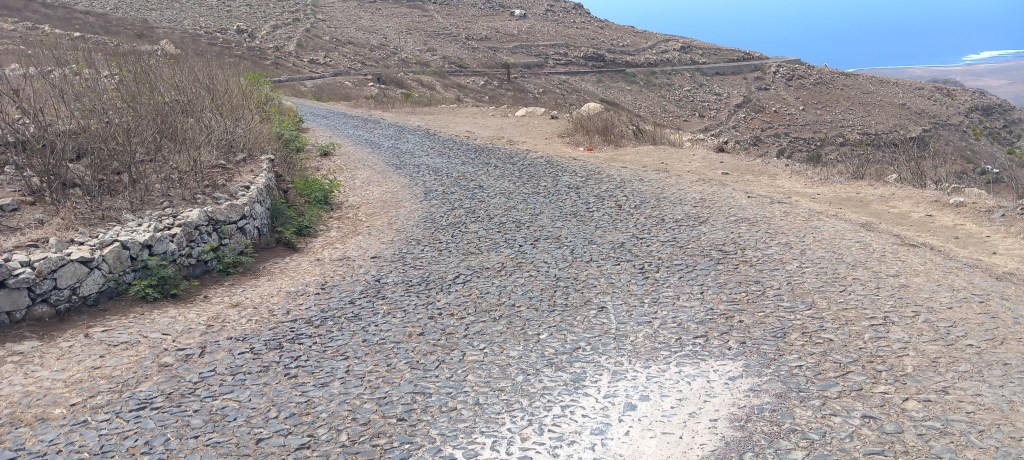
The main road surfaces are very good (no frost to ruin them!).  The road to the top of Mount Verde (744m) was very impressive – strongly built, well maintained and topped with slates.  Built by locals over a number of years, it now provides stunning views for we tourists!

Catfish Bay, a holiday area for the locals, provided a stopping place on our tour, where we were given local food and drinks and treated to some local music and dancing – some passengers were invited to dance!!

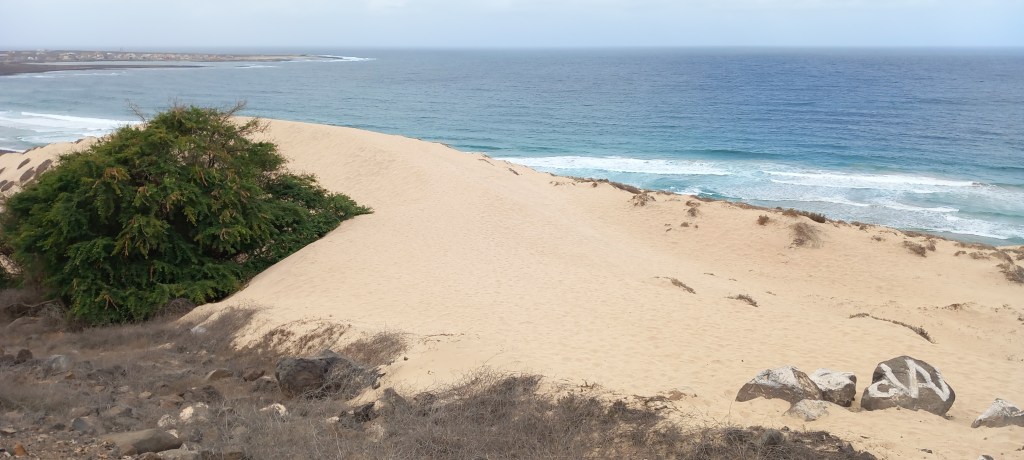
The coastline near Catfish Bay afforded us a good view of huge sand dunes created purely from sand blown in by the continual cyclonic winds from the Sahara Desert – which then settles along with the black volcanic lava sand. 

Mindelo itself had several pretty little squares with brightly coloured buildings, and a plethora of street markets. 

The gorgeous white sandy beach right next to the port was too good to miss.  We enjoyed a walk in the evening sunshine to a friendly café where we watched the sunset, before beating it back to the ship ready to sail after a short ten hour visit to a ‘cracking’ place!

Only one stop left before we reach Southampton  – where have those three months gone?

Cape Town & Namibia

Cape Town:  A two-hour flight from Durban to Cape Town, enabled us to rejoin the ship late on day one of a two day visit.  One day was not enough  to explore such a beautiful city – however, a hop-on/hop-off bus tour gave us a good feel.  Sadly, the cloud was down over Table Mountain so our views over the city were from lower down. 

As in most big cities, great areas of poor housing were a massive contrast to the wealthy areas.  Camp Bay is not only a select place to live, but enjoys white sandy beaches, up market restaurants and (so we were told) a hide-away for celebrities! 

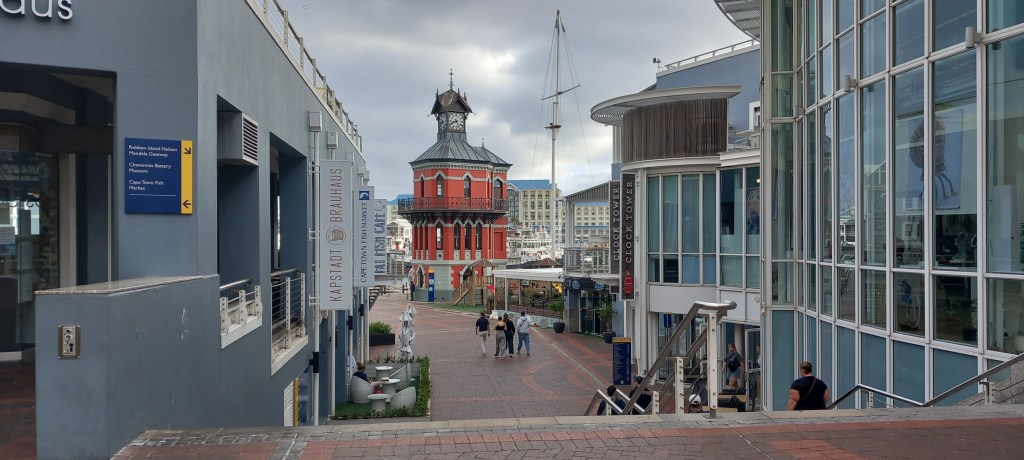
Borealis berthed near the Waterfront, which is a maze of shops and cafes which proved (on Easter Sunday) to be a magnet for locals to take their families for a day out.  This is certainly a city to be revisited and explored in more depth. 

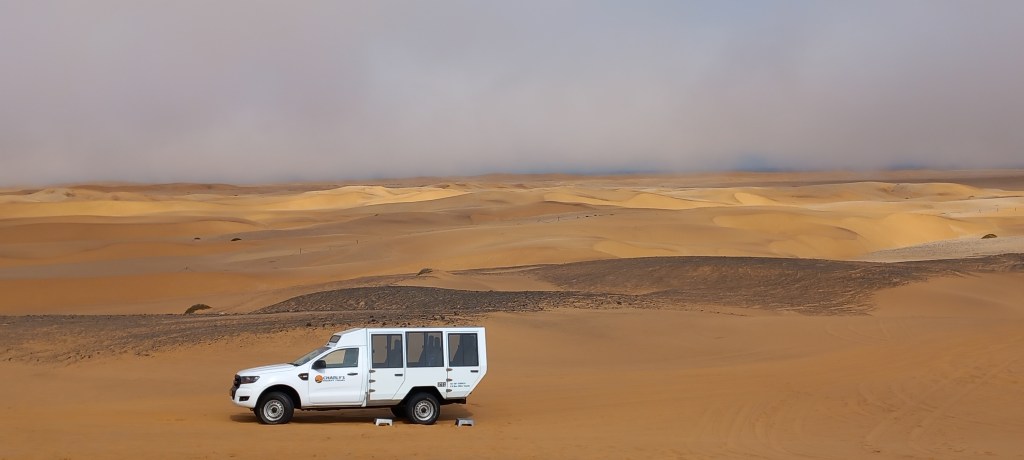
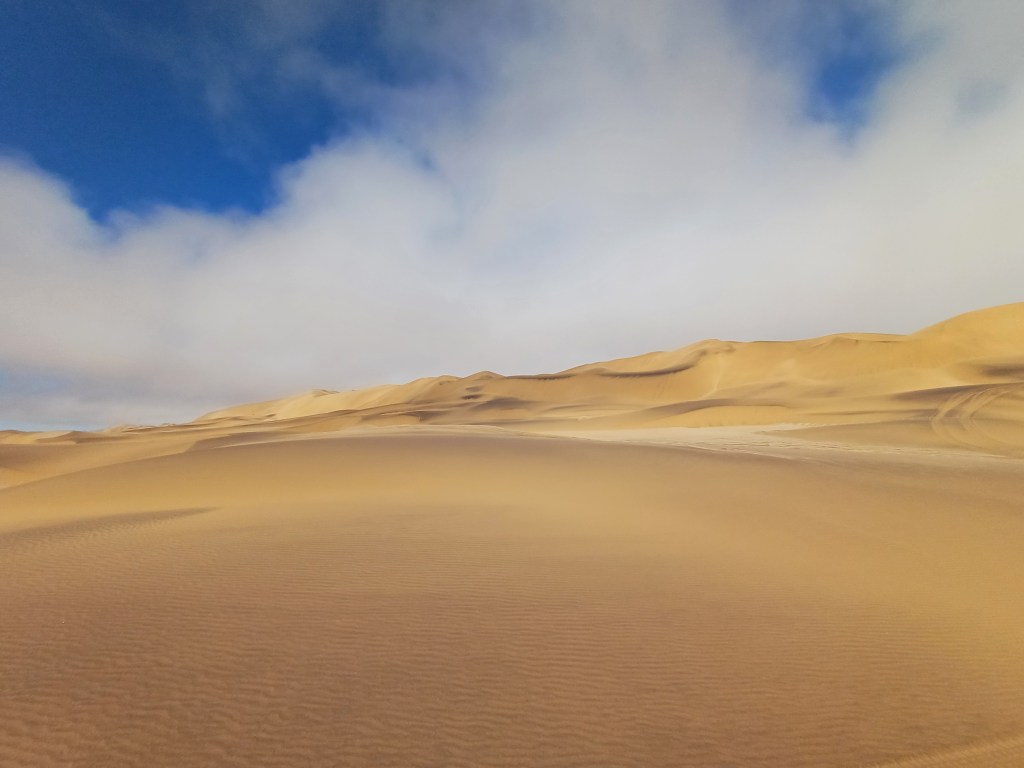
Walvis Bay, Namibia:  The Namib Desert covers an area of 13,000 square miles along the coastline, and for 140 miles inland, in Namibia.  It is the oldest desert on the planet and receives less than two inches of rain per year.  The Benguela Current runs along the coast.  The meeting of this cold current with warmer tropical waters means that coastal fog is a daily occurrence.  However, the fog has become the lifeblood of the desert, as it provides sufficient moisture for small mounds of greenery to form, which in turn gives various small creatures water and a place to hide. 

With their ingenuity, our guides could recognize any signs in the sand of something buried, then carefully dig with their hands to unearth several creatures who have adapted to life in the desert. 

Tyres on the 4 x 4 vehicles were lowered to maintain a better grip, before we delighted in a hair-raising ride up, down and around the dunes!

Iron deposits are spread on the wind, giving a black hue to the dunes.  This is eventually oxidized turning the sand to a red, terracotta-type colour.  Another ‘pinch-me’ moment, when I realized that I was in the middle of the oldest desert in the world, and in the middle of Africa!

Mining provides income for the country – uranium, diamonds, gold and other minerals are exported via the enormous deep-water harbour in Walvis Bay. 

I must mention here the very friendly and highly accommodating immigration officials in Namibia.  The whole process (we had to be ‘stamped in’ and ‘stamped out’ again) took place onboard – the officials were all very welcoming and full of smiles – making the procedure the quickest and most pleasant that we’ve encountered throughout the entire voyage.  Well done, Namibia!    

Splendid South Africa

The winds turned against us again between Mauritius and Durban – two days of very rough seas in a Force 8 gale, had everyone rock and rolling about the ship!

Getting to Zululand: We were very excited to arrive in Durban and join sixteen other passengers for a four-day trip to a Game Reserve.  We saw very little of Durban on our way out of the city, though the enormous football stadium built for the World Cup in 2010 stood out above the tree line.

 A four-hour drive took us up the east coast of South Africa to Richards Bay, where we turned inland through the area known as Zululand.  Plantations of eucalyptus, sugar cane and macadamia nuts were slowly replaced with rolling hills of savannah.   Zulu homesteads known as ‘kraal’ were tradionally a group of beehive shaped houses built around a cattle enclosure.  The round houses were cost effective and comfortable.  Most importantly, they were resistant to strong winds.  Zulu beliefs are formed around ancestral spirits.  Modern houses still have at least one beehive shaped house nearby. To this day, the round houses are the site for ritual worship of the ancestors. 

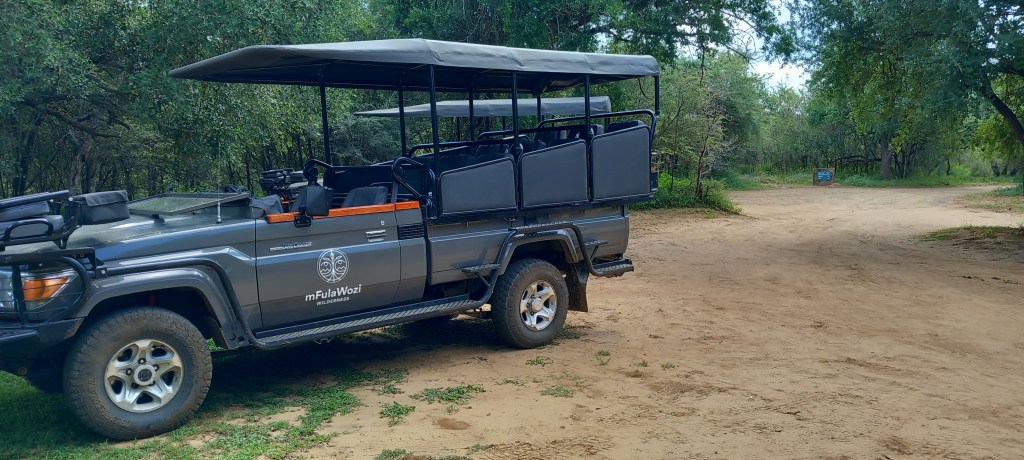
Biyela Lodge: Zulus practice and believe in ‘ubuntu’, meaning humanness or good disposition.  This was brought home to us at the wonderful Biyela Lodge.  We were met at the gate by smiling guides and suitcases were carefully stowed away (and found in our suites later), before we embarked on our first experience of travel within this 60,000-hectare private reserve.  Nine-seater land cruisers negotiated uneven, rutted dirt roads whilst our very amicable and knowledgeable guides managed to keep the vehicles upright and stimulate us with their enthusiasm.  What a jolt to our senses having spent two months onboard ship, to be plunged into the African Savannah.  The silence and the immense openness astounded us.  Imagine our excitement at coming across both zebra and antelope before we’d even reached the lodge!
The staff welcomed us with huge smiles and the offer of cool flannels and refreshing drinks.  Biyela Lodge consists of twelve stand-alone suites built into the hillside – built by members of the various local communities.  The suites were pure luxury – totally private and very spacious.  Having lived for two months with the restrictions in our ship’s cabin, we were totally overawed by the capaciousness of our suite.  Huge windows and an enormous balcony afforded wide ranging views over the iMfolozi River which runs through the reserve. 

Early morning and late afternoon safaris were the order of the day – siestas and lazing by the pool filled in the gaps.  Food was delicious and beautifully presented – including sundowners when out on safari! 

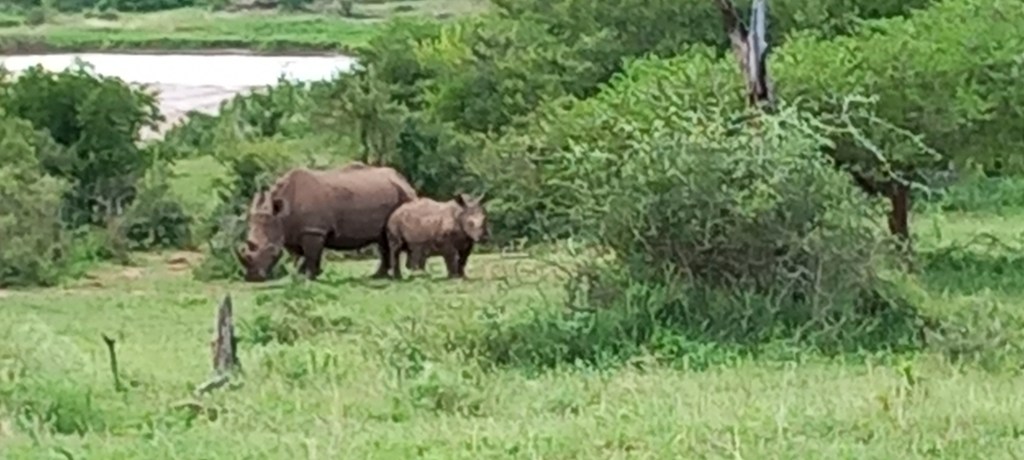
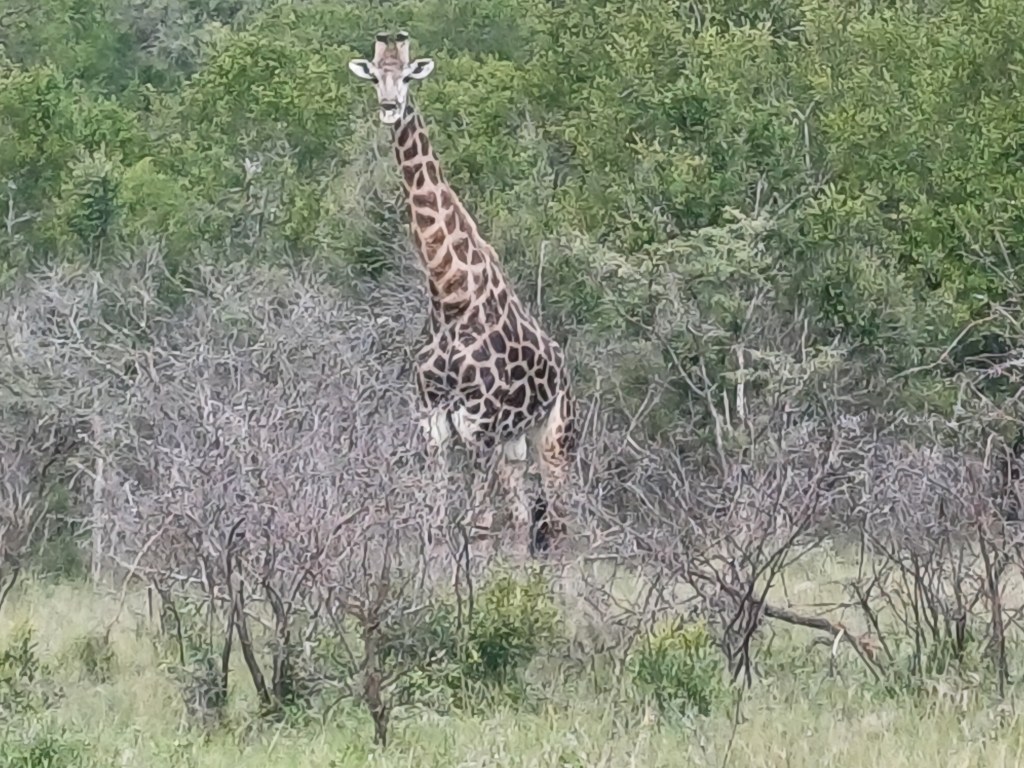
But it was the animals we had come to see, and we were not disappointed.  Three sorts of antelope, zebra, buffalo, white rhino, wildebeest, warthog, giraffe and elephant, not to mention numerous birds, lizards and tortoise. Just a few photos, in order that you don’t have too much to download.

The final evening’s treat was an outdoor BBQ, all beautifully served by candlelight whilst the guides walked continual circuits around us with torches to ensure no wildlife approached.  Zulu warriors danced and chanted for us – a perfect end to the evening.  None of us had our cameras with us, as this was all a last-minute surprise. 

I’m sure you can imagine how animated we were (the guides were beside themselves!) when fresh lion tracks were discovered around our BBQ site the following morning, as we were being driven back to the gate!  A suitable finale to a very special few days. 

Mauritius

Mauritius is a tiny island, just 790 square miles in area, situated in the Southern Indian Ocean, east of Madagascar. After six days at sea, we were all desperate to put our feet onto land.  About 350 of us had signed up for a day’s tour of the island!  Hence, we had to face VERY long queues of people checking in for one of the ten coaches that were to be ‘home’ for the day.  (Oh, the joys of cruising – NOT!)

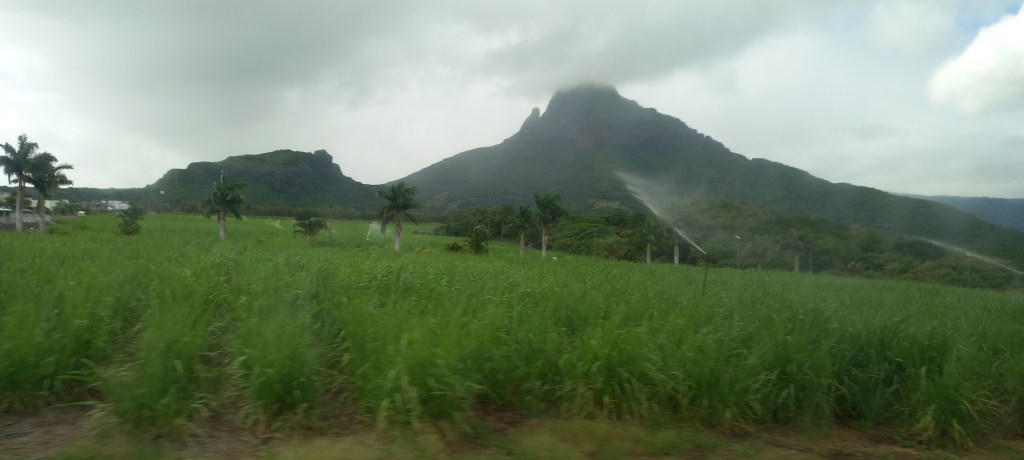
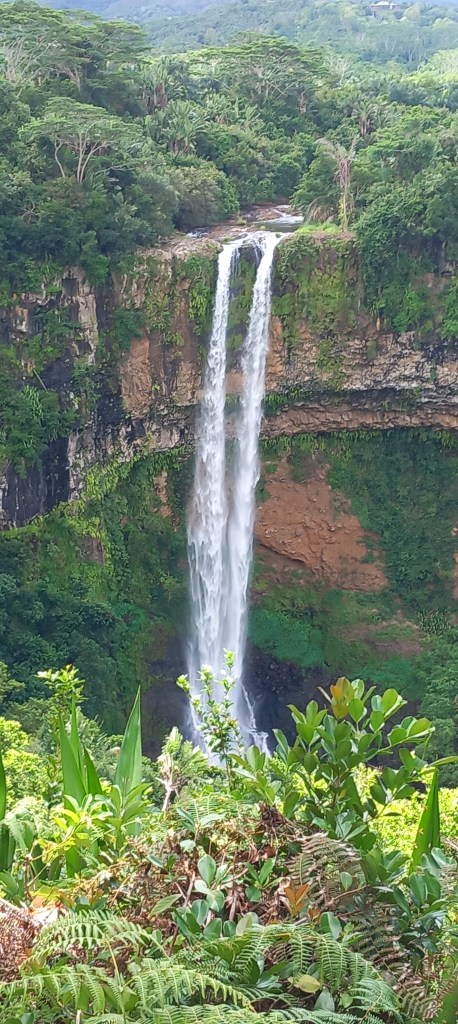
Borealis berthed in Port Luis, the island’s capital on the Northwest shore.  Heading south, through the many miles of sugar plantations, we enjoyed good views of the western Coast, before heading inland, and upwards into the mountainous area to the Black River Gorges National Park.  A 100-metre waterfall made a good photo stop – it would be even more spectacular in the rainy winter season. 

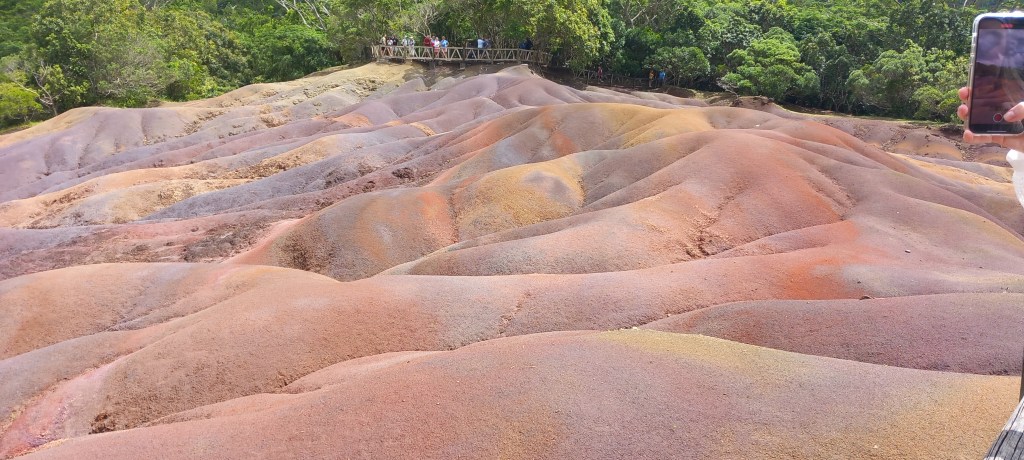
The ’Earth of Seven Colours’ intrigued us – this is a geological wonderment of basalt rocks which, over millions of years have, through chemical alterations, formed iron and aluminium oxides which produce the colourful shades. 

The population of 1.3 million comprises 52% Hindus and 33% Christians.  English, French, Creole, and Chinese are spoken.  The government provides free healthcare and free education.  However, there are NO benefits paid out. People are expected to work – our guide stated, “if you choose to have four children, then you choose to support and pay for them!”.  Pensions are very small, and the family is expected to care for elderly relatives in their homes as necessary.  Family values and a hard-working ethic are the norm.

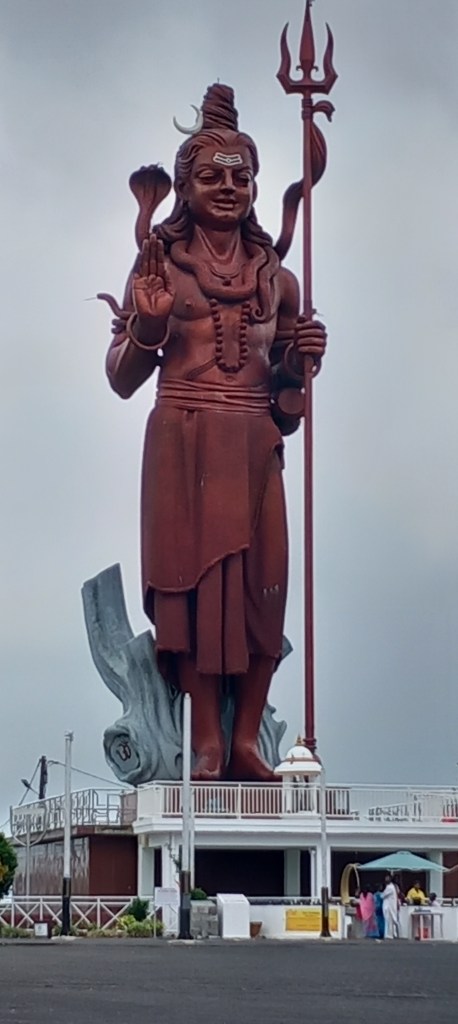
Still in the mountains, we visited a Sacred Hindu area, which included two enormous (33 metre high) statues of Lord Shiva and Lord Durga.  Shiva is the spiritual God of Hinduism.  Half a million pilgrims flock to this site every year to celebrate the Great Night of Lord Shiva – roads, walkways and huge car parks have been built to accommodate this most sacred of festivals. 

We wondered what the monkeys must make of it all!  No doubt they are well fed . . .Long tailed monkeys, deer and wild boar make up the few wild animals found on Mauritius.

The Hindu Temple is on the edge of a sacred lake – several smaller, respected, and revered statues of various Hindu Gods stand in the water – the waters are holy and treated by local worshippers rather like the waters of the Ganges.  Thousands of fish frequent the waters, and we were amused to watch a group of scruffy, local cats sitting on the water’s edge waiting for their moment to pounce on a fish as it came just too close to the edge to resist!

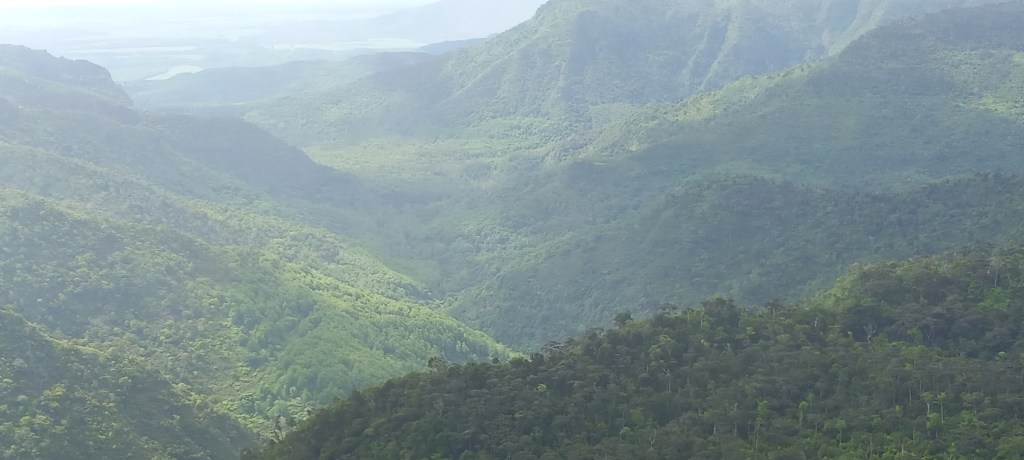
Having enjoyed a buffet lunch in a mountainside restaurant, we stopped again to take in spectacular views, on a misty afternoon.  A pair of Paille-en-Queue (which translates to Straw Tails) relished the afternoon thermals in the mountain air.  These birds have tails that are half their length making them very strong fliers.  Hence they have become the emblem on Air Mauritius planes (sorry no photos of them  . . .too quick for me)

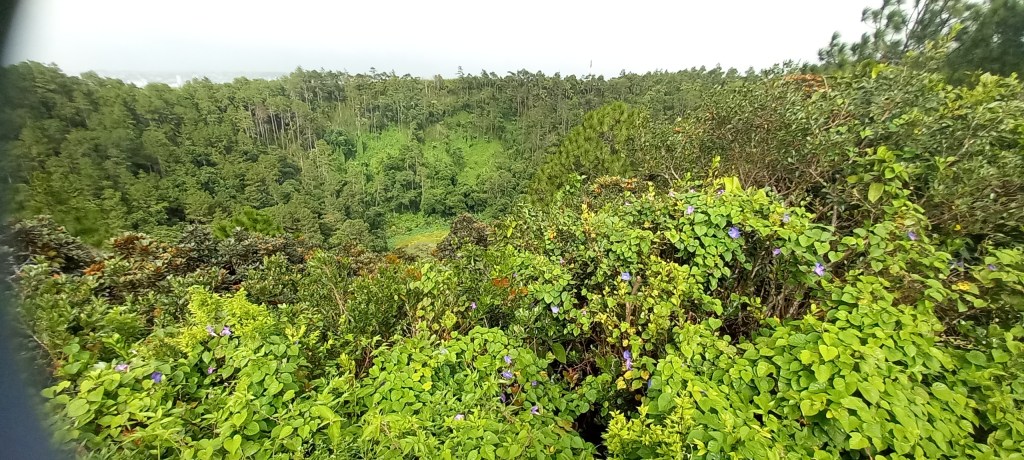
Our last photo call was above a volcanic crater left from the original eruption which formed the island.  Millions of years of prolific green growth make the crater almost impossible to see.  Our efforts were not helped by a torrential rain shower which sent us running back to the bus for shelter. 

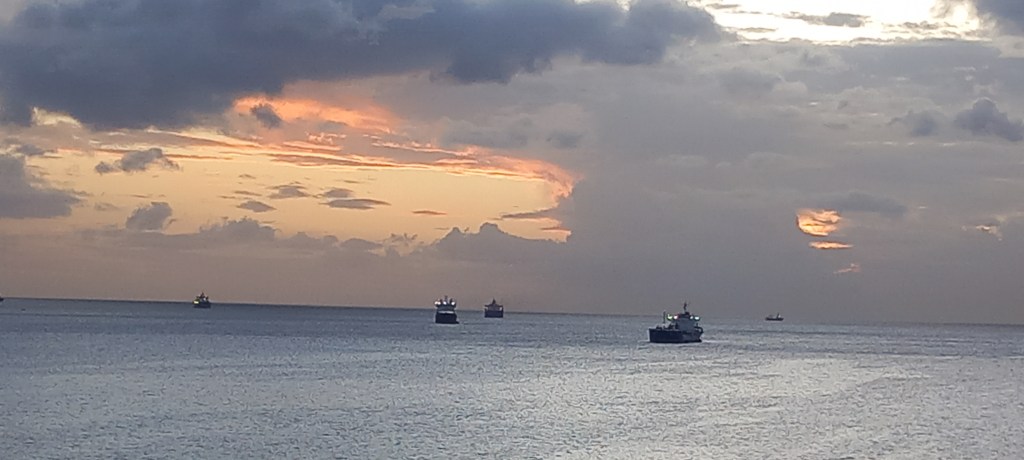
I should mention our bus driver who thought he was Lewis Hamilton and drove like a lunatic for the entire trip!  The roads are good but very narrow with hairpin bends up and down the mountain.  Torrents of rain did little to diminish his determination to break all speed limits.  Those of us sitting in window seats held our breath as we skirted the very edges of the road – deep ditches just waiting to gobble us up!  Imagine the hilarity from all corners of the bus, as the rain began pouring in through the air conditioning ducts as we hurtled back down the mountain!  One couple put an umbrella up, which sent the water onto the passengers in front and behind!  Having already been caught in the rain, many of us looked as if we’d been through the shower – the added deluge from a leaking bus had us all in hysterics!  Did the bus driver slow down?  NO!  He just grinned in the mirror and sped on . . . . . .Borealis was such a welcome site.  Much needed cups of tea and dry clothes afforded us the pleasure of watching the sun set as we set sail for our next port – Durban in South Africa.


Singapore and Thailand

Sizzling Singapore

Heading north-west from Indonesia through the Java Sea was like being in the English Channel – so many ships!  We had cruised the world’s two main oceans without seeing a single ship, hence this busy shipping area gave us something else to talk about . . . .

Having visited Singapore in 2015, we were intrigued to look more deeply into its history and culture.  We had forgotten that this is indeed a SIZZINGLY hot and sticky city, made all the worse by jumping on and off an air-conditioned bus on a guided city tour.  Those of you enduring a long cold, wet winter have no sympathy, I’m sure!


For anyone who has never visited this thriving place – a VERY brief history . . . . Sir Thomas Raffles established a thriving trading post here in the early 19th century.  It eventually became part of Malaysia before becoming a fully independent state in 1965.  Prime Ministers since then (all from the same family) have established strict rules which are heavily enforced – a few examples . . .no chewing gum in public, no eating or drinking on public transport, respect your elders (comes into its own on the metro!), cleanliness is paramount (no litter!) . . . drugs, rape and domestic violence are not tolerated and yes, they have a death penalty.  It may be like living in a ‘controlled state’ but it works!  Singapore is now one of the most powerful financial and industrial states on the planet with a VERY low employment rate.  Chinese, Malaysia and Indian are the three official ethnic groups.  It’s an extremely diverse culture but everyone strives for individualism and excellence. 

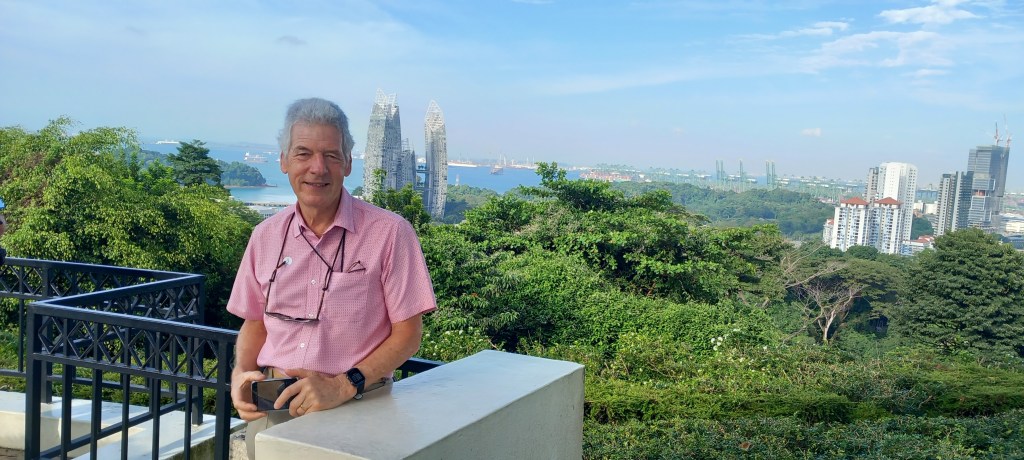
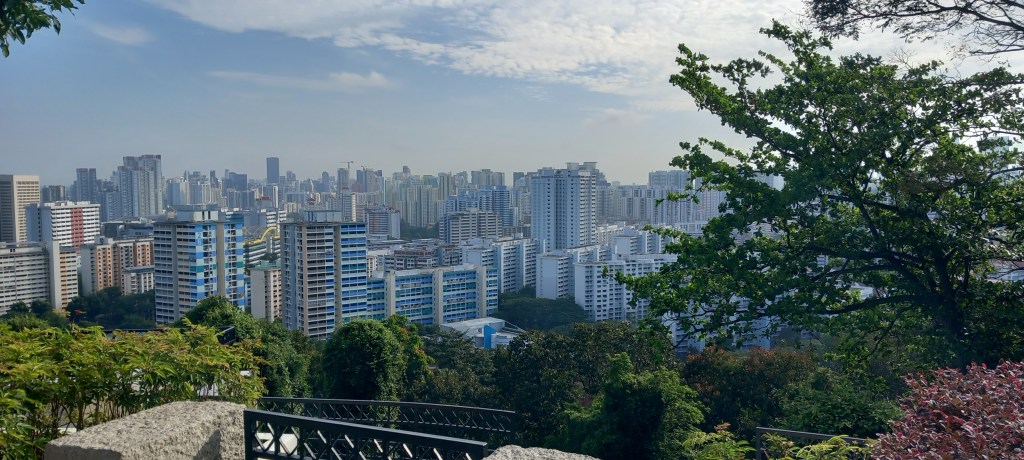
An early morning visit to Mount Faber afforded beautiful views over the busy harbour and over the extensive living areas. 

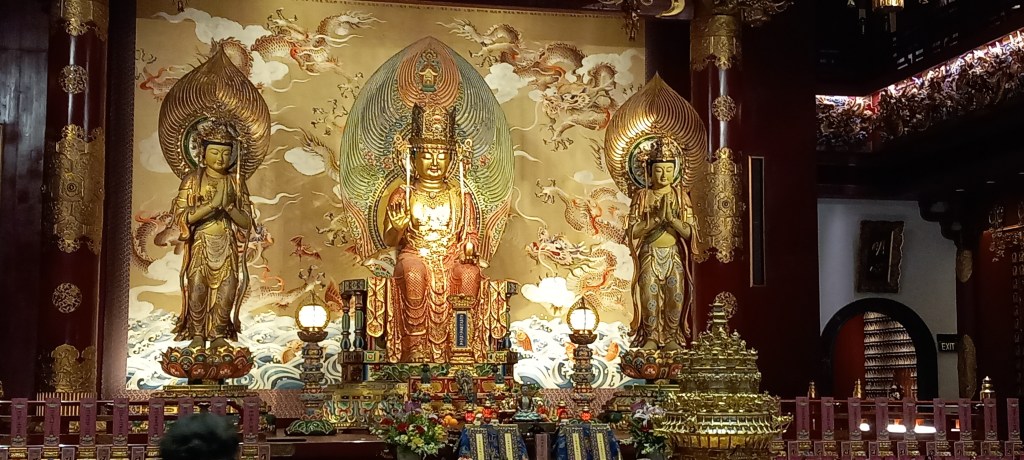
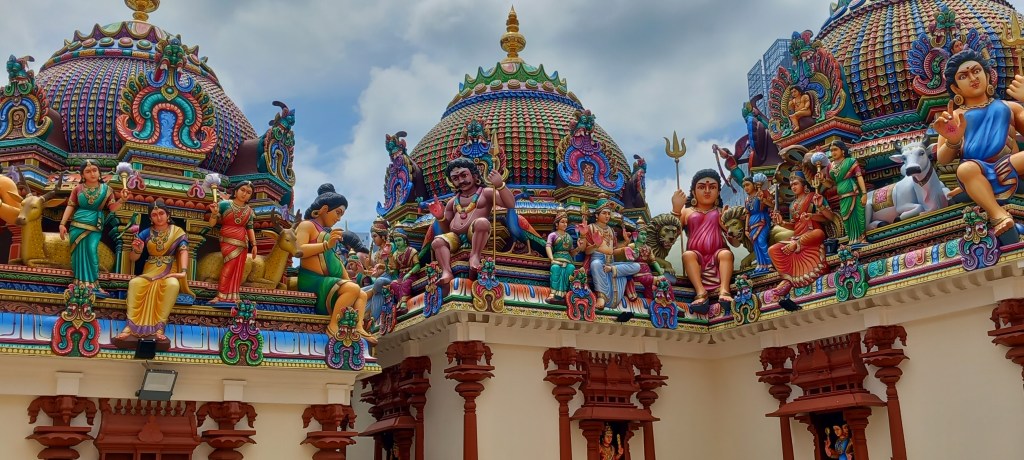
Chinatown pulses with restaurants, cafes, markets, and temples  – both Chinese and Hindu.  We were assured that everyone lives peacefully together.  Hindu temples the world over ask that shoes are removed before entering.  My goodness, the pavements were red-hot – real sole burning stuff!

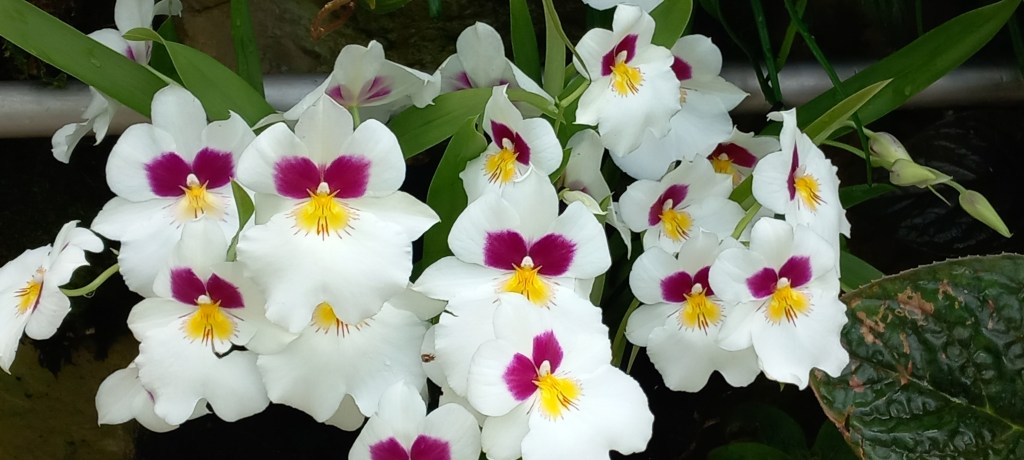
The National Botanical Gardens are a complete joy.  A heady mix of colour and scent – with thousands of different orchids growing in their preferred habitat (i.e., hot and humid!)

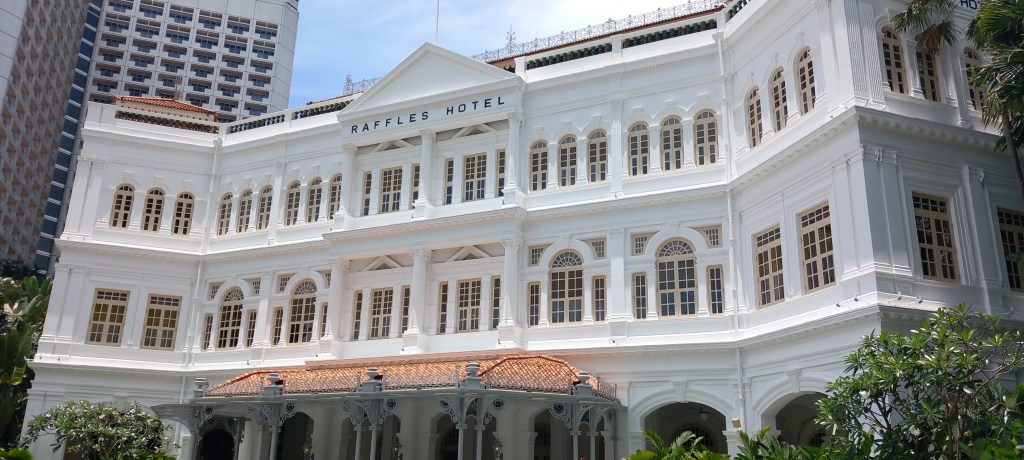
A visit to Raffles Hotel  – famous for its Singapore Slings – was a let-down  for us.  It seemed like the entire contents of TWO cruise ships had joined the queue for the Long Bar! We were not enthralled with the thought of an hours wait in the crippling heat, so we unobtrusively left the queue and nipped across the road to a quiet little café, where we relaxed over a cup of iced tea!  Not quite a Singapore Sling (or non-alcoholic in our case) but the peace and quiet away from hundreds of cruise passengers was bliss!  We had been lucky enough to enjoy Raffles and its Slings in 2015, so felt replete. 

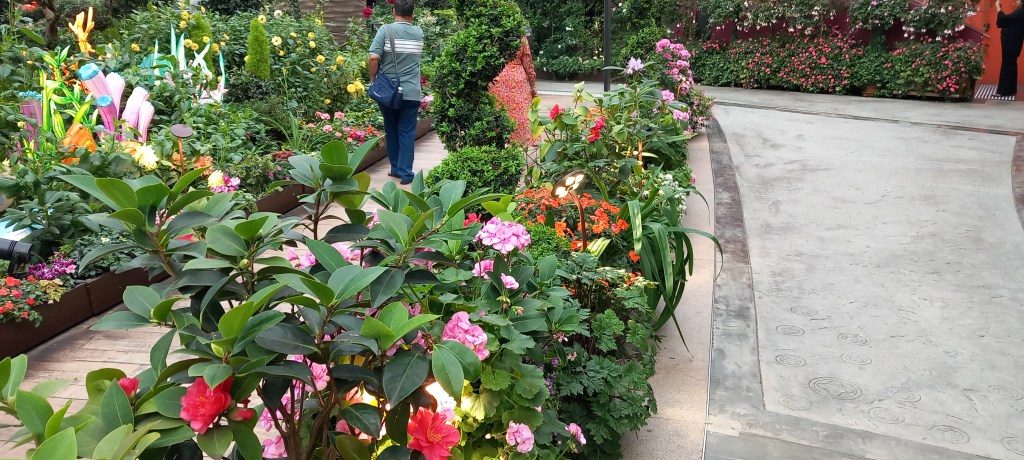
Later in the day, we took the very clean and orderly MRT (metro to you and me) to the Gardens on the Bay.  This huge green ‘lung’ is a credit to Singapore. 

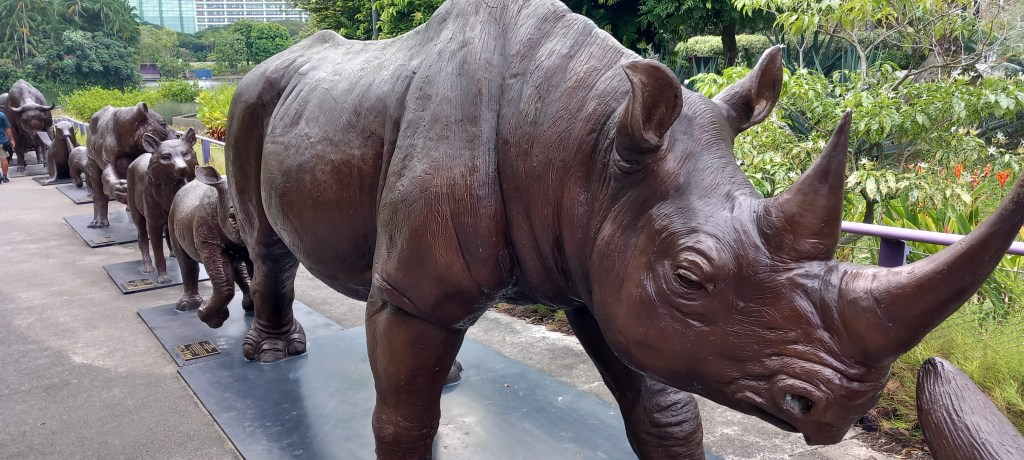
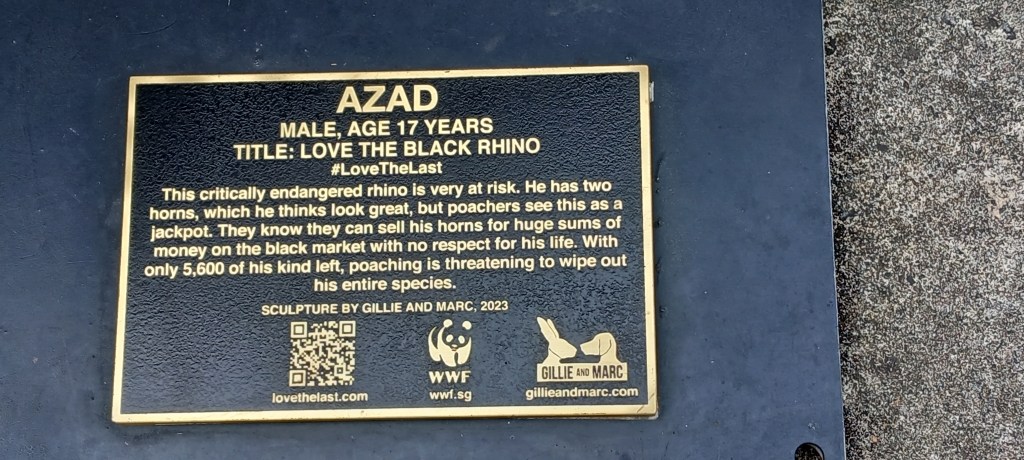
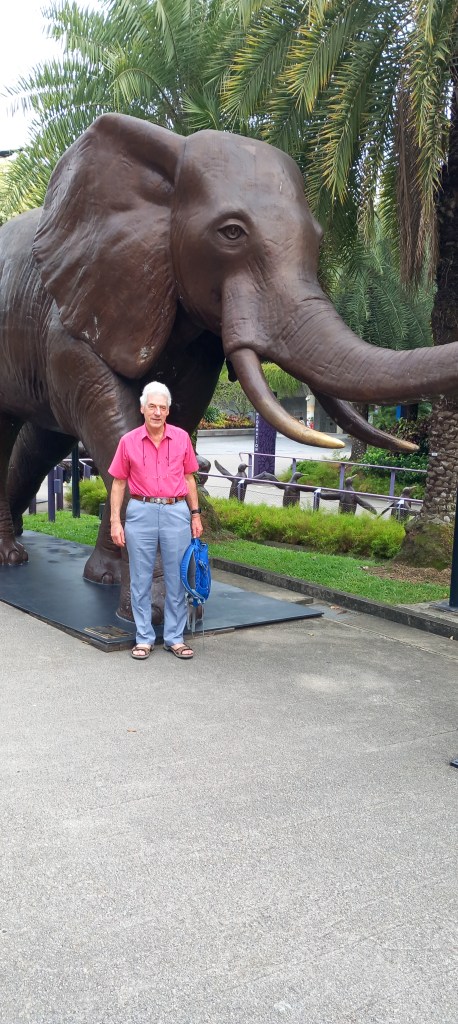
We were in awe of a sculpture exhibition of hundreds of animals, threading their way around the gardens – all endangered species. What a clever way to get the message to many thousands of people!


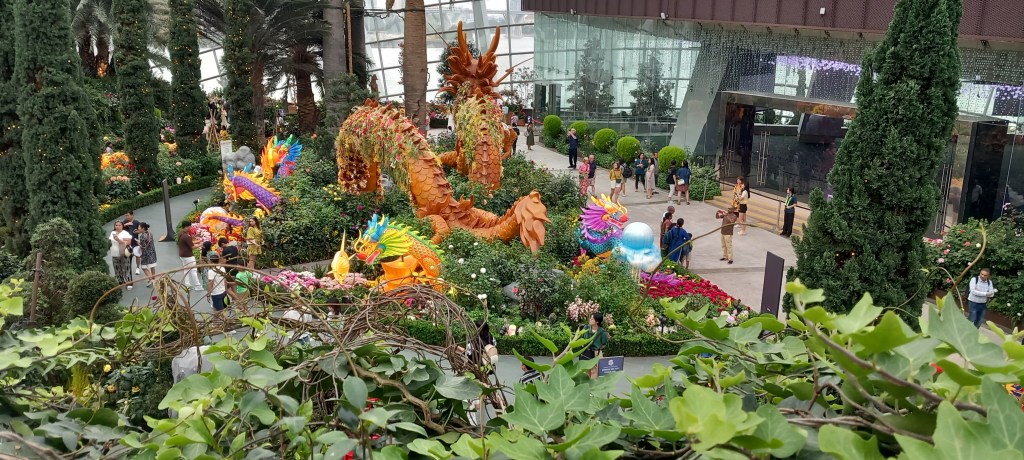
The growth on the Super Trees has progressed in leaps and bounds.  Two huge glass domes have been added – the Floral Dome and the Cloud Forest – both spectacular. 

We ended our whistle stop visit to this magical place by watching the Sound and Light Show which takes place nightly on the Super Trees.  The trees come to life with impressive colours and a cacophony of musical sound.  Hundreds of people attend – no chairs, no entry fee.  Just sit on the ground and look upwards.  What an atmosphere! 

Tantalizing Thailand

A further day’s cruising in a north-westerly direction conveyed us to the island of Phuket in southern Thailand.  A gorgeous sunrise over the deep-water bay greeted us. 

An early start gave us a two-hour bus ride (very comfortable air-conditioned coaches) up the east side of the island, through the main city and into the countryside.  Huge plantations of rubber trees, coconut palms and oil palms lined the roadsides.  Housing here is, once again, very rudimentary for the majority, but no litter anywhere. (phew!)  Most houses have a Buddhist shrine outside – the main faith of the country being Buddhism.  Huge ornate temples were plentiful, often with a giant Buddha in the grounds.  Passing over the bridge and through a checkpoint, we had arrived on the Thai mainland. 

A further half an hour’s journey carried us to a jetty on the edge of Phang Nga Bay where we were loaded onto a series of Long Tailed Boats.  These are traditional wooden boats – often decorated beautifully – about 30 metres long with a canopy.  They run on second-hand car or truck engines and are VERY noisy! The driveshaft is a long metal rod which extends backwards from the boat (hence the name!) with a propeller on the end.  The engineers amongst you will be able to work out the intricate workings for yourselves. . .

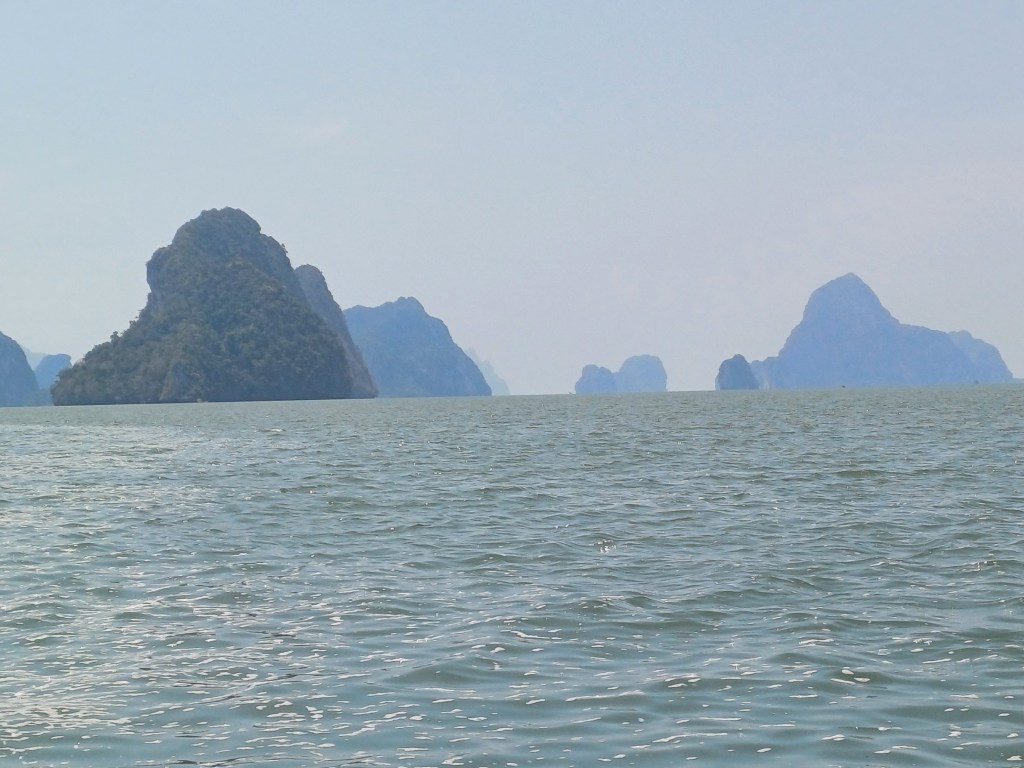
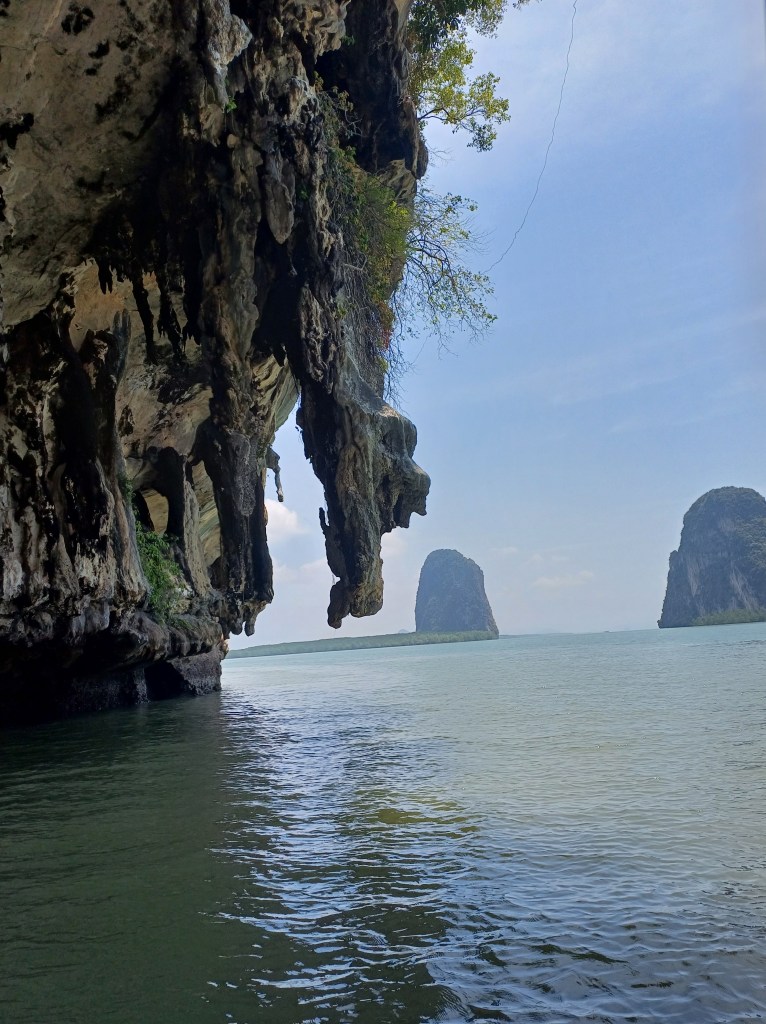
Our boat journey began through mangrove swamps before some AWESOME scenery began to appear in front of us.  Incredible geological features formed by fault movements, have been pushed upwards out of the sea.  These massive limestone blocks have sheer cliffs, enormous overhangs, and many caves.

After millions of years, they are now covered in verdant vegetation.  Each ‘block’ or island has been named (often with an animal name), and the guides took great delight in pointing out James Bond Island.  This distinctive feature was used in 1974 for “The Man with the Golden Gun” which has given this area international recognition.  The local name for it translates to Nail Island – very appropriate we thought!  We wondered how on earth it stays standing!!

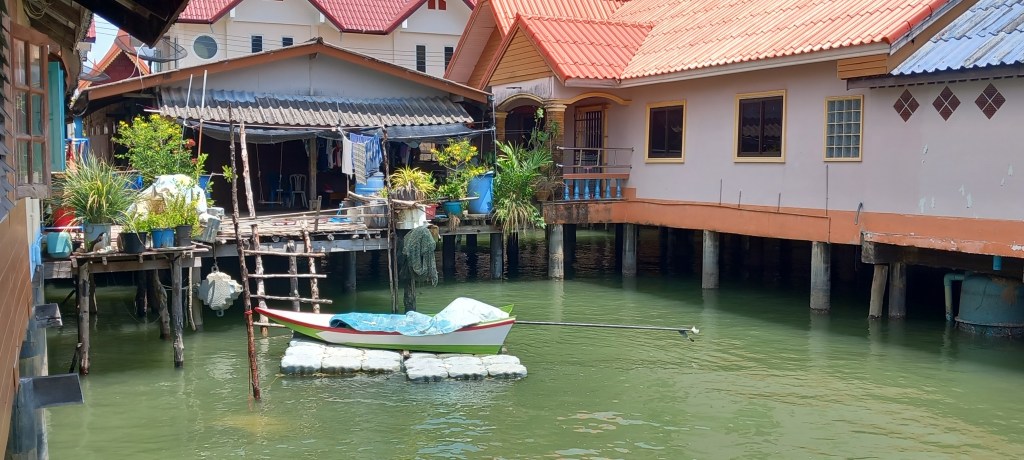
Exhilarated after more than an hour on the water, we were deposited on a jetty at Panyee Village for lunch.  A floating Muslim village that was settled 200 years ago, now boasts its own school, its own Mosque and even a floating football pitch!  I can only guess that tourism must be their main income.  Three hundred of us descended for lunch – a very good buffet from very friendly people.  We were encouraged to walk through the village afterwards where every passageway held numerous market stalls.  You guessed it!  Yet more cheap pearl necklaces and T-shirts!! 

The Long-Tailed Boats dutifully returned to collect us, for the half hour’s whizz across the water back to our waiting buses.  A visit to the Golden Cave Temple served to break up the two-hour trip back to Borealis.  A golden reclining Buddha awaited us in the cave, but we could only look (no photos).  We wanted to respect the numerous ladies on a Buddha temple pilgrimage who were ardently praying when we visited.  Our bus driver needed their prayers, as we got held up in late afternoon traffic – drivers and guides are under strict instructions to return us to the ship within a time frame, ready for us to set sail again.  It was ‘touch and go’ . . . .

CROSSING THE EQUATOR

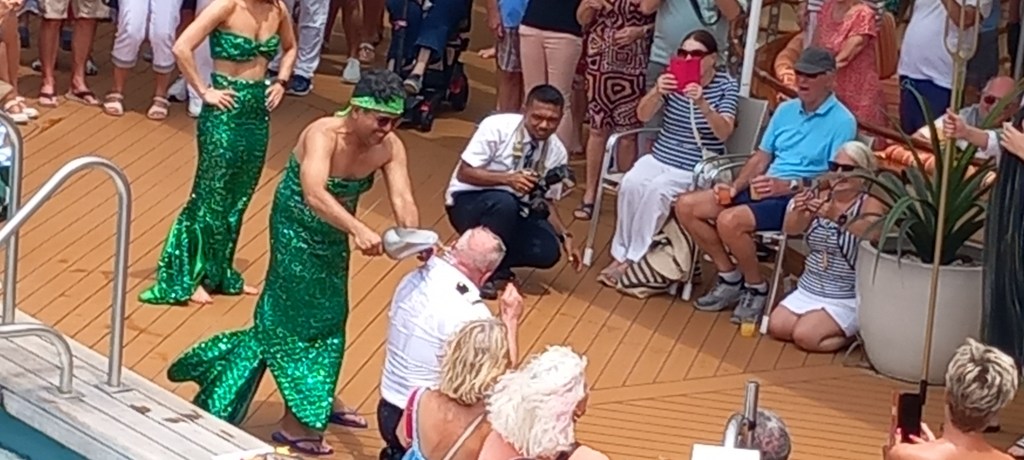
If you’re following us on a map, you will be aware that we have crossed the Equator a few times.  The ships horn has just been blown again, (11am on 18th March) telling us that we’ve crossed it going south across the Indian Ocean.   The mandatory ‘ceremony’ was held on one of our crossings last week.  King Neptune and his mermaids arrived ready to ‘punish’ several members of staff (including the Captain) siting their guilt at providing us all with ‘such a good time’!  “Guilty, Guilty, Guilty!”  we all yelled, upon which ice cubes were tipped down their backs before being pushed into the pool fully clothed.  A bit of fun to while away the time on one of our numerous ‘sea-days’.

Indonesia

 Komodo Island

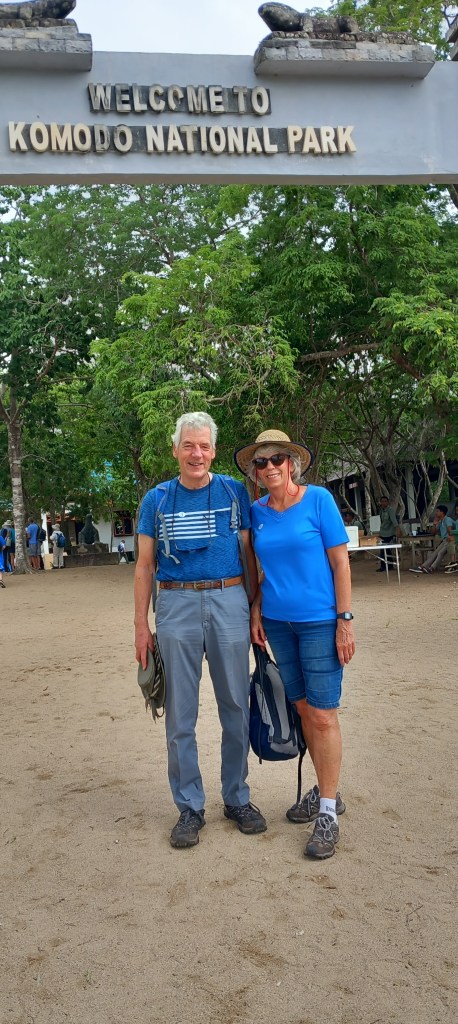
Heading south-west from Papua New Guinea, we cruised through the Torres Strait (which required having a pilot onboard, as the Strait is fairly narrow), then through the Arafura Sea, passing East Timor and many other small islands before reaching Komodo Island.  Strict rules dictate that you are not permitted ashore unless you are on an organized trip.  Komodo Island is largely a National Park.

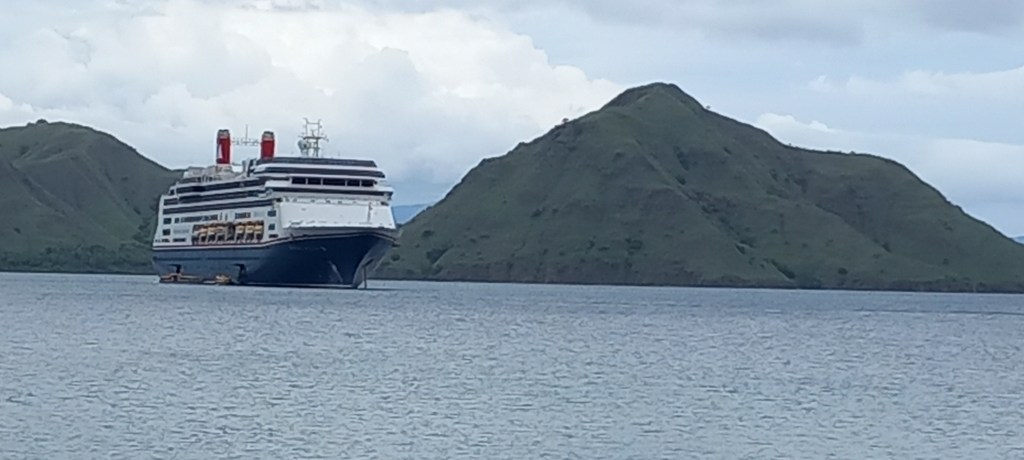
The jetty here is not deep enough for big cruise ships – hence we were anchored in the bay and our lifeboats ‘tendered’ us ashore.  We were led in groups (the nightmare of cruising hits again!) by our local guides along the very long jetty and into the ‘dry’ jungle. 

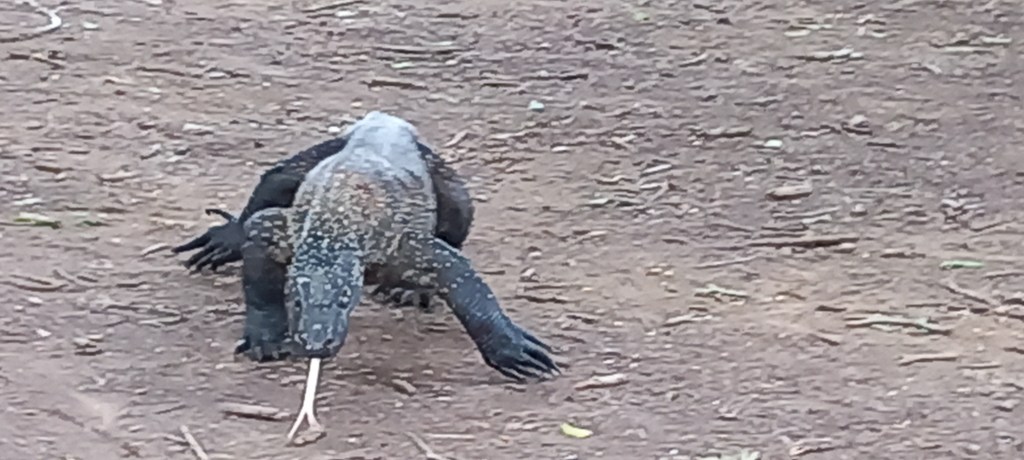
We were delighted to see a lot of GREEN thanks to it being rainy season, though we were lucky enough to have a dry day.  Several carefully constructed paths meant that we didn’t all follow the same route.  However, we were all THRILLED to encounter several Komodo Dragons roaming in the jungle.  Despite huge numbers of gawking tourists, they were making their way to a watering hole – trained rangers who each carried a long-forked stick (would they have really done the job, I asked myself?) – made sure that we were moved away if they were heading in our direction.  Three thousand of these creatures live on two or three of the islands – they don’t like the water but will swim if necessary.  They are carnivorous and live on wild horses, deer, snakes, monkeys, and water buffalo all of which live and breed on the islands.  I should add that we were given stern instructions NOT to wear red, and NOT to visit at all if we had any open wounds.  The dragons can smell blood from a good distance!  They have a snake-like tongue which darts out of their mouths as they move  and they can move quite fast to catch their prey. 

They certainly wouldn’t win any beauty competitions, but to see these beasts in the wild was a privilege.  They dig holes in the ground to lay their eggs.  Rather like turtles, the hatchlings must look after themselves once born.  An adult dragon would eat them, so they spend their first three years of life up in the trees.  The adults get too big to climb trees, so it is left to mother nature to prepare them for adulthood. 

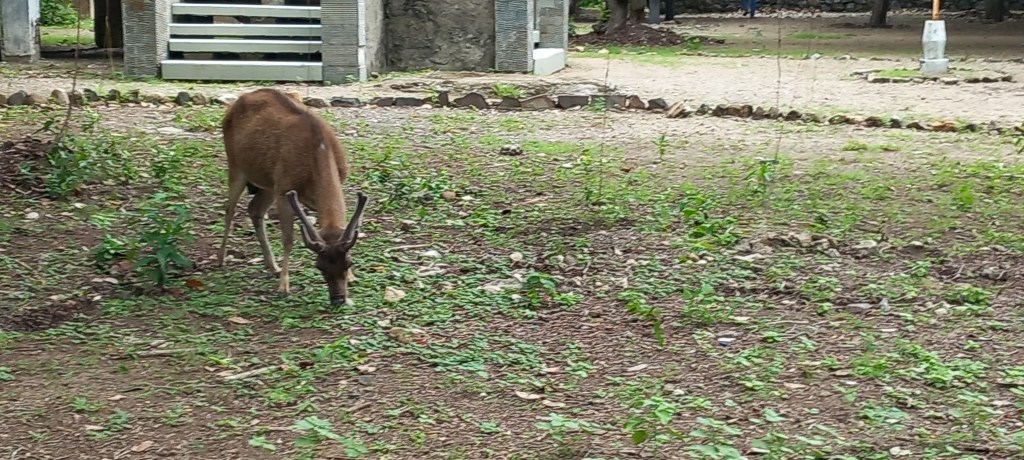
They can live for up to 60 years, can grow up to three metres in length and weigh an average of 70 kg.  They are quite agile, have sturdy legs, strong necks and long tails.  We were intrigued by a couple of deer who were grazing happily very near the huts and markets on the beach  – they were clever enough to have worked out that they would be safe being that close to the community  – the rangers would keep the dragons well away from the little children. 

Pink Beach, on Komodo Island

We left the dragons in peace and then had to run the gauntlet of the local market stalls – every stall sold the same T shirts and cheap pearl necklaces, and every stall holder was ‘in your face’ – NOT a pleasant experience!

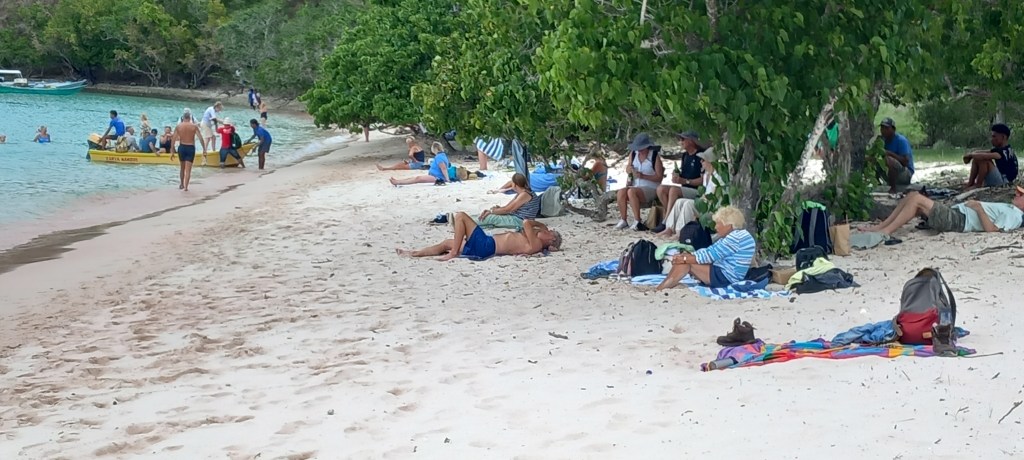
The next adventure began as we were loaded (literally!) – bottoms first and man-handled!! onto very dodgy wooden boats where most of us had to sit on the floor! (thank goodness for yoga!)  The ship provided us with a packed lunch which we tucked into during our half hour trip across the bay where we were delivered onto a gorgeous beach.

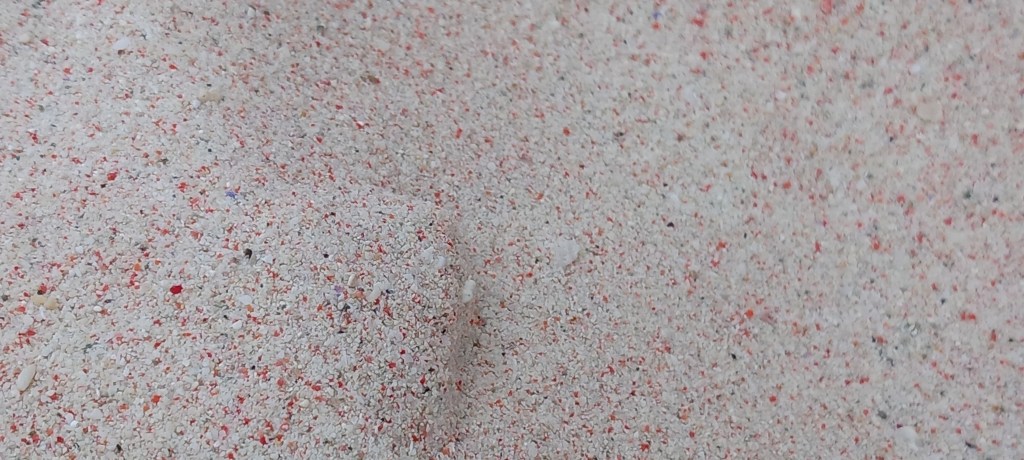
We were blessed with no rain (despite heavy grey clouds) and enjoyed snorkelling just yards from the beach over more coral reef – loads of colourful fish delighted us, and there was time for a bit of “bronzy-bronzy” on the beach. (UV rays are strong in this part of the world) . The sand itself appeared white until you looked closely.  – Enlarge the photo below and you will see the tiny particles of pink coral. 

Leaving the island in the late afternoon, was a real pinch me moment.  To be in such a remote part of the world, and so far from home, where we were able to relish the beautiful landscapes and experience the local cultures was a joy. 

The Island of Lombok

A night of rough seas (yes, again!) made us slightly late arriving into Lombok.  This did not diminish the enthusiasm of the traditional musicians as they performed for us on the jetty.

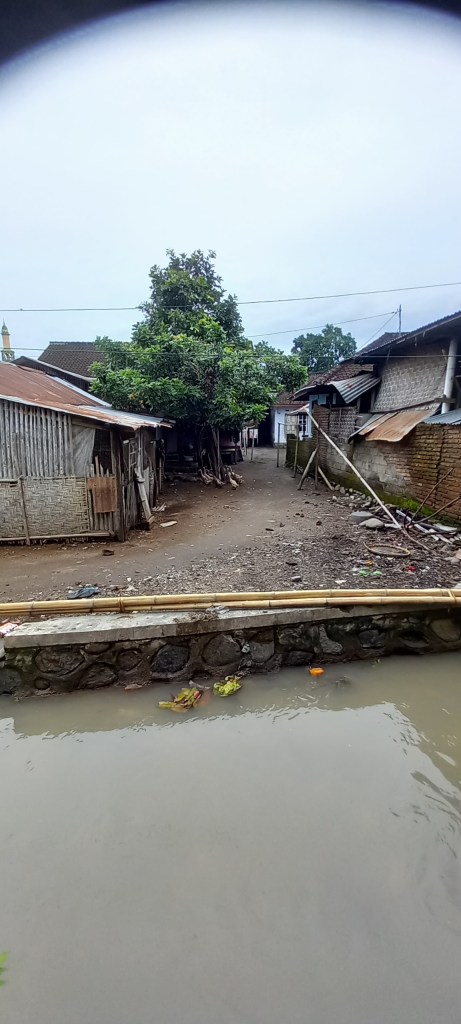
The modern cruise ship terminal gave a false impression of what we were about to see.  An hour’s coach journey through the city of Lembar, and then into the countryside brought us to a local village.  Sadly the roadsides were full of filth and rubbish.  Ditches full of muddy water (with rubbish floating in them) did nothing to improve the dilapidated shacks that most people live in – corrugated iron walls and roofs – barely any windows  (it’s always hot and humid). 

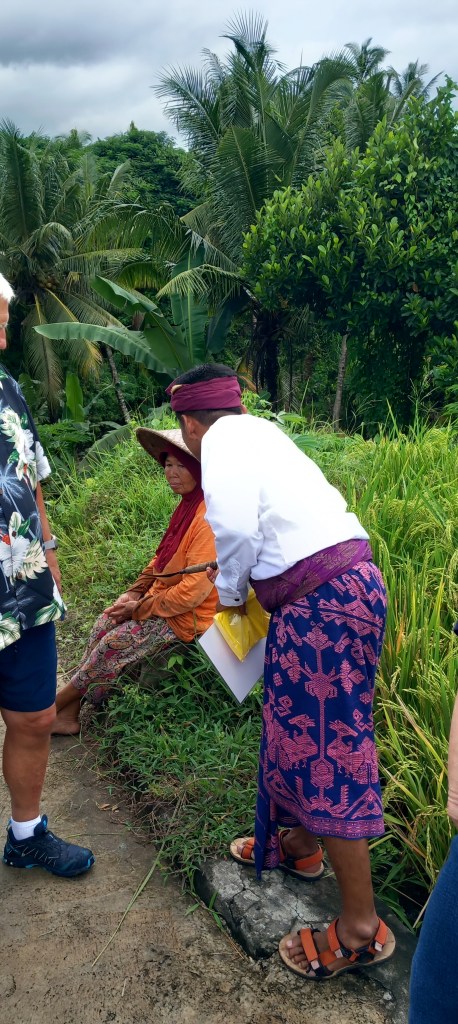
The majority of people get around by motorbike – helmets are supposed to be worn in the city but this is quite obviously not enforced.  The population is 85% Muslim and there are more than 1000 mosques!  The mosques and government buildings are all modern and well built.  This simply makes the levels of poverty even more obvious.  Our guide, dressed in the traditional costume, did his best to convince us that his country was ‘good’. 

Every family has a rice paddy – varying sizes depending on what they’ve inherited and how many children they have.  Back yards are used to grow whatever they need – the warm, wet climate means they often harvest rice three times a year.  The rice is not exported – in this part of the world, they eat rice with all three meals per day (our Philippine crew onboard eat the same)

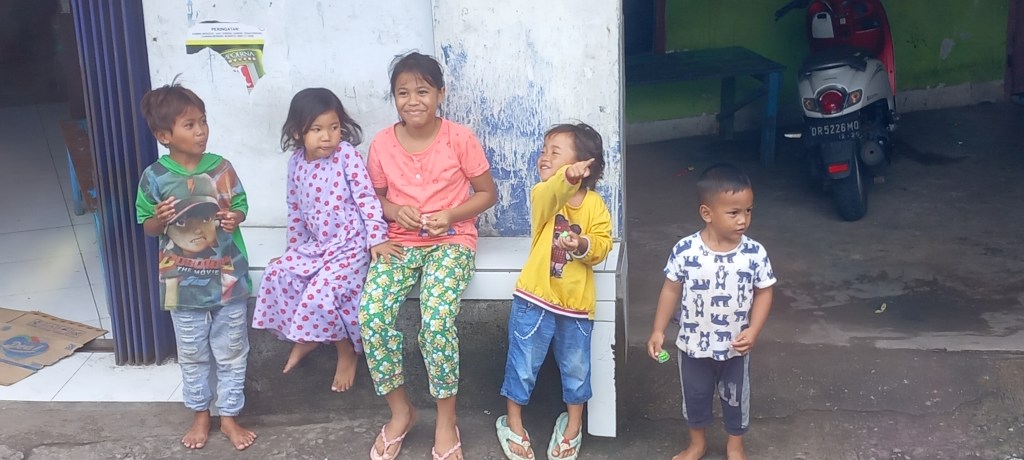
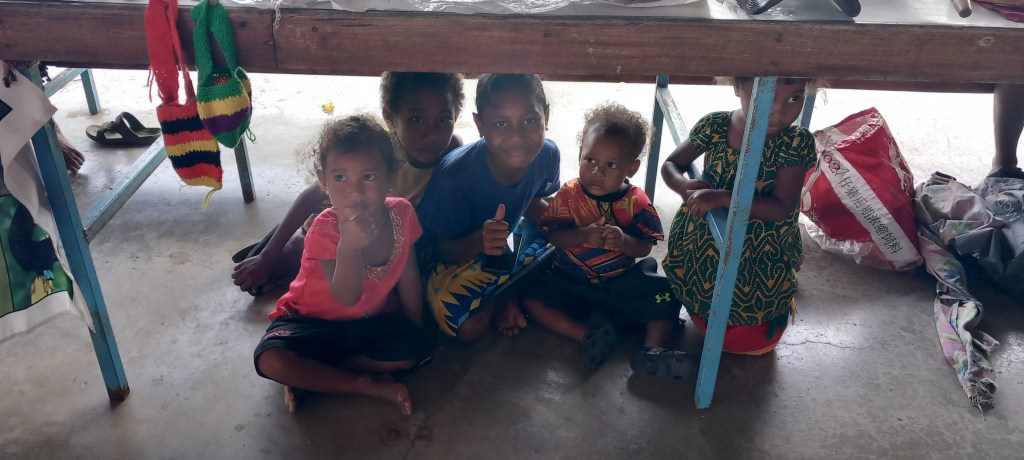
Notwithstanding their hardship, the locals had big smiles on their faces, were happy to be photographed and appeared to be ‘happy with their lot’.  The children stole our hearts – so contented and loved.  We visited on the day before Ramadan began.  Oh, my goodness, we have SO MUCH to be grateful for!

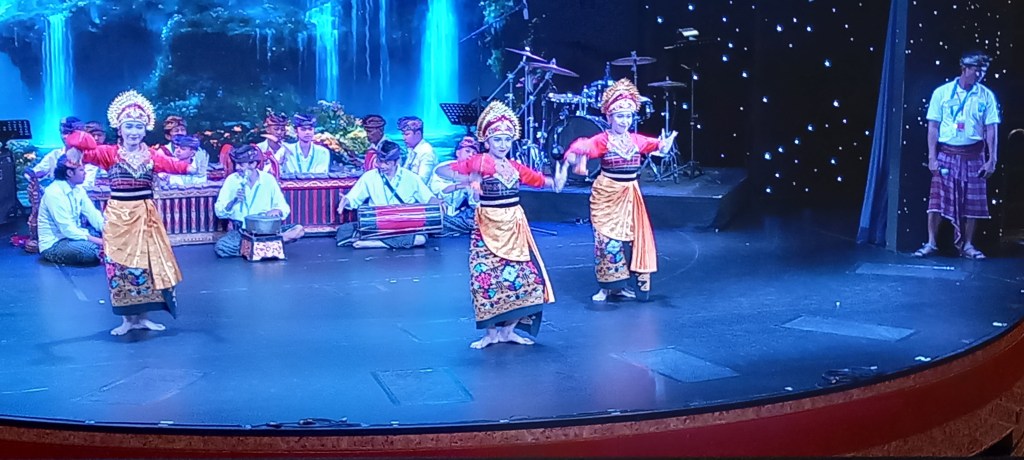
We were ALL so thankful to be back on the ship and to have a hot shower.  Local dancers came onboard once we were all aboard and performed for us in their exquisite costumes.  A pleasant end to another humbling day. 


Papua New Guinea

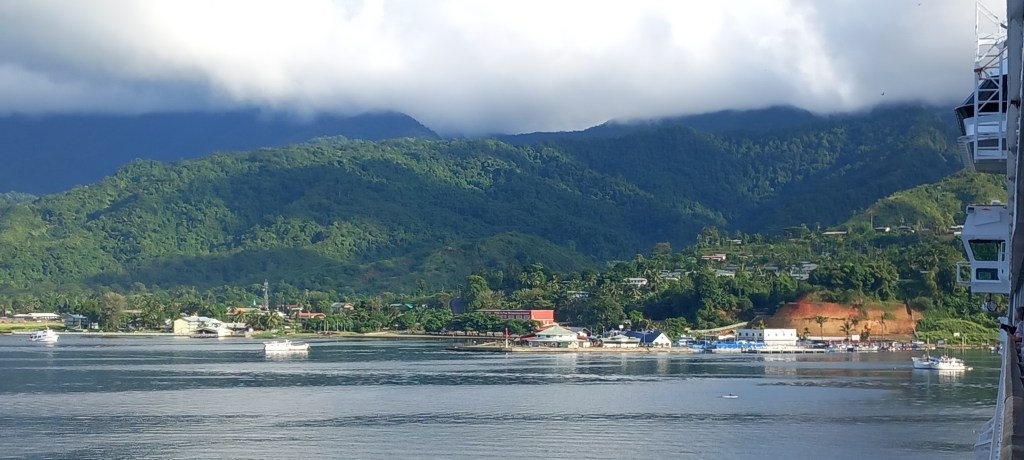
From Cairns we headed north along the Australian coast, before turning north-east across the Coral Sea to Alotau, situated on Milne Bay in Papua New Guinea.  

Six hundred islands make up Papua New Guinea – More than eight hundred different tribes, all of whom speak their own language, are spread over this large underdeveloped country. Most live in geographic isolation as the area is very mountainous and, in some places, impossible to travel between areas or islands.    These people survive by subsistence farming.  The vast majority of the population live below the poverty line.  Sadly, this was very evident during our short journey from the ship to the Festival site – see below.  Five hundred of us (my cruising nightmare!) were transported in very old minibuses which ran a shuttle service from the ship.  Very basic plastic covered seats and no air conditioning – it was 32C and very humid!  Poorly built roads, run-down shacks and uninviting shops.  A few passengers who braved the heat, reported young men selling  SINGLE cigarettes for $1 just to be able to make ends meet. 

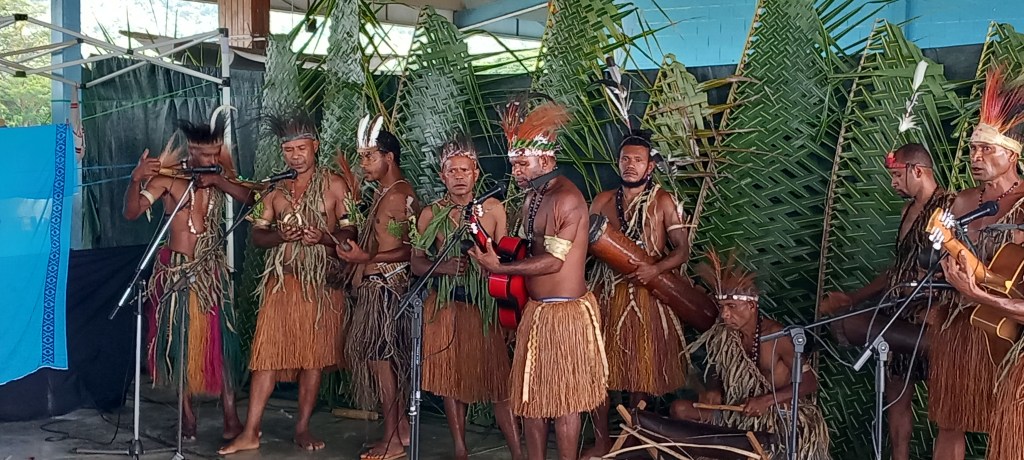
Alotau took full advantage of a cruise ship visit – especially from UK, as PNG is a Commonwealth Country.  The Lik Lik Festival was laid on especially for us.  A vibrant and colourful extravaganza demonstrating their culture and heritage.    

Spectacularly painted bodies  – charcoal used over their skin, water colour paint for the decoration.  All manner of plants and feathers used in headdresses and skirts.  Each tribe has its own costumes and customs.  Several tribal dances were performed for us  – also a young mother, with the most beautiful voice, sang both a lullaby that she sings to her babies, and then wowed us with a rendition of Halleluiah!

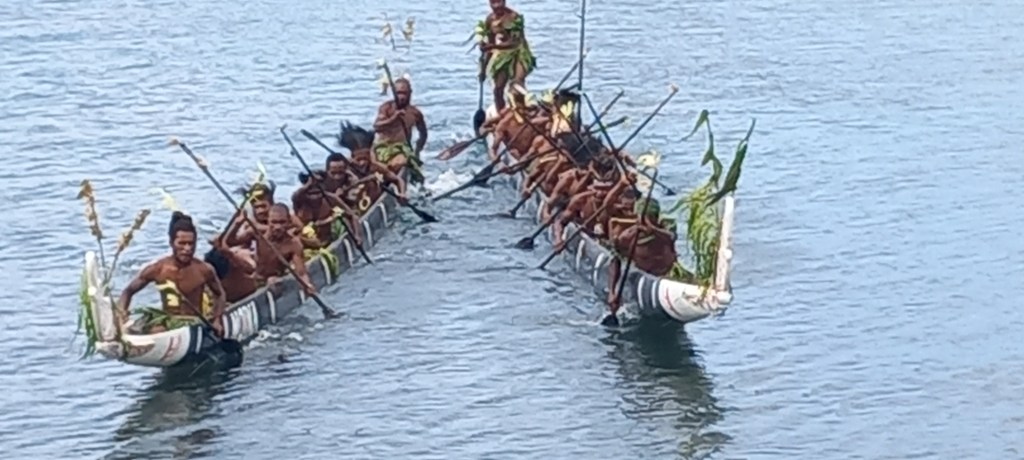
War canoes full of chanting warriors raced about the bay in front of us  (and gave a few passengers a go in the canoes!)

Needless to say, there was a great array of market stalls selling hand made wooden carvings and jewellery.  All the stall holders spoke English – it is taught at school  (for those who GO to school).  Everyone was very friendly and full of smiles.  However the big grins took some getting used to – they all chew Betel Nut which is a stimulant and colours their teeth and tongues bright red!  As you can imagine, it shows up well against their very black skin colour! 

The festival went on for the whole morning, whilst groups of passengers were shuttled to and from the ship.  Two hours was enough for most of us  – the heat and humidity were fierce  – as were the warriors! 

In summary, we were given an insight into their culture and heritage, and no doubt increased the pennies in their pockets for a day or two.  Apparently, the ship was giving food parcels out as well.  We all have SO MUCH to be thankful for  – it made us feel very humble