Crossing the North Atlantic
Hello again folks: I felt I must share with you our journey north . . . . . .For those of you who like to ‘track’ us, we are on Bolette (not Borealis) – they are ‘sister-ships’ and the lay-out is exactly the same (and I still don’t know my way around!!)
For the non-cruisers amongst you, the check-in system is very organized and straight forward. No standing in long queues for hours! Seats are provided and we are called forward according to the colour of our luggage labels. Our luggage is collected from the car by a porter who takes it away to go through security, and we next see it standing outside our cabins a couple of hours later. We were onboard and enjoying lunch within an hour of arriving at the port drop-off point.
We sailed at 5pm on the dot . . . much noise from the ship’s hooters to say goodbye to Liverpool. I only wished that Tanya had been in her office – it’s so close, we could have waved! By now, the earlier rains had cleared and we enjoyed a sunny evening. The first evening is all about unpacking, settling in, finding your dinner table and ‘eyeing up’ who your neighbours are going to be!
They say it takes a few days to find your ‘sea legs’ – however . . . .we were dropped in at the deep end!! A force 8 gale with driving rain greeted the ship as we left the protected waters of the Irish Sea and the North Channel. . . . VERY rough seas with 6 – 8 metre waves stayed with us throughout our first day at sea. Walking about on the ship was a challenge, as we were lurched from one side of the corridor to the other – grabbing handrails or standing firm with your legs apart and knees bent (very unlady-like but very Elvis Presley!) became the norm. Huge thanks to my dear friend Rose, who introduced me to Echinacea tablets for seasickness – along with wrist bands, the echinacea worked a treat. (Yes, I know that echinacea is normally a herbal cold remedy, but in this case, I’m guessing it also settles the balance in the middle ear). We noticed that the dining room was fairly quiet for dinner – many people had a miserable day. As you’ll remember from our last cruise, during rough seas, the swimming pool is emptied, and the gym and walking promenade are closed for safety reasons.
What a change on Day 2 as we awoke to sunshine and a much calmer sea.
Day 3 – Reykjavik (meaning Smoky Bay) from where we enjoyed a full day’s guided tour, much helped by beautiful weather and a very knowledgeable guide. Iceland is the ‘youngest’ country in the world and has been independent since 1940. Two tectonic plates run through Iceland, (the North American and the Eurasian) which are separated by a huge fissure. (read on, to find out more!) Much of the island is a hot spring . . . plumes of steam can be seen billowing out of earth. The islanders take full advantage of this by producing geothermal power for 99% of their population. In simple terms, the steam is used to produce electricity, then sent back underground to heat water – 3000 km of pipe work provides residents with hot water. The impressive power station is the biggest in Europe and the 8th biggest in the world.

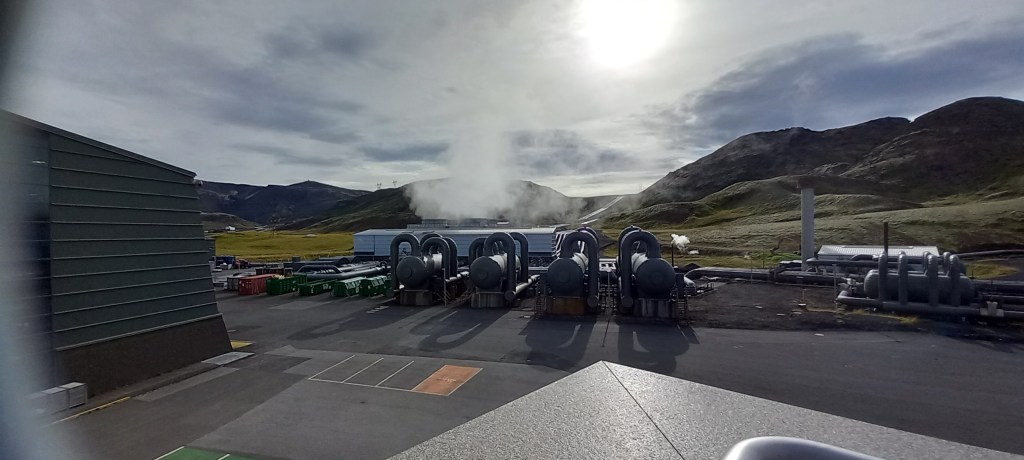
Two thirds of the island’s 400,000 population live in the Reykjavik area. No one lives in the mountains – which of course, are fairly active volcanoes. There have been 12 volcanic eruptions since 2001 and earthquakes are almost a daily occurrence! Icelanders are made of strong stuff! There are 200 glaciers spread over 11% of Iceland. The countryside to the south of the island appeared quite flat, but always with jagged mountains nearby. The native tree is the birch which is very slow growing and rarely gets very high. Lava fields are the norm – those that we saw were covered in a thin layer of moss.


Large areas have been cleared for farming – sheep roam for the summer but are brought to shelter for the long, cold, dark winters. The Icelandic horse is very much revered – it is very strong, despite being smaller than our horses, and has five ‘gates’ (I’ll let you look that one up!) Apparently, if Icelanders take their horses out of the country (eg for a competition) they are NOT permitted to bring them back to Iceland because of the threat of disease being carried. It must be so sad to have an award-winning horse which one must sell on. Leaving it behind must be so hard – or maybe I’m just a softie!
Geysir is an area – you guessed it! – of bubbling geysers, one of which spurted forth every 6/7 minutes. Did you know the Icelanders created the word ‘geyser’?

The Golden Waterfall was a spectacular sight – two waterfalls totalling 31 metres in height, plunge into a 70-metre-deep canyon which stretches for 2.5 km. Colossal amounts of water thundering through the valley make an awe-inspiring sight.

Our last stop was to one of three National Parks in Iceland. Overlooking a huge lake (84 sq km) of pristine clear but VERY cold water (glacial melt), is the Silfra fissure. This huge fissure separates the two tectonic plates mentioned above which are moving apart by 2 cm per year. Walking through the fissure, surrounded by mounds of lava was, I felt, quite a creepy experience!
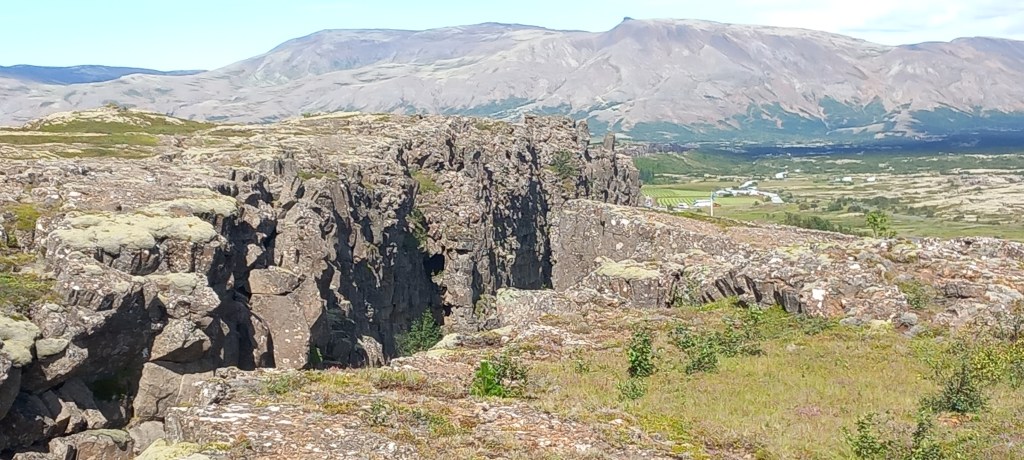
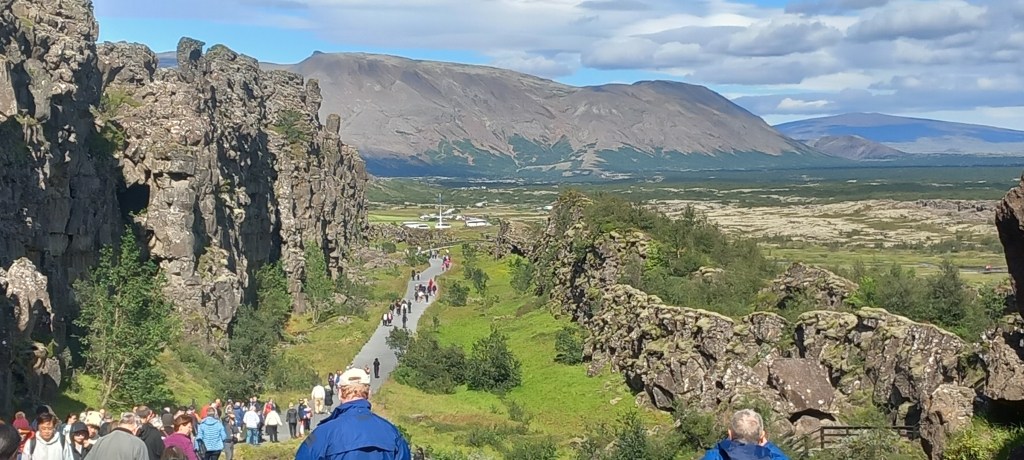
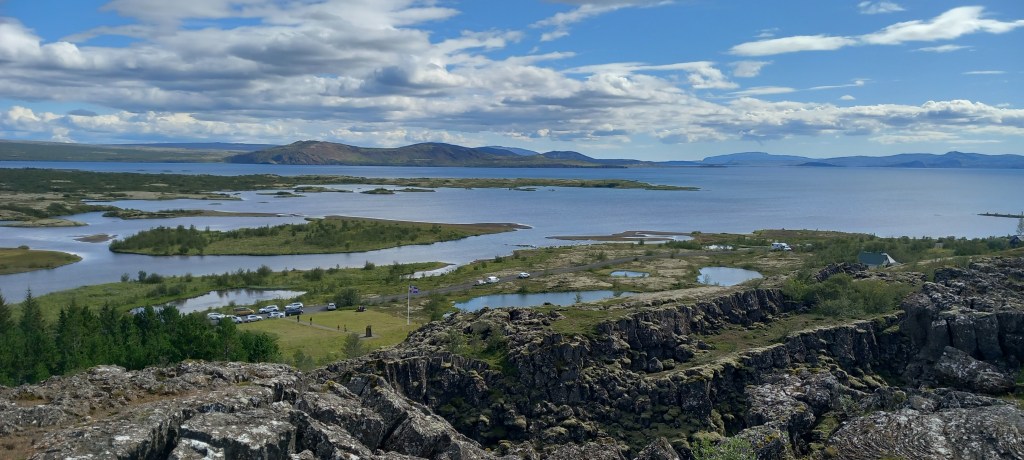
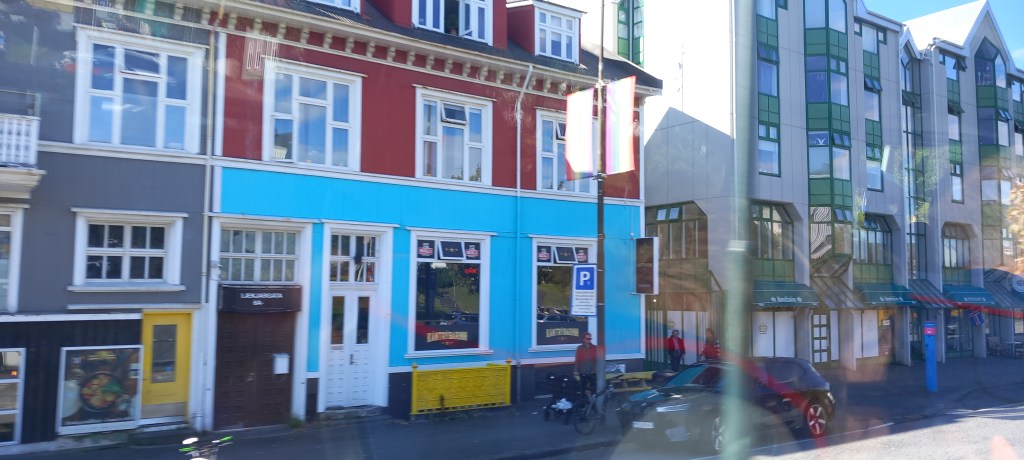
A very quick drive through Reykjavik on our way back to the ship, gave us a taste of a modern and very carefully built city. Older wooden houses are now covered in corrugated iron for insulation and protection against the harsh weather – they’ve been painted in bright colours, symbolic of their history.
We return to Iceland later in the cruise, but today we are bouncing around at sea again (Force 6 gale today!) on our way across the Denmark Strait to Greenland – very jealous of the reported English heat wave!!
 Molly's Folks
Well it all sounds wonderful …..except for some lousy sea conditions. I must add echinacea to my motion sickness regime. Thanks for giving the name of your ship. I have already looked you up to see where you are headed. Looks like a very long fiord coming up.
LikeLike
Hi back Mal (and Peter), what a great summary of the first days of your trip.
No wishing to “black cap” you, I thought you might be amused to know that my first real trip in the RN was to Iceland as a Midshipman in 1971.
On our way back we were also treated to some rough weather with the Met Office informing us that in our location the winds were moderating to Force 13!!!
Somewhat incredibly in the middle of this we had a Trafalgar Night dinner where much of the meal went for a walk of its own.
Anyway enjoy the rest of the trip and greetings from Aus with a mid-winter temperature of around 22-23deg C!!
Peter
LikeLike
Wonderful images and text. I do hope the seas calm down! JSent from my iPhone
LikeLike
Dear Marilyn, Sounds like a packed excursion with superb sites. In Greenland, in Nuuk, I was very impressed with the ethnographic museum which is by what I think they called the colonial harbour, near the hold dpired church. A real tardis snd most interesting. Also, more in the centre, the art gallery was worth a visit. In Narsarsuaq (sp?) The museum about Bluey base 2 (something like that!) also interesting. I loved Nanortalik. Sorry you’re experiencing rough seas but hope that storm has now passed. Very best wishes to you and Peter. Anne
LikeLike
I am enjoying reading about your experiences, although you have my sympathy re the rough seas.
I once applied for a job in Iceland (didn’t get it and went to Denmark instead) so am always interested to read about it. Thanks for the description of your time there.
Enjoy the rest of the trip!
LikeLike