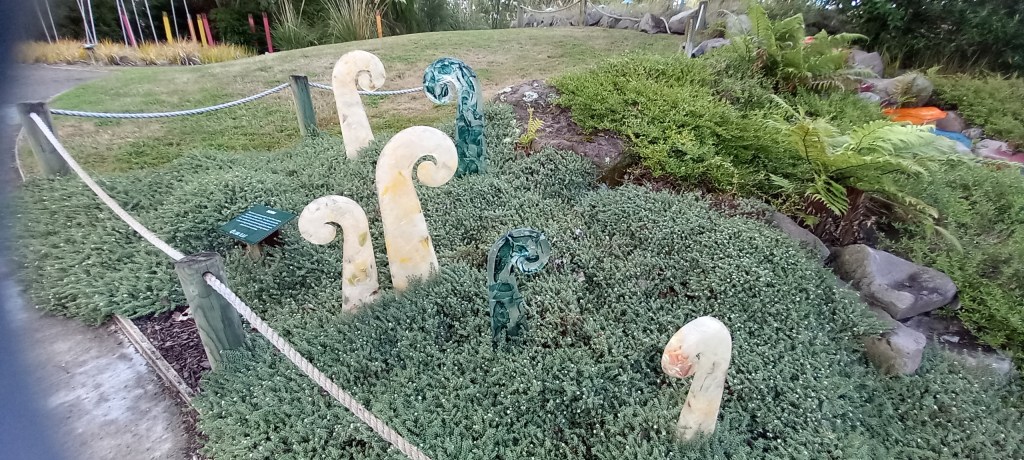
Rotorua – A last minute decision to visit a Glass Blowing Workshop proved worthwhile. Not only do they make and sell beautiful glassware – all inspired by the surrounding landscapes – they have also set up a glass sculpture garden. A clever idea for allowing the glass blowers to experiment and show off the results. Note the furled ferns, seen everywhere we’ve been. Also, the ingenious flowers shrewdly placed to create a waterfall feature.

Another visit to a geothermal park was on the cards. First, a little bit of science . . . New Zealand has a huge supply of geothermal energy due to the fact that it sits on the boundary between two tectonic plates. Geothermal energy taps the earth’s natural heat flow from the hot mantle up into the cooler crust. Power stations abound in this area!
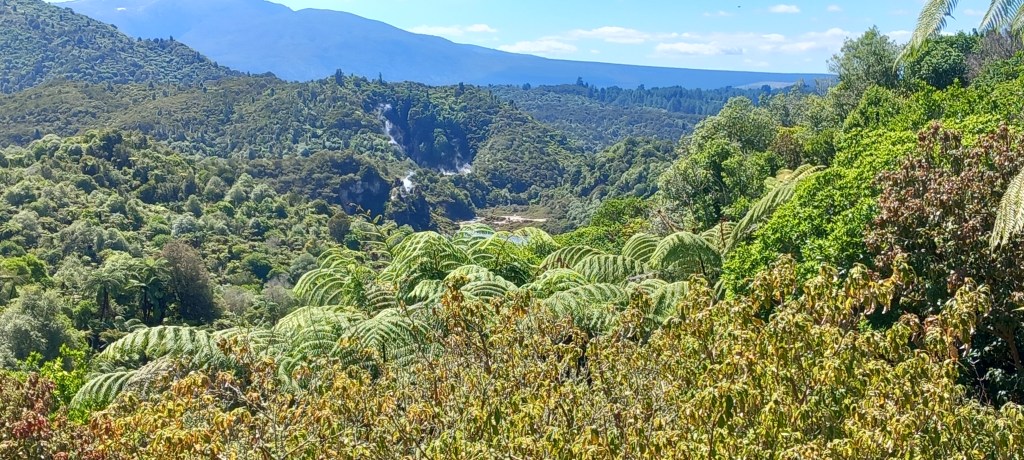
Waimangu Volcanic Valley was awe inspiring. In 1886 the Mt Tarawera Volcano erupted, causing a huge split in the land and forming 22 craters. Everything in the valley was decimated. Hot springs and geysers continued to bubble in the valley and still do today. Thirty years later (1915) plants and trees began to grow again, with no human input. It is easy to see that the native forests have completely re-established themselves.
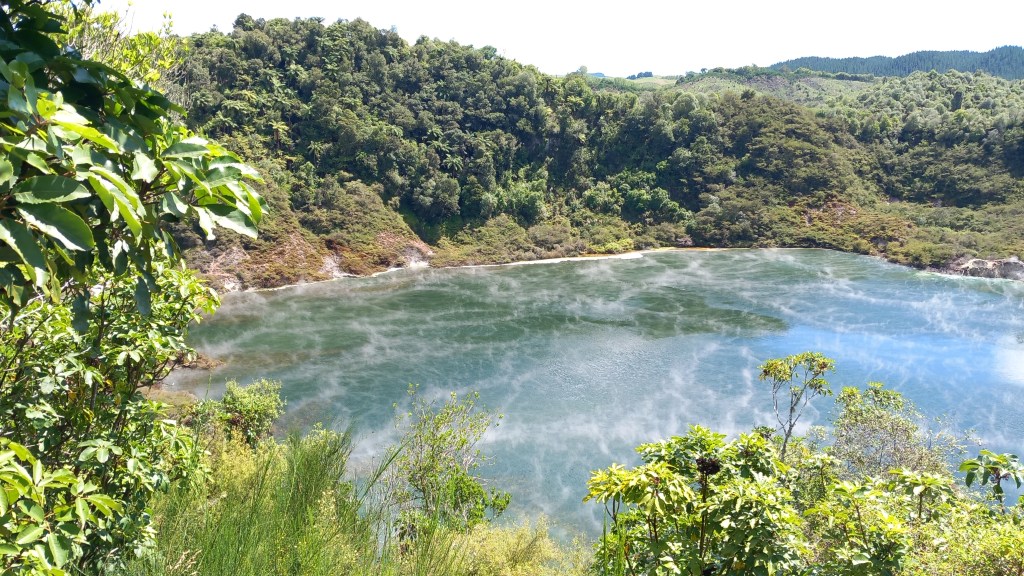
In 1917 one of craters erupted violently, deepening and enlarging itself significantly. Known as Frying Pan Lake, the crater quickly filled with water and now has an area of 38,000 square metres, making it the world’s largest hot water spring. It averages 6 metres deep with a temperature of 55 degrees C.
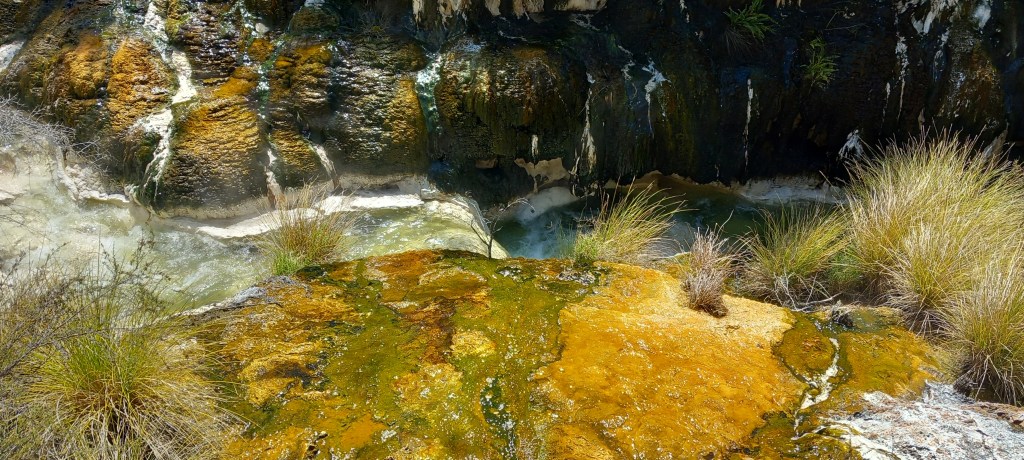
As we have found throughout New Zealand, the park was really well interpreted, footpaths were well kept with clear signage, and everyone showed respect for their surroundings. We followed the river valley, enjoying the brightly coloured hot spring algae and noting the plumes of steam erupting all around us. A challenging climb up many steps took us to Inferno Lake where we caught glimpses of the turquoise water under masses of steam. An unseen geyser ‘plays about’ at the bottom of this crater . . . .spooky or what?!

Needless to say, the ‘rotten egg’ smell takes some getting used to in this area. Not only in the geothermal parks, but throughout the town – I was aware of the smell in the hotel! A guided tour of ANOTHER geothermal park, included watching a geyser in motion. Many moons ago, local Maoris used to stand washing themselves with soap. It didn’t take long for them to realize that the soap was setting off the geysers. Hence today, a geyser is set in motion by a ‘feed of soap’ every morning at a set time, to entice the tourists – they come by the bus load!

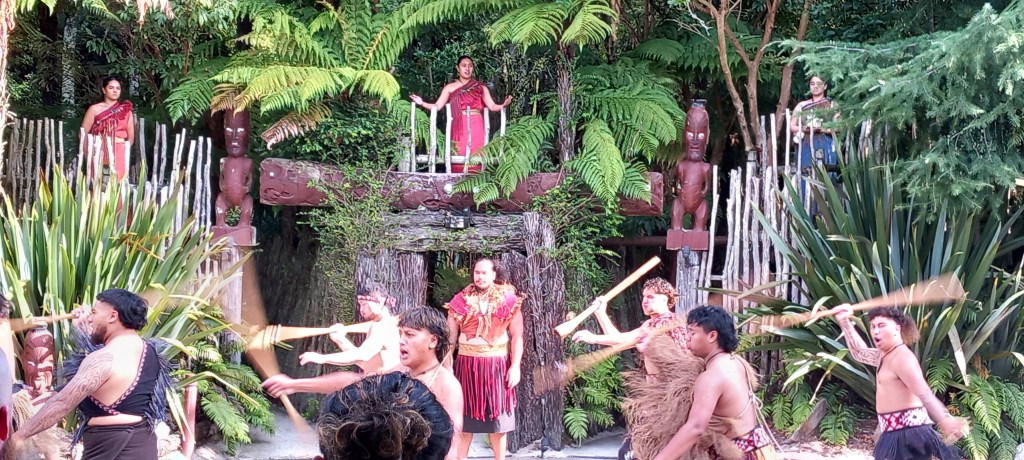
We spent an interesting evening learning about Maori culture and customs. Lots of war battle cries, lots of chanting and dancing. We were served a full three course meal, some of which had been cooked in a “hangi” ( heated stones in an underground pit) – all of which was absolutely delicious!
Coromandel Peninsula has been our last stop on this epic adventure. More spectacular scenery accompanied us on our journey north from Rotorua. Well kept farmland with the ever-present mountain ranges in the background. Much more dairy farming on the North Island, compared with many more sheep farms in the South. We stopped to have a walk up to Wairere Falls. A strenuous 45 minute walk, each way. through the forest, climbing over and around huge boulders led us to the base of this 153 metre cascade. Impressive to see during the drier summer months . . . this must be even more spectacular to see during the rainy winter months.

Our accommodation in Whitianga is a three bedroom apartment on three floors – Peter NOT amused to be carrying heavy suitcases up three flights of stairs! However, it is one minute from the idyllic seafront.
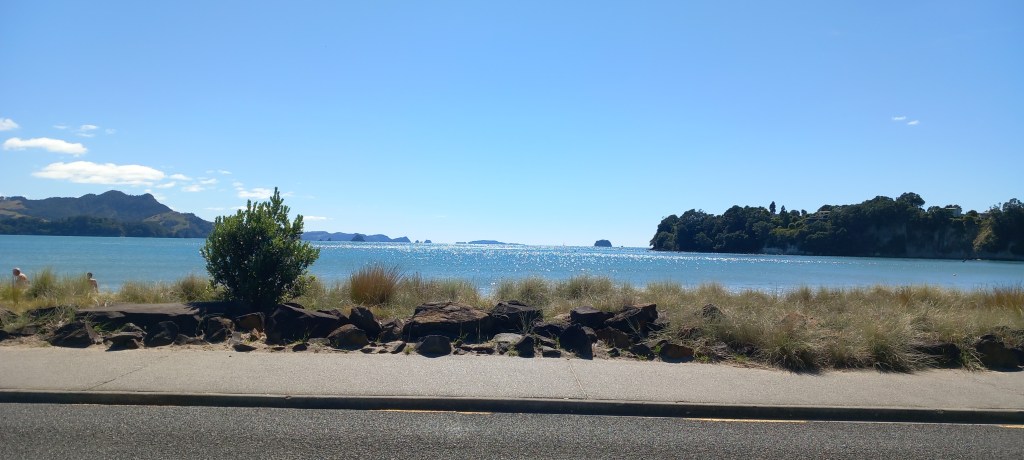
We caught a little ferry across the inlet to be met by our mini bus and guide for a full day’s tour of the area. We visited an old gold mine in the forest at Puketui – the present government is keen to begin mining gold again – as you can imagine there is a lot of objection from nature lovers!
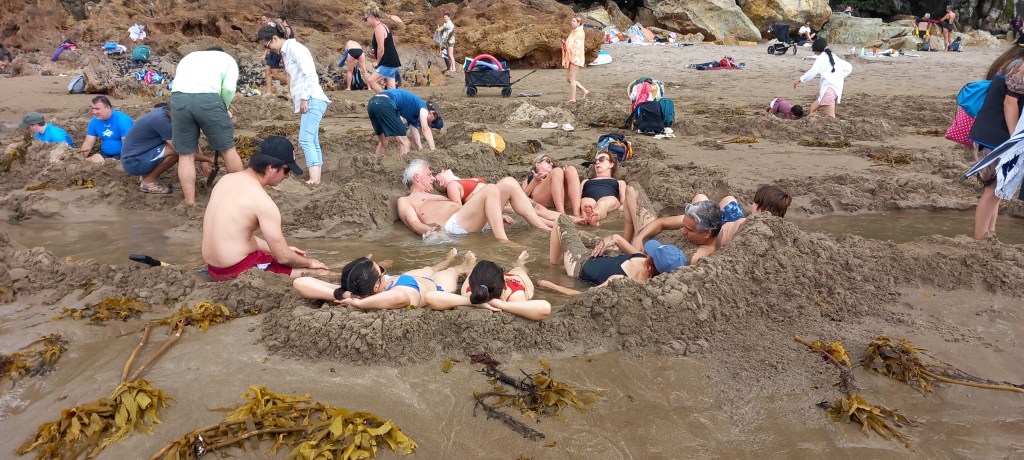
Hot Springs Beach was an eye opener. When the tide is out, many hot springs can be found by gentle digging with a spade (sold on the beach, of course!). A few hours relaxing in your own little hot spa is what the locals enjoy!
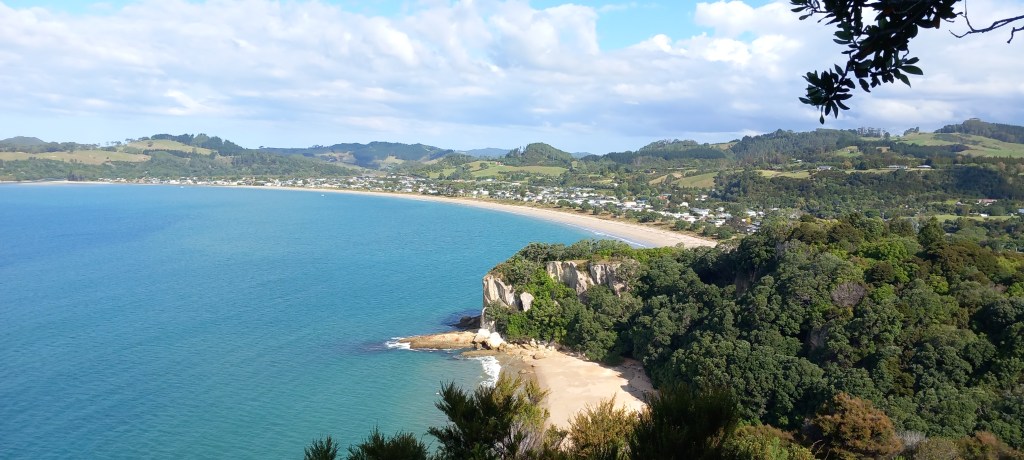
A long (up & down!) walk in the hot afternoon sunshine led us to Cathedral Cove – an idyllic beach only accessible by foot – which gets cut off by the incoming tide.

Our last stop was Shakespeares Cliff, where we had our final history lesson, looking over Cook’s Beach – where Captain James Cook came in HMS Endeavour in 1769 on a mission to record the Transit of Mercury, as well as taking lots of plant specimens. Cook named the bay where he was moored . . . Mercury Bay.
A quiet day today before we make our way to Auckland. I’ll send a final summary from there. . . . . .


Marilyn Yet more amazing pictures and information. I have enjoyed your tour very much. Thank you.
Jan M.
LikeLike
HI,
Following your tour with great interest. It seems you are having an amazing time. Take care, Denise x
LikeLike
Once again, wonderful pictures. Safe travels. JSent from my iPhone
LikeLike