Our campsite on Benbecula was called Otter’s Edge – ‘that sounds hopeful’ we thought. Silly us! Having taken advice from the owners (and he gave the same advice to everyone) we got up very early and walked 40 minutes out onto the beach, to a carefully placed bench where we could expect to see sea otters – two hours either side of hide tide was the advice. NOTHING! Are we jinxed? The campsite owners like to remind us of how far we are from the rest of the world..

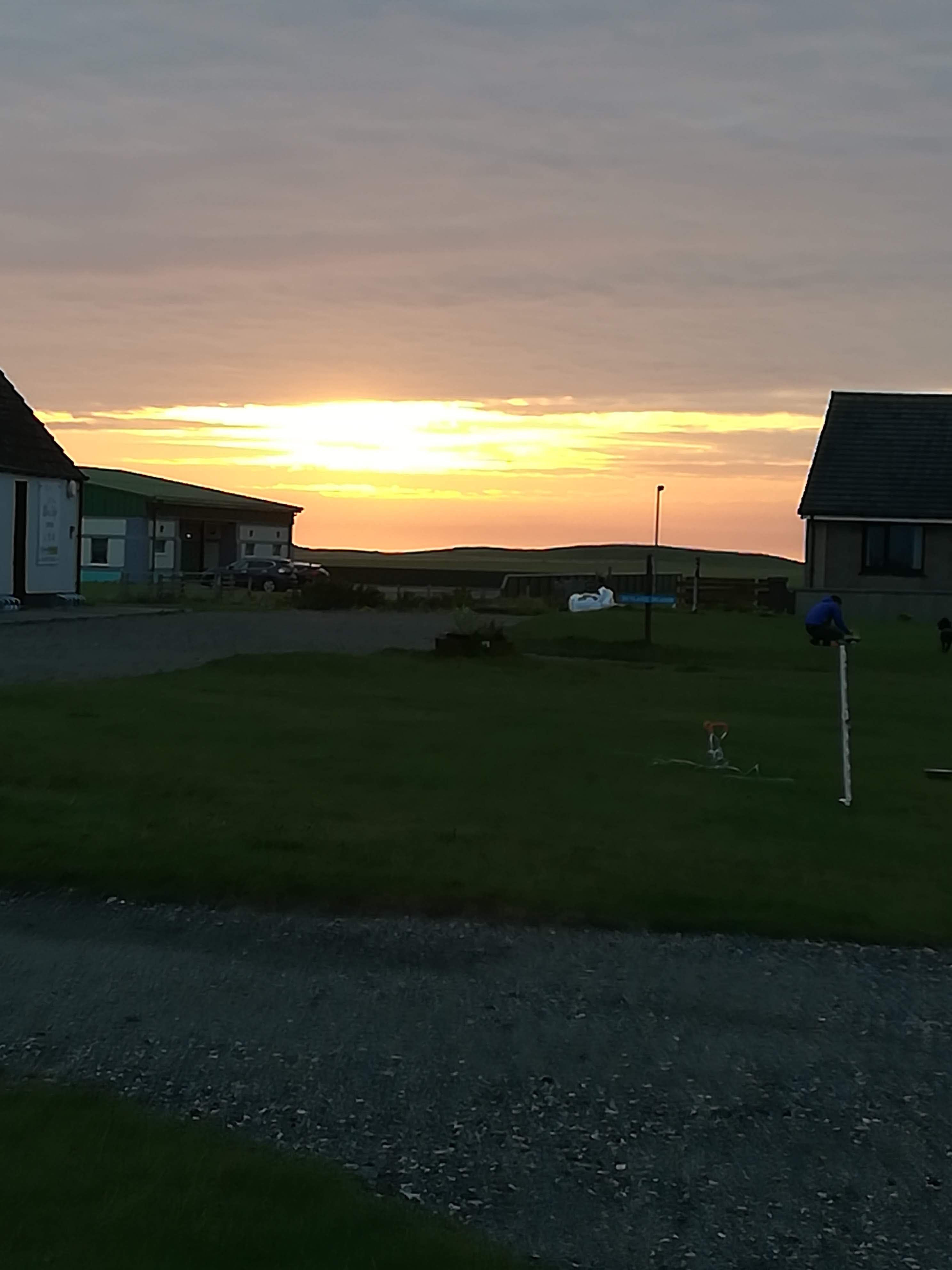
Our planned walk for later in the day never happened due to thick fog/sea mist rolling in and blanketing everything in all directions. The fog became rain at times and then just reverted to damp, all encompassing yuck! BUT . . . . you don’t come to the Outer Hebrides expecting sun and warmth. The Islanders assure us that they’ve HAD lots of sun and warmth and now they need rain! A brief respite from the rain, produced a wonderful sunset which lifted our spirits.
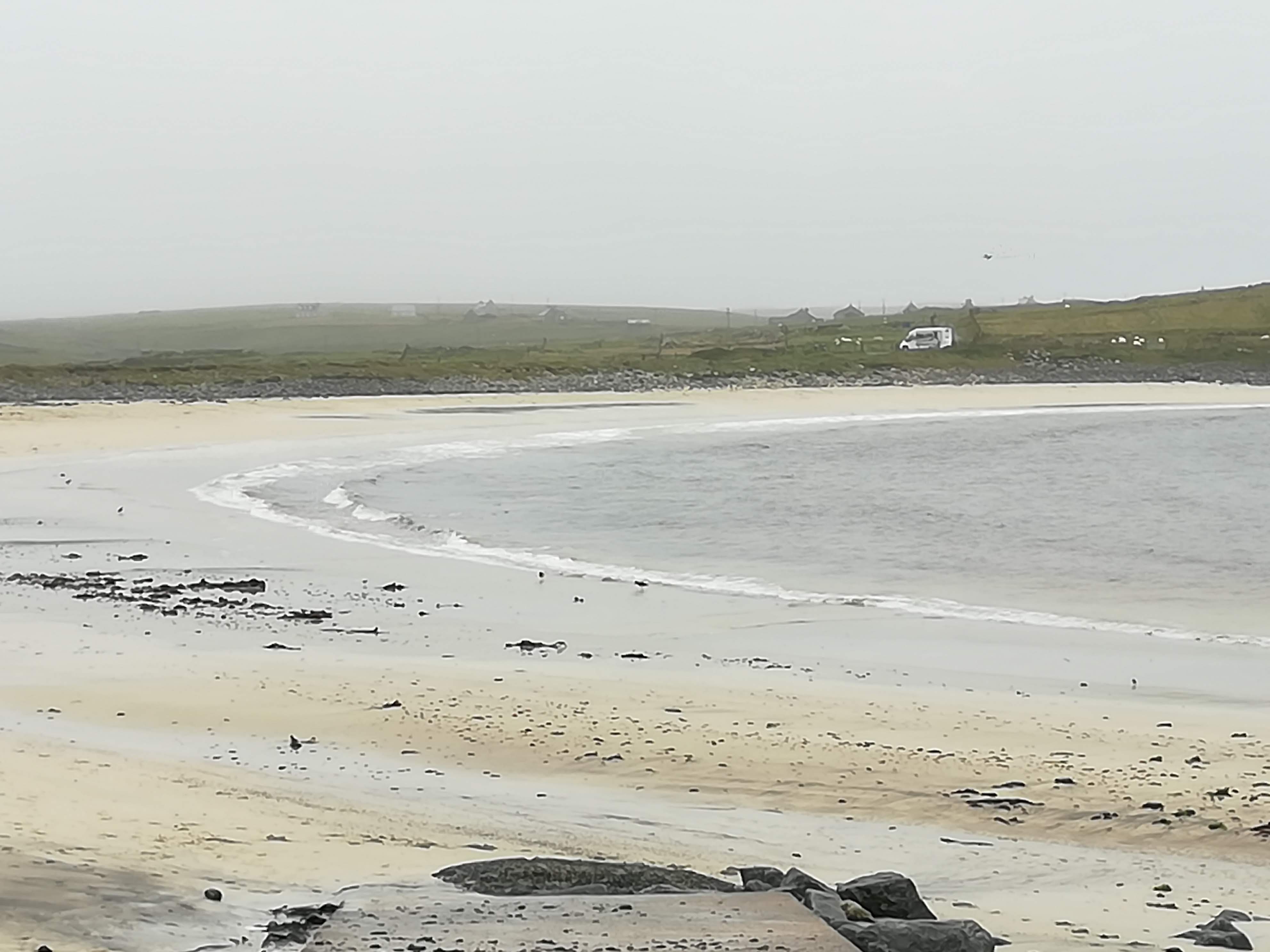
As with most of the islands, Benbecula boasts many miles of white sandy beaches. A brisk walk along any beach in a strong wind is a sure-fire way of improving one’s zest for life.
A Boat Tour was recommended from the little island of Grimsay – just to the east of Benbecula. Ten of us took to the seas on Lady Anne, with much promise of wildlife ‘as seen on every trip’. A happy two hours passed by, as we pottered about the inshore lochs and inlets. . . . seeing many red deer and numerous sea birds. Yet the famous sea eagle, who normally ‘poses for the camera’ was nowhere to be seen. Told you we were jinxed!

Moving North:
As recommended, we ‘wild camped’ amongst the sand dunes on the little island of Berensay, ready to catch the 07:15 ferry to Harris. Joining the queue at 06:45, little did we know what a long day we were going to face. . . . . Thick fog meant our ferry was cancelled. Spring tides meant fewer ferries were running. A few lucky cars and MOHO’s were squeezed onto the 10 am, but the rest of us had to wait (with fingers firmly crossed) until 4pm. Not only were we praying to get on the ferry, but that the much-threatened fog would not close in again! No one moved from the queue – we didn’t want to lose our place and perhaps miss out on a crossing. There is NO OTHER WAY to cross to the Island of Harris. Not only was the weather vile, but the midges were horrendous – no wind and thick fog meant the midges had a party! Creeping outside to stretch our legs, required large amounts of bug spray AND the (very fashionable) netted head cover! What a motley sight we must have made! Chat with other people in the queue just didn’t happen, thanks to the midges, and not daring to sit inside one another’s MOHO’s because of COVID restrictions. Cups of tea, too many biscuits and many a crossword kept us going . . . . .
The Sound of Harris is a notorious crossing because of the many rocks that make navigation a nightmare. Not being a good traveller, I was relieved that the waters were calm, and the fog had lifted sufficiently for the captain to see the buoys marking this hazardous journey.
Harris & Lewis:
Very heavy rain and fog greeted us at Leverburgh. Two hours of difficult and tense driving followed as we made our way north through the mountain roads which effectively divide Harris and Lewis. As the rain became heavier AND fog became thicker, our full attention was needed on the road – all the peaks were covered in thick cloud. Peering ahead through the mist to check for oncoming cars on single track roads was the order of the day.
Making our way up to our booked campsite near the north-west coast of Lewis, we passed through many little villages. All with unpronounceable Gaelic names, the villages are well spread out with majority of the houses down the main road. Plots extend back onto the ‘machair’. This is the low lying arable or grazing land formed, over many years, by deposits of sand and shell fragments near the coast. The Machair is the focus of what little agriculture there is in the Hebrides. Houses are bigger and in general, built to a higher standard than the tiny crofts in the Uists.
It was the change from trees and mountains in Harris, to open moorland in Lewis that really stood out for us. North of Stornaway the peat bog (known as blanket bog) covers an area of nearly 59,000 hectares. There are no crofts and no livestock as far as the eye can see. Not only one of the world’s largest carbon stores, but the bog is also a haven for water birds and plays a big role in water management. Driving across it however, makes one feel like you’re approaching the end of the world!

Sites of Interest on Lewis:
Stornaway serves as a jolt back to reality. It has tree lined streets, big houses, lots of business and industry, as well as a busy port. Heavy rain necessitated a day indoors, so we headed for the Museum nan Eilean. What a find! Opened in 2016, with interesting displays and galleries, the museum manages to humanize the many stories of fishing, farming, and singing which bring the islanders together. They have learned to live with what they’ve got and take the inclement weather into consideration at every turn. If nothing else, the six Lewis chessmen, found in the sands of Uig in Lewis, (on permanent loan from the British museum) and thought to be 12th century are worth seeing. Carved from walrus ivory, they are a stark reminder of just how long the intricacies of the game of chess have been testing the human brain.
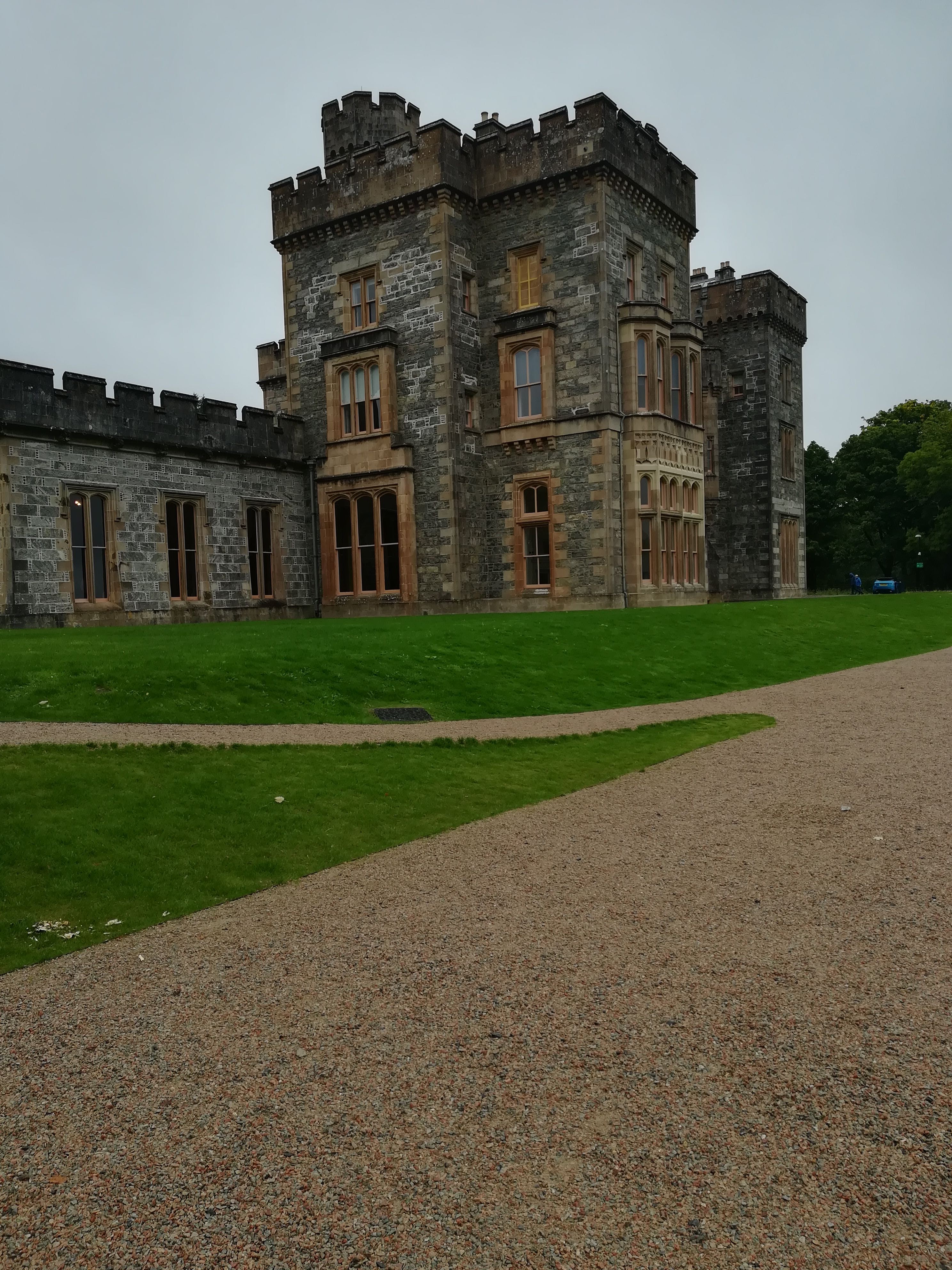
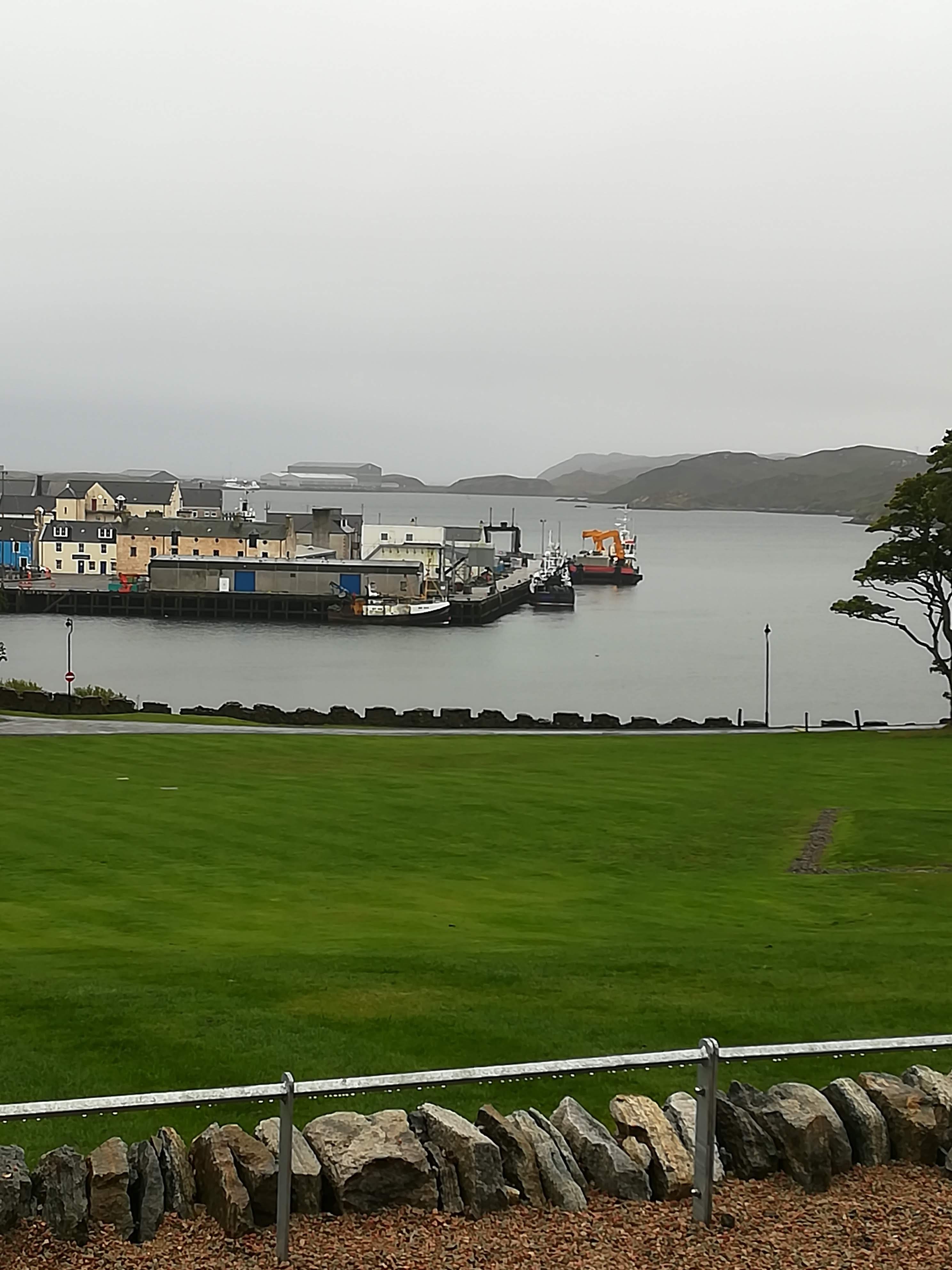
The museum is a clever addition to Lews Castle, parts of which are medieval, and recently restored. Nowadays it is run as an events centre and has accommodation on offer. Beautiful grounds surround the castle, including a golf course (you can all guess who was looking at that with interest!) with panoramic views across the harbour.
Trushal Stone – the tallest monolith in Scotland at 5.8 metres, this stone was once part of a 5000 yr old stone circle. Sadly, the other stones have been used over the centuries to build the surrounding walls. The stone now stands in splendid isolation between crofts.

Livestock – what little livestock there is live on the various crofts scattered about on the machair. Hebridean black sheep often grow two sets of horns making them easy to identify. Highland cattle survive well in the inclement weather conditions.


Community Centres are commonplace in the Hebrides. Bragar, on the west coast of Lewis, has just such a centre – recently opened in an old school building. It now has an excellent café (visited twice for its coffee and CAKES!), an exhibition room, accommodation, AND a launderette (which saved our ‘bacon’ when trying to deal with wet washing in the rain!)
Restored Ancient Houses
A Shieling is a hut (or several) situated out in the mountain pasture, into which the family would move for the summer months to keep watch over their livestock on the higher ground.

Blackhouse is the term used to describe the original dry-stone longhouse which existed here in the islands more than 1000 years ago. Double stone walls filled with peat helped to keep the families warm. The peat fire in the living area was always kept burning. The livestock lived in an adjoining wing on the side. Cattle provided dairy products and meat, hens were kept for eggs and meat, sheep provided mutton. The proximity of any livestock provided extra warmth.

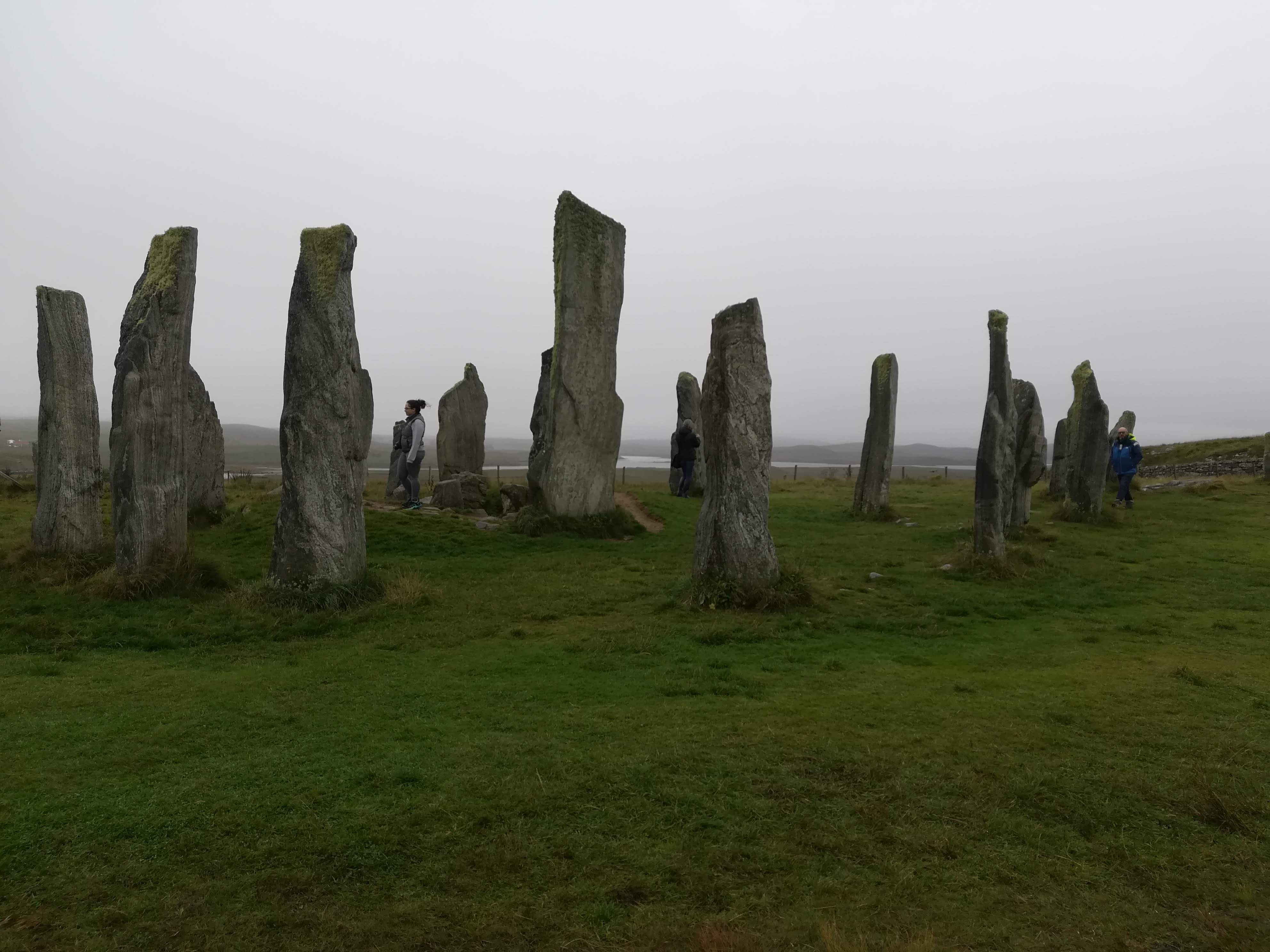
Callanish Standing Stones – said to be older than Stonehenge, this circle has a central monolith at 3.5 metres tall, which is surrounded by 13 stones, whilst avenues of other stones lead away to the points of the compass. Built in the local Lewis Gneiss stone, it is an unbelievable triumph of strength and determination by whoever created it. The purpose is a mystery . . . . .

Butt of Lewis
Standing on the most north-westerly point of the British Isles and of Europe was a real ‘pinch me’ moment. Known to be the windiest place in the UK, we were (almost) relieved that rain and fog were the order of the day. The 60-to-80-foot cliffs tower above the broiling seas whilst seabirds swoop and slice through the winds and the waves. The 36-metre red brick lighthouse, built in 1862, is now fully automated and controlled from headquarters in Edinburgh. It would have been a lonely existence for the lighthouse keeper in days gone by.


We are promised better weather tomorrow – the photos may improve!


Hope Molly has a good heater! Love following you by looking every place up on goggle maps.
LikeLike
Brrrrrrrr! Damp and Foggy/misty. So sad as the scenery is so…… especially in sunshine
LikeLike
What a trip! It’s a pity about the “jinx” on seeing otters and the sea eagle, but the scenery is amazing and I love the photos.
LikeLike