Acres of pine, birch and hemlock forest dotted with beautiful lakes. Provincial Parks and picnic areas off the beaten track. Some good road surfaces , some bad (really bad!). But it’s Nova Scotia’s outstanding coastlines, both on the Bay of Fundy to the north, and the Atlantic coast to the south that have really taken our breath away.

South and west from Louisbourg, St Peter’s Tidal Locks, (the only tidal locks in North America) rewarded our ‘canal freak’ with a chat with the lockkeeper. The Lock system runs with the tides, and links the Bras d’Or Lakes with the Atlantic Ocean. Used now mostly by fishing and pleasure boats, the drop is only three to four metres. Lunch always tastes better if you have a nice view!

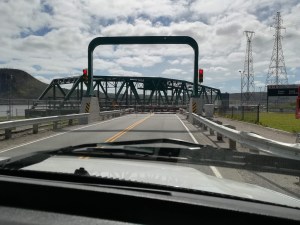
The huge tidal range on the Bay of Fundy, continued to fascinate us. The only access to and from Cape Breton is via the Canso Causeway. Retracing our steps we inadvertently arrived at the Causeway, just as they were closing the bridge for a 15 minute repair, to the locks. Cue . . . . one excited ‘canal freak’!
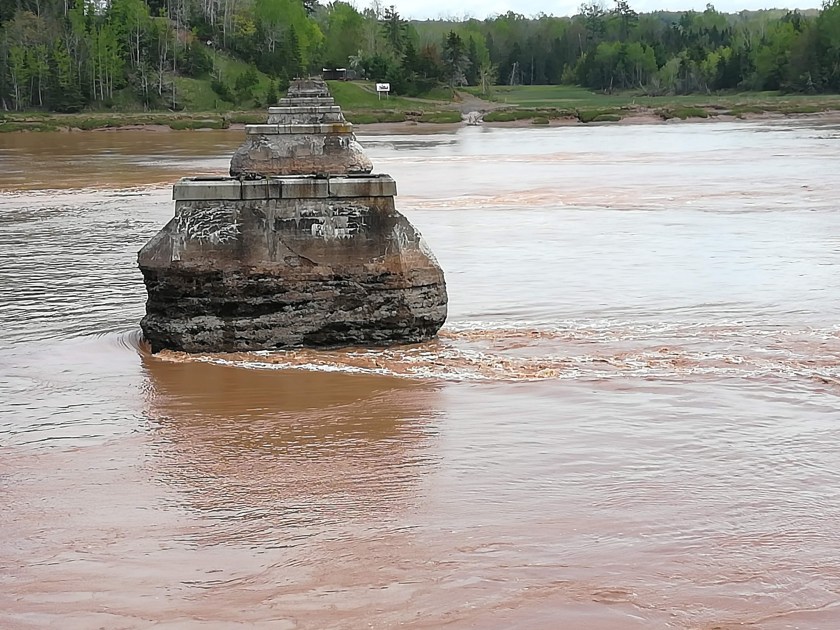
Antigonish was our destination – an ‘in town’ campground, meant we could actually walk into town and eat out! Not a cheap pastime here (unless you want fast food) – but trying the local fish is an absolute must, throughout Nova Scotia. Antigonish is a university town, so lots of life and energy. The campground, though central, was attractively laid out and beside a river. Opting to follow ‘B’ roads (as we would call them), meant a visit to the Tidal Bore interpretive centre at Maitland. We were blown away by the racing waters here – it was as if a sluice gate had been opened – and vast amounts of muddy water were rising in front of our eyes.
Interpretation centres here in Canada are VERY WELL done. Very knowledgeable volunteers are always welcoming and on hand to answer any questions (stupid or otherwise!) that may come to mind. Informative boards are placed in appropriate places. This has helped considerably with our travels along the Bay of Fundy (on both sides!), but even more so with our look at Canadian history on the shores of Nova Scotia. Grande Pre campground on the Bay of Fundy proved a turning point weather-wise. Sweaters and jeans were replaced by shorts and T shirt – hurray!. Leaves were fully out on the trees, gardens were in full bloom. 450km from North Sydney, west to Grande Pre had changed spring into summer – Oh! The bliss of feeling the warmth!

Grande Pre (meaning Great Meadow) is a National Historic Site, and was the centre of an Acadian Settlement (Acadians being a mix of Indian and French descent – come on! Keep up!) between 1682 and 1755. These settlers came up with the ingenious idea of building dykes to keep the sea water out – allowing previously flooded land to become fertile agricultural land. They thrived until the British and French began to want control of the lands. Because the Acadians refused to take sides, the British (bullies, in my feeble opinion!) deported them – ghastly stories abound of how these people were treated. And to think that humans are still treating each other in such despicable ways (think Syria, Gaza Strip, Yemen, Afghanistan), makes me want to weep.
Annapolis Royal is another historic site – changing hands from Indian, to French, to Scottish, and finally British in 1710. These days, it’s a quaint little community with many restored houses, a lovely boardwalk along the bay, lots of arts and crafts, and several footpaths to keep up those 10,000 steps! Its Historic Gardens are well documented, and with good reason. The rhododendrons and azaleas were out in force, so much so that we had to keep reminding ourselves that we were in Canada, and not visiting a National Trust garden in UK!

The Tidal Generating Plant at Annapolis Royal kept ‘the other half’ happy, where he was able to witness the incredible power of the Bay of Fundy’s world-renowned tides. It generates enough power for 4500 houses over five hours in each tide cycle. That’s quite enough figures for you! I’m sure he’ll be answering questions when we get home! We spent two comfortable nights at the campsite on the edge of town aptly named Dunromin. Our site overlooked the water and like everywhere so far, was very quiet.
The highlight of the week has been our visit to Lunenburg – another UNESCO world heritage site on the southern Atlantic coast of Nova Scotia. More history, and this time enhanced by a guided walking tour of the town. Our guide, a descendant of the first settlers here, was very informative and kept us entertained with numerous anecdotes. A British Colonial settlement was established here, ( an extension to their control of Halifax) in 1753, recruiting German, Swiss and French (protestant) farmers. Whilst farming proved almost impossible (very poor rocky soil), the sea provided a much needed income. Fishing was the making of Lunenburg, along with boat building. As with any fishing community, there was much hardship and loss of life. Line fishing out of dories (launched from the schooners), in the fierce storms and/or thick fog of the North Atlantic was a very dangerous task in the 1800’s. Despite the recent crack down on cod fishing, the town still thrives not just from a huge fish processing plant, but several other industries as well. The UNESCO recognition encourages tourism. As does the famous Bluenose II – a replica of the Lunenburg schooner who beat the Americans in every race she entered from 1921 to 1939. Bluenose has national recognition on the face of the ten cent piece – known here as a ‘dime’.
Beautifully restored houses, many of which are original, show wonderful examples of the various forms of architecture. A bit of rivalry and one-upmanship have created some quirky additions over the years. The Widow’s Watch – a dormer-type window built into the roof with a view far out to sea, to watch for the fishing boats returning. Black flag meant there had been loss of life, white flag meant all safe and well. The well-known Lunenburg Bump, which is a five-sided dormer window protruding over the central doorway, was originally for ladies to sit and sew with some natural light – but also to keep an eye out for any gossip!

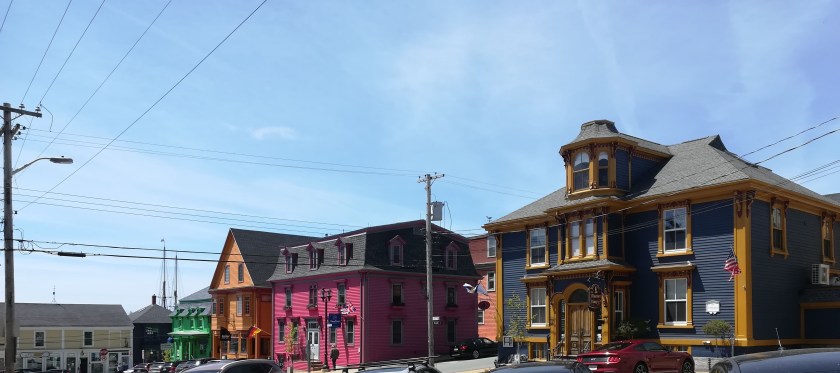
Two nights on the Board of Trade Campground, allowed us to walk into town and explore to our hearts content. Sadly the warm weather deteriorated, and a cold north westerly wind reared its ugly head. Sweaters, jeans and winter coats accompanied us as we moved along the coast. Peggy’s Cove is an idyllic little fishing village, seemingly built on huge lumps of granite. My mother often related happy memories of a holiday here with my father, so this little side trip was done in her memory. Thanks Mum!


There will now be a lull in blog entries. We’re flying to Newfoundland on Wednesday for a week – without the computer! See you in about 10 days . . . . . . .
 Molly's Folks
Enjoying your travellers tales much. Enjoy Newfoundland and look out for some ‘Newfies’ (four legged variety). xx
LikeLike
Nice to hear you’re enjoying it.. So are we, you may have gathered!
It snowed in Newfoundland yesterday (in June) so we’re taking winter gear. Not much warmer here in Halifax…
Enjoy your lovely summer. I’ll bet you’re spending a lot of time eating outside down by the river.
LikeLike